WHAT IS THE FITZPATRICK SCALE AND HOW CAN I CONFIRM WHERE I FALL?
The Fitzpatrick Scale, set out by Thomas Fitzpatrick in the Archives of Dermatology in 1988, classifies skin by how it responds to ultraviolet light. In practical terms, it helps determine how likely you are to burn, tan, or tolerate certain laser treatments such as laser hair removal.
It is one of the most important tools used in aesthetic and medical skin treatments because energy settings, safety margins, and expected results all depend on it.
WHAT THE FITZPATRICK SCALE IS
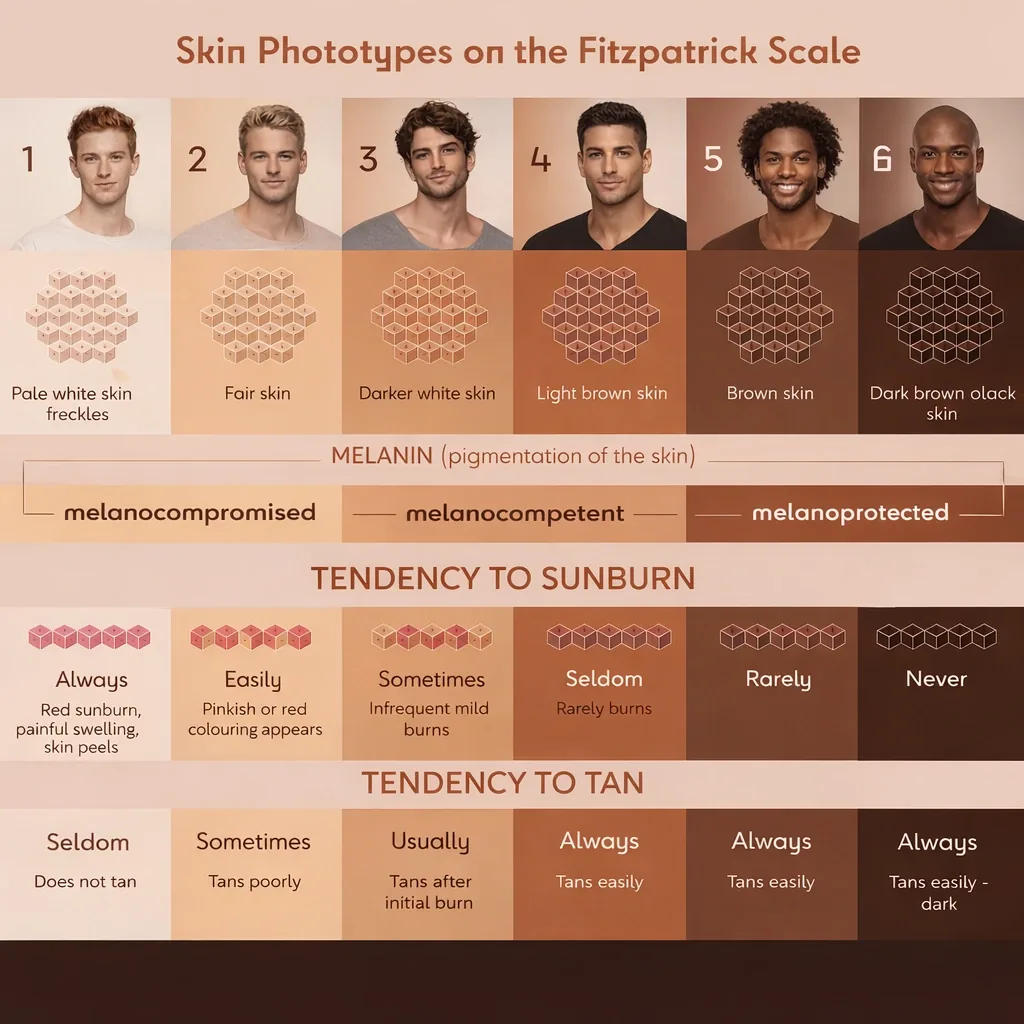
The scale is divided into six types, based primarily on how your skin reacts to sun exposure, not just how light or dark it looks.
FITZPATRICK TYPE I
- Very fair skin
- Always burns, never tans
- Often freckles
- Common in red or very light blond hair types
FITZPATRICK TYPE II
- Fair skin
- Usually burns, tans minimally
- May freckle
FITZPATRICK TYPE III
- Light to medium skin
- Sometimes burns, gradually tans
- One of the most common skin types
FITZPATRICK TYPE IV
- Medium to olive skin
- Burns minimally, tans easily
- Higher natural melanin content
FITZPATRICK TYPE V
- Brown skin
- Rarely burns, tans darkly and easily
FITZPATRICK TYPE VI
- Dark brown to deep skin tones
- Never burns in the classic Fitzpatrick wording, although Leybengrub and colleagues, writing in Cureus in 2026, warn that treating deep skin as immune to sun damage is itself a barrier to sensible sun protection
- Highest melanin concentration
This scale is not about ethnicity. Ware and colleagues, writing in Cutis in 2020, found that providers routinely misuse Fitzpatrick type as shorthand for race, when it was built to predict burning under phototherapy. People of many backgrounds fall into different Fitzpatrick types.
WHY THE FITZPATRICK SCALE MATTERS FOR LASER
Laser treatments work by targeting pigment. The more melanin present in the skin, the more carefully energy must be delivered.
Correct Fitzpatrick classification affects:
- Whether laser is appropriate for you at all, or whether electrolysis is the safer route
- How aggressive settings can be
- How many sessions are typically needed
- Risk of burns, hyperpigmentation, or under-treatment
My reasoning is that misclassification pushes a session one of two ways, either so conservative it does nothing or so aggressive it risks injury, and I have seen both walk in from elsewhere.
HOW TO CONFIRM YOUR FITZPATRICK TYPE
1. LOOK AT HOW YOU REACT TO THE SUN
How you react to the sun is the single most useful question you can answer at home, though Olsen and colleagues, writing in the HCA Healthcare Journal of Medicine in 2026, point out that self-reported Fitzpatrick typing is exactly where the scale is weakest, since it rests on self-perception and on how the question gets asked.
Ask yourself:
- Do I burn easily, even after short sun exposure?
- Do I tan gradually, deeply, or not at all?
- Does my skin peel after sun exposure?
Your answers matter more than your current skin colour.
2. IGNORE TEMPORARY TAN OR WINTER PALE SKIN
A summer tan or winter lightening does not change your Fitzpatrick type. The scale is based on your natural response, not your current shade.
3. CONSIDER AREAS WITH NO SUN EXPOSURE
Look at skin that rarely sees the sun, such as:
- Inner upper arms
- Under the breast or chest
- Upper inner thigh
These areas better reflect your baseline skin tone.
4. BE HONEST ABOUT BURN HISTORY
Many people overestimate their tanning ability. If you have ever burned badly before tanning, that matters.
5. PROFESSIONAL ASSESSMENT MATTERS
A trained provider evaluates:
- Natural skin tone
- Melanin density
- Hair contrast
- Reaction history
This matters because the scale has only six steps for a continuous range of skin tones, and Olsen and colleagues in the HCA Healthcare Journal of Medicine in 2026 name that limited range as one of its known weaknesses. In my chair, the people hardest to place usually sit between Types III and IV.
COMMON MISCONCEPTIONS
- “I tan easily so I must be a higher type.”
Not always. Burning first still places you lower on the scale. - “My ethnicity determines my type.”
It does not. Sun response does. - “I’m darker now so my type changed.”
Temporary pigment does not change Fitzpatrick classification.
WHY THIS MATTERS AT MAIR CARE INC.
At MAIR Care Inc., Fitzpatrick typing is not a checkbox. On the one device I run, the SharpLight Formax, it directly informs energy levels, pulse structure, cooling and treatment spacing, and it also tells me when IPL is the wrong answer and electrolysis is the right one.
Correct classification ensures treatments are effective without being reckless. It prevents wasted sessions on low settings and reduces unnecessary risk from overly aggressive ones.
Intense pulsed light is a powerful tool, and the SharpLight Formax I run is an IPL system rather than a laser. Power only works when it is applied with precision.
THE BOTTOM LINE
The Fitzpatrick Scale is about how your skin behaves, not how it looks in a mirror. Understanding where you fall is essential for safe, effective laser treatments.
When done correctly, it protects your skin and improves your results.
Worth reading alongside this. burns, hyperpigmentation and scarring, and how to avoid them, hidradenitis suppurativa and hair removal, those bumps after a laser treatment, the pain map, every area ranked and joining the MAIR Care team.