
Why Hair Removal Myths Persist
Hair removal is an industry full of half-truths, outdated advice, and marketing-driven promises. Many of these myths sound convincing because they are repeated so often. Unfortunately, believing them can cost clients years of ineffective treatments and thousands of dollars with little to show for it.
The most expensive mistakes usually start with the most common myths.
One word before the myths. What I run is intense pulsed light, a filtered xenon flashlamp rather than a laser, and Sonoda and Omatsu argued in Lasers in Surgery and Medicine in 2026 that calling IPL laser hair removal is a genuine misclassification rather than loose shorthand. Where this post says laser it means the category as the industry sells it. Where the difference matters I say IPL.
Myth 1: Laser Hair Removal Is Permanent
Laser hair removal is not permanent hair removal.
Laser gives long-term hair reduction, not removal. Haedersdal and Wulf, reviewing the controlled trials in 2006, found no evidence that any such method achieves complete and persistent removal, and Ugonabo and colleagues reported mean reductions of 64 to 85 per cent twelve months after five sessions in 2026, depending on wavelength. That is a real result. It is also not zero hair.
Why this myth is costly:
- Clients expect an endpoint that does not exist
- Maintenance sessions continue indefinitely
- Facial and hormonal hair often returns
Electrolysis is what I reach for on fine, light and hormonally driven hair that laser leaves behind, and that is my clinical preference rather than a settled finding. Haedersdal and Wulf's 2006 review of nine randomised and twenty-one controlled trials reported that photoepilation actually outperformed electrolysis where the two were compared, and that no method has yet shown complete, permanent removal. The best-known electrolysis evidence, Richards and colleagues' series from 1986 and 1995, was uncontrolled and came from a single practice.
Myth 2: Six Sessions Is Enough for Everyone
There is no universal number of sessions.
Hair grows in cycles, and only a percentage of hair is treatable at any given time. Hormones, body area, hair type, and consistency all affect timelines.
Why this myth costs money:
- Underestimating treatment length
- Stopping too early and losing progress
- Restarting years later
Realistic timelines save money. Promised shortcuts do not.
Myth 3: Stronger Settings Mean Faster Results
More aggressive treatment does not equal better results.
Higher settings raise the risk of burns, hyperpigmentation and scarring. Paradoxical hair growth does not belong on that list. Snast and colleagues pooled 9,733 patients in the American Journal of Clinical Dermatology in 2021 and found it in about 3 per cent of people treated with laser or IPL, tied to the face and neck rather than to the device or the settings, and appearing in only 0.08 per cent of cases elsewhere on the body.
Effective hair removal is precise, not aggressive.
Myth 4: Laser Works on All Hair Types
Laser relies on pigment.
It does not work well on:
- Blonde hair
- Red hair
- Grey or white hair
- Very fine hair
This myth leads to endless treatments with minimal improvement and missed opportunities for permanent solutions.
Myth 5: If Hair Grows Back, the Treatment Failed
Not all regrowth is failure.
Hair can return due to:
- Hormonal changes
- Dormant follicles activating
- Areas with ongoing androgen sensitivity
Understanding the cause of regrowth determines the correct next step.
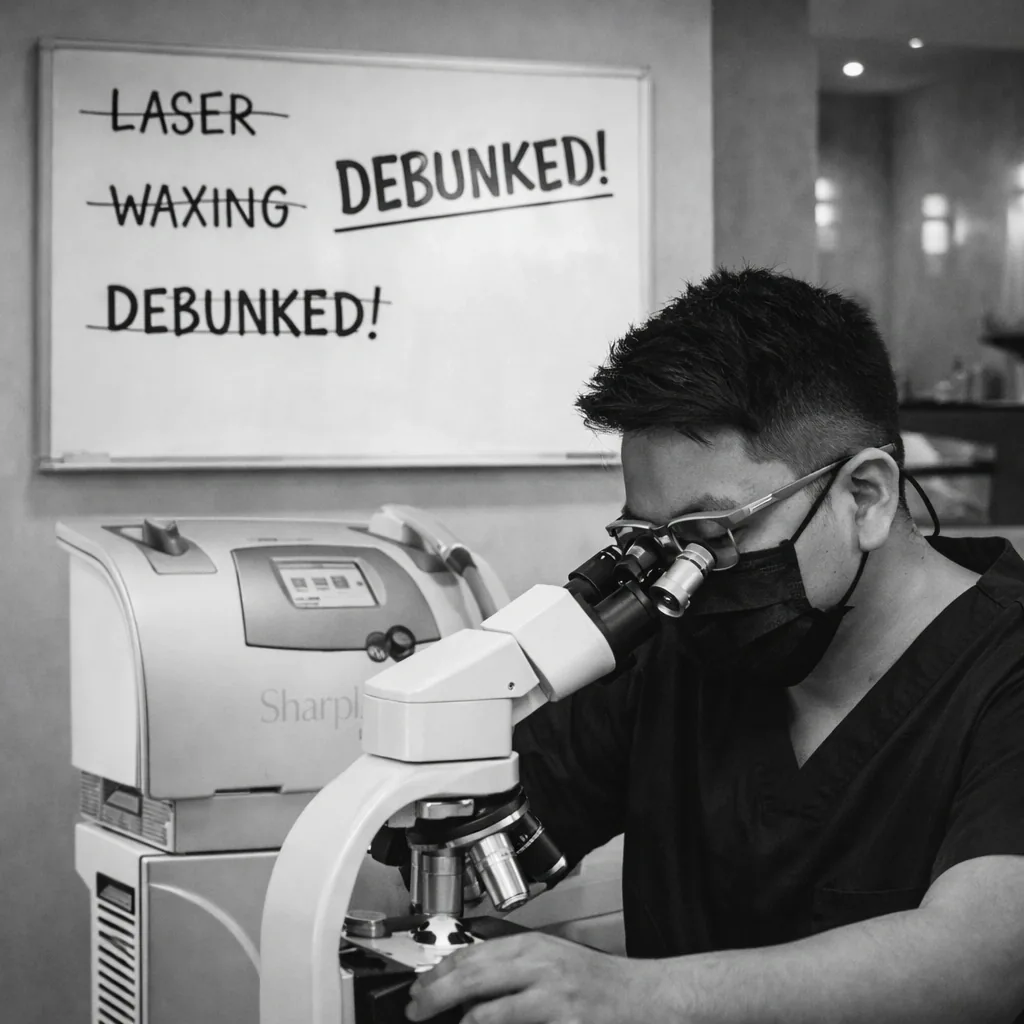
Myth 6: Waxing Makes Hair Grow Back Thicker
Waxing does not make hair grow back thicker. The closest hard evidence is Lynfield and MacWilliams's 1970 shaving study in the Journal of Investigative Dermatology, which found no change in diameter or growth rate, and nothing since shows waxing behaving differently. Saying the follicle is untouched goes further than the evidence allows. Chen and colleagues reported in Cell in 2015 that dense plucking in mice recruited up to five times more neighbouring resting follicles into growth, and Khanna and colleagues documented follicular inflammation after waxing in twenty-eight patients in 2014.
Myth 7: All Clinics and Machines Are the Same
They are not.
Differences in training, assessment and technique affect outcomes, and so does the machine. Barros and colleagues' 2026 split-body randomised trial found a diode laser left lower hair counts and thinner residual hairs than IPL at the seven-month follow-up, so equipment is not neutral. My own view, from the treatment room rather than from a trial, is that operator skill is the part clients can least easily assess and the part that most often explains two very different results from the same device.
Myth 8: Pain Means It’s Working
Pain is not a measure of effectiveness.
Excessive pain often signals poor technique or incorrect settings, not better results.
Myth 9: One Method Works for Everything
No single method works for every hair type, body area, or situation.
Laser, electrolysis, and temporary methods each have specific strengths and limitations.
Myth 10: Cheaper Treatments Save Money
Low-cost treatments often cost more long term due to under-treatment, endless maintenance, and the need to correct poor results later.
Final Takeaway
The most expensive hair removal mistakes come from believing there is a single, universal solution.
The reality is that permanent hair removal is often achieved by combining methods, not relying on just one. Laser can reduce bulk and slow growth in the right candidates and areas. Electrolysis permanently removes the remaining hair, fine hair, light hair, and hormonally driven regrowth that laser cannot eliminate. Temporary methods may play a role early on, but they are not end solutions.
Clients who achieve the best long-term outcomes use each method for what it does best, at the right time, on the right hair.
Understanding this early prevents years of ineffective treatments and thousands of dollars spent chasing promises. Permanent hair removal is not about shortcuts. It is about strategy.
If you want the why behind this. the pain map, every area ranked, seasonal hair removal, how hair biology determines your results and when hair removal stops working.