
Numbing Cream for Hair Removal: An Honest Guide
It is the question I get more than almost any other. "Can I numb first?"
The honest answer is yes, often you can, and sometimes you should. But numbing cream is not magic, it is not free of risk, and the strongest option is not always the right one. People have been seriously hurt, and a couple have died, doing this wrong before a hair removal appointment. So this is worth getting right.
Here is what numbing cream actually is, which products are worth knowing about, how to use one safely, and where I land on it as an electrologist.
What numbing cream actually does
Topical numbing creams are made from local anaesthetics. They sit on the skin, soak in over time, and quietly block the nerves near the surface from sending a pain signal. They do not change the treatment. They change how much of it you feel.
There are four active ingredients you will see, and they behave differently:
- Lidocaine. The workhorse. Reliable, well understood, and the active in most creams you can buy. Over the counter it is usually 4 to 5 percent.
- Prilocaine. Rarely used alone. Paired one to one with lidocaine it forms what pharmacists call a eutectic mixture, which stays liquid at room temperature and lets a lot of anaesthetic sit against the skin at once. That pairing is the classic pharmacy cream, EMLA. It carries one risk lidocaine does not. Prilocaine breaks down into ortho-toluidine, which can turn haemoglobin into methaemoglobin so it stops carrying oxygen properly. All three women in the Care report developed methaemoglobinaemia, and benzocaine can do the same thing. If your lips or fingertips go grey or blue, or you feel short of breath after using one of these creams, that is an emergency room visit rather than a wait and see.
- Benzocaine. Fast and shallow. It numbs the very surface within a minute or two, but it does not go deep and it does not last.
- Tetracaine. Slow to start and the most potent of the group. It takes longer to kick in but it goes deeper and lasts the longest.
This is why some clinic and compounded creams blend three of them, often called BLT (benzocaine, lidocaine, tetracaine). Benzocaine for the quick surface numbing, lidocaine for the middle, tetracaine for depth and duration. One ingredient covers what another misses.
The trade is always the same. Deeper and longer means more of the drug crossing into your body. Hold that thought, because it matters later.
The brands worth knowing
You do not need a pharmacy degree to shop for this, but it helps to know the categories.
Pharmacy creams. In Canada the two names that come up are EMLA (lidocaine 2.5% plus prilocaine 2.5%), which Health Canada classes as ethical, meaning you ask the pharmacist for it rather than needing a prescription, and Maxilene (lidocaine, sold as Maxilene 4 and Maxilene 5, both fully over the counter). These are designed for needles and minor procedures, they are predictable, and they are a sensible starting point.
Tattoo numbing creams. Do not dismiss these. Tattoo artists put clients through hours of needles, so this corner of the market is competitive and, frankly, very good. Most are lidocaine 5%. A few worth knowing:
- Zensa (5% lidocaine, pH neutral and made for sensitive skin) and Dr. Numb (straightforward 5% lidocaine) both hold Health Canada drug identification numbers, so you are buying a product reviewed for sale here. Ebanel, Numb Master and Hush come up often online and are not listed in the Health Canada Drug Product Database, which means no Canadian review of the label or the contents. I would rather you bought the two with a DIN.
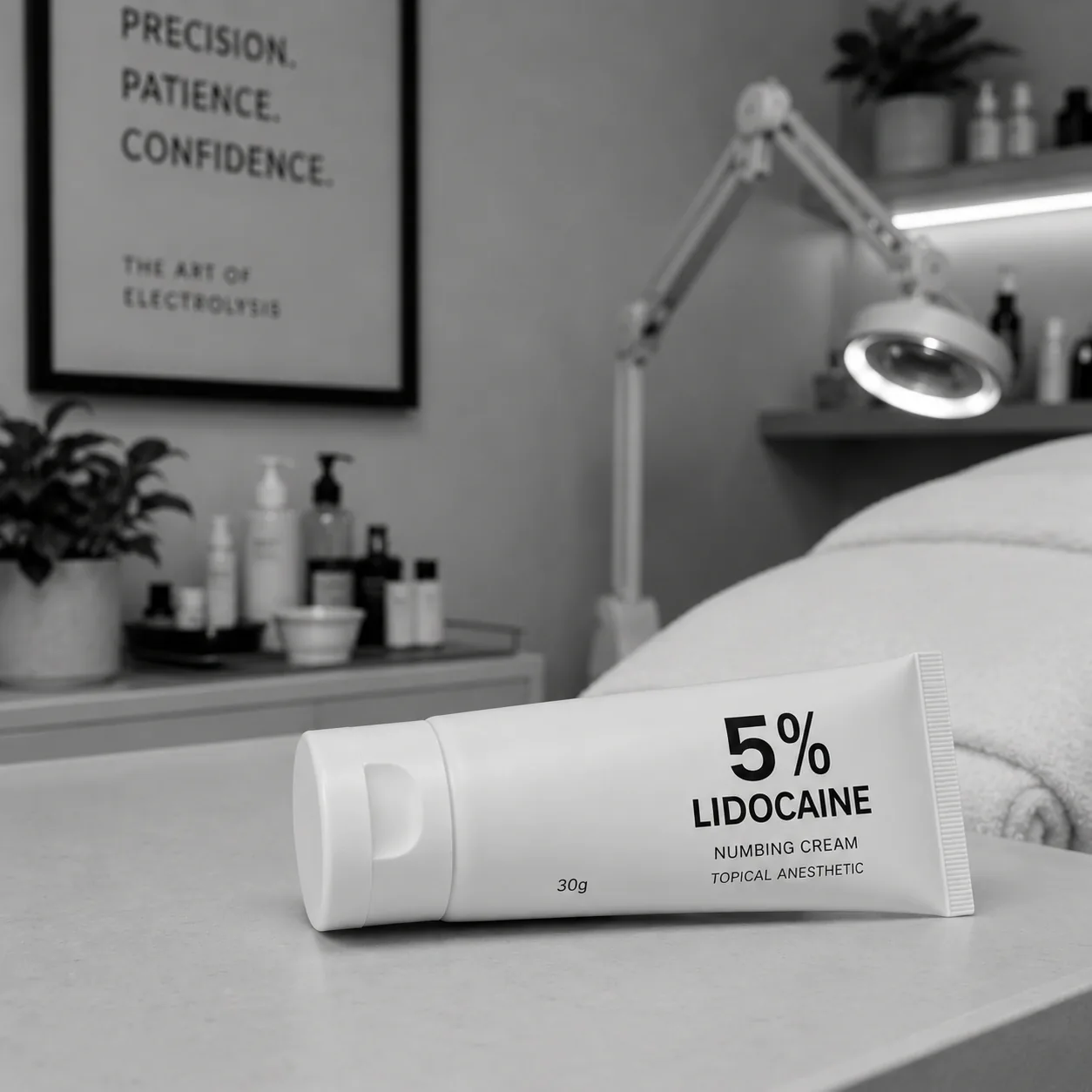
For most hair removal, a clean 5% lidocaine cream from a reputable tattoo brand is as good as anything.
A note on TKTX and similar grey-market creams. They are potent because they stack prilocaine and tetracaine on top of lidocaine, and the labelling is not always honest, which means you cannot calculate a dose you cannot trust. Strong is not the same as safe. I would skip the mystery tubes.
How to actually use it
If you are going to numb, do it properly or do not bother.
- Apply a thick layer to clean, unbroken skin. A thin smear does almost nothing.
- Know your two numbers before you start. For the lidocaine and prilocaine creams the adult ceiling is 60 grams of cream over no more than 600 square centimetres, which is roughly a 25 by 25 centimetre patch, about the size of a sheet of paper. Care and colleagues, writing in the International Journal of Legal Medicine in 2019, described three women poisoned before laser hair removal who had followed every instruction except those two. One used 140 grams where 60 is the maximum, and all three covered more than 600 square centimetres. Then cover it with a little plastic wrap. The heat and seal help it absorb, which is exactly why the dose and the area matter so much once you wrap. Sealed skin is the difference between a cream that stays local and a drug that reaches your heart.
- Wait, and wait longer than you think. The lidocaine and prilocaine label calls for at least one hour under occlusion for small work and at least two hours for anything larger, with peak numbing at two to three hours. A 5% lidocaine cream is usually ready closer to the one hour mark. Surface tingling at five minutes is not the same as being numb.
- Wipe it all off before your appointment. This is not optional for laser. The cream is white and the laser reads light and pigment, so any residue is a barrier and a burn risk. Clean skin only.
- Tell your provider you used it, and what.
The part nobody likes to talk about
In 2009 the FDA put out a warning after two healthy young women died. Both had slathered numbing gel over large areas of their legs, wrapped them in plastic, and headed to laser hair removal appointments. One was twenty two. She had a seizure in the car and died days later. The cause was lidocaine toxicity, too much of the drug absorbed through too much skin at once.
This is rare, and it is preventable. The risk goes up when you:
- use too much, over a large area,
- wrap it under plastic or heat for too long,
- put it on broken or irritated skin,
- or reach for the strongest product you can find.
Concentration is not the lever people think it is. Health Canada lists 5% lidocaine creams such as Maxilene 5, Zensa and Dr. Numb as non-prescription, so 5% is a normal over the counter strength here. What sent the women in the Care report to hospital was not strength. It was total grams, total area and plastic wrap. Stay inside the dose and the area, treat one reasonable area at a time, and do not turn your whole body into a sealed numbing experiment. A numb chin before electrolysis is sensible. A numbed leg-to-hip wrap before a long laser session is where people get hurt.
There is a second, quieter risk. Numb skin cannot feel heat. During laser that means you may not notice if a spot is running too hot. A good practitioner is watching your skin, not just your reaction, but it is one more reason numbing and laser need an experienced hand.
Does it change the result?
For electrolysis, no. Numbing the area does not affect whether the hair is treated. It only changes the comfort. For very sensitive zones, the face, the brows, intimate work, it can be the difference between finishing a session and cutting it short.
For laser, the treatment still works as long as the cream is fully removed, but the heat-blindness point above is real. I would rather adjust settings, cooling, and pacing than rely on a heavy numb.
What I would try before reaching for a tube
Numbing cream is a tool, not the only one. Often these do more, with none of the risk:
- Cooling. Cold air or a chilled tip takes the edge off in real time.
- Timing. Plenty of my clients tell me sessions land harder at certain points in their cycle, and the research on pain thresholds across the menstrual cycle is genuinely mixed, so I would not claim a rule. Track your own pattern over a few appointments and book around what you find.
- Pacing and breaks. A calm operator who works in passes beats a rushed one every time.
- A free test patch and a real consult. Most people are far more nervous than the treatment warrants, and a few minutes on the machine settles it.
Technique matters more than chemistry. The most comfortable treatment is usually the one done by someone who is not in a hurry.
The Bottom Line
Numbing cream can absolutely make hair removal easier, especially for sensitive areas and for electrolysis. A clean 4 to 5 percent lidocaine cream, applied to one reasonable area, given time, and wiped off completely, is safe and effective for most people.
The danger is never the cream itself. It is the instinct to go bigger, stronger, and more wrapped than you need. More is not braver. It is just riskier.
If you are unsure, ask before you smear. At MAIR Care Inc. I am happy to tell you whether you even need it, and for most areas, most people are surprised to find they do not.
Numb if it helps. Never numb if it hurts you.
The course where these limits bite hardest. A trans woman clearing a beard is doing hour-long sessions on the same area for a year or more, which is exactly where total dose, treated area and how often you are applying it stop being theoretical. The guide for trans women covers what that course looks like.
The rest of the comfort picture. how to prepare, by method, the pain map, every area ranked, handling erections during a treatment, how to identify a skilled laser technician and preparing for a wax treatment.