
Electrolysis and Pregnancy What You Need to Know
Pregnancy shifts hair growth, and clients notice it. Wilson and colleagues, in a 2025 review in Primary Care, describe changes in hair growth during pregnancy and again after delivery as part of the ordinary run of hormonal skin changes, and note that most of them are benign and settle postpartum. That last part matters. Some of what you are seeing now will go on its own, which is a genuine reason not to rush into treating it.
The safety question is nuanced. Electrolysis is not automatically unsafe during pregnancy, but not all methods are treated equally, and clinics must take a conservative, medically informed approach.
Is Electrolysis Safe During Pregnancy
Here is the short answer, and I would rather you had it up front than buried at the end of this page. There are no published trials, case series or professional guidelines comparing electrolysis modalities during pregnancy. I looked for them. No modality has been shown to harm a pregnancy, and none has been shown to be safe in one either, because the studies were never done.
What that means in practice is that every clinic policy you will read on this subject, mine included, is careful reasoning from how the machines work rather than a finding from research. That is worth knowing before you weigh anyone’s confidence, including mine.
Electrolysis has been performed for well over a century and involves no ionizing radiation, no light energy of the kind a laser uses, and no medication entering the body. Thermolysis works by radiofrequency energy concentrated at the tip of a fine probe inside the follicle. Pregnancy still changes how the body responds to pain, inflammation and healing, which is the real reason for caution here.
Because of this, safety depends on:
- The electrolysis modality used
- The area being treated
- Client comfort and tolerance
- Clinic policy and medical guidance
Most reputable clinics proceed cautiously and may limit or modify treatment during pregnancy.
Electrolysis Methods Explained
There are three primary electrolysis methodologies. Their safety profiles differ during pregnancy.
Thermolysis (Shortwave or Flash)
The modality most clinics prefer during pregnancy when treatment is approved, on mechanical reasoning rather than on evidence
Thermolysis uses heat generated by high-frequency alternating current to destroy the hair follicle.
Why it is preferred:
- No direct current passes through the body
- Very localized energy delivery
- Short treatment time per follicle
- Less total energy and less total time for the same number of hairs, which is a reason to prefer it rather than a measured safety result
When performed conservatively, thermolysis is the method most commonly allowed during pregnancy, particularly on the face.
Blend Method
Often restricted or requires a doctor’s note
The blend method combines thermolysis with galvanic current.
Concerns during pregnancy:
- Uses direct current
- Longer treatment time per follicle
- Greater cumulative electrical exposure
Many clinics choose not to perform blend electrolysis during pregnancy, or will only do so with written medical clearance.
Galvanic Electrolysis
Typically avoided during pregnancy
Galvanic electrolysis uses direct current to create a chemical reaction within the follicle.
Reasons it is usually not performed:
- Prolonged direct current exposure
- Increased discomfort
- No pregnancy-specific safety research, which is true of all three modalities rather than of this one alone
Most clinics consider galvanic electrolysis contraindicated during pregnancy.
Treatment Areas and Pregnancy Considerations
Even when a method is considered acceptable, treatment areas matter.
There is no published standard I can point you to on treatment areas in pregnancy. What follows is the policy I work to at MAIR Care, and it matches what most careful clinics do.
- Face and neck, treated conservatively and in shorter sessions
- Abdomen, chest and lower back, avoided
- Anything over or near the uterus, excluded entirely
Positioning and comfort matter as much as the area. Lying flat gets harder as a pregnancy progresses, and a session you cannot settle into is not a session worth having.
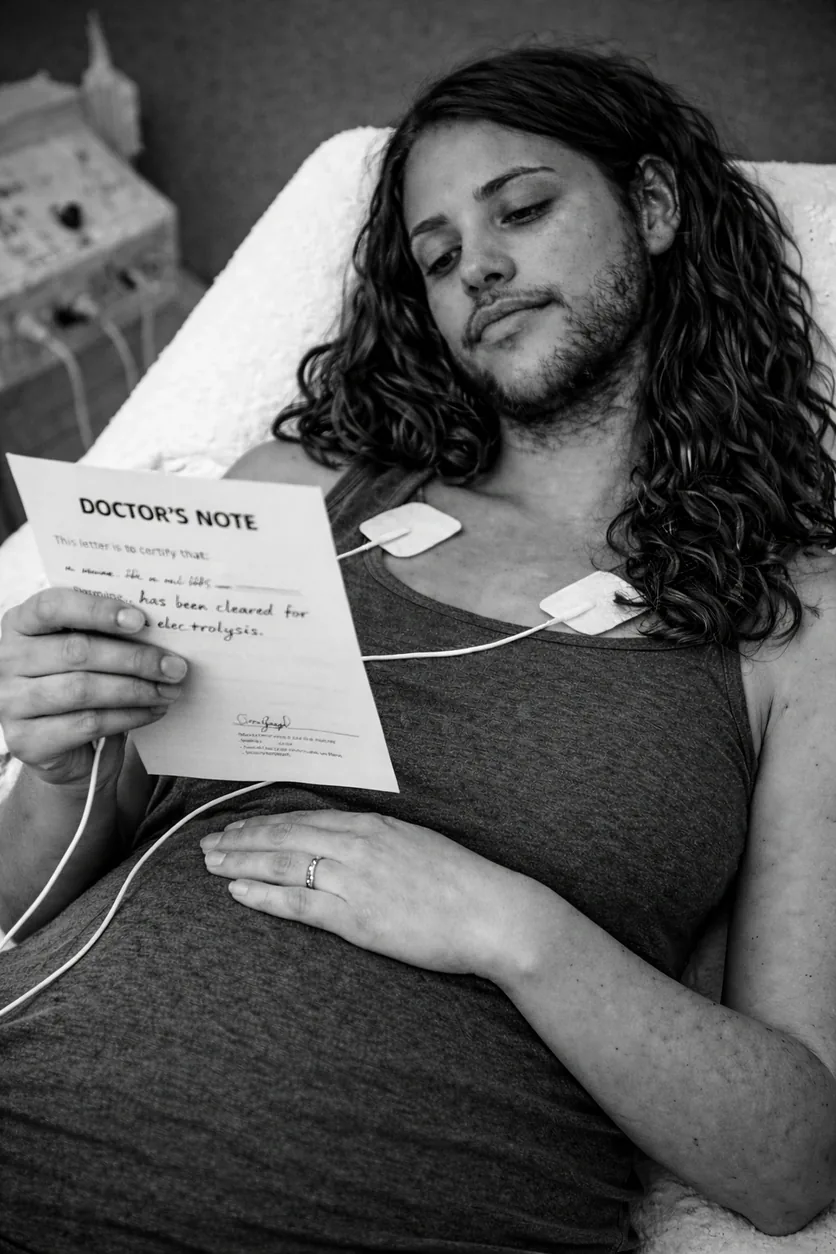
Do You Need a Doctor’s Note
Many clinics require a doctor’s note before performing electrolysis during pregnancy. This is not a legal requirement, but a clinical safeguard.
A doctor’s note may be required to:
- Confirm there are no pregnancy-related complications
- Approve specific electrolysis methods
- Clear treatment of certain areas
Clinics that request medical clearance are prioritizing client safety, not creating unnecessary barriers.
What to Expect If You Proceed
If electrolysis is approved during pregnancy:
- Sessions are usually shorter
- Treatment frequency may be reduced
- Conservative settings are used
- Healing is monitored closely
Some clients choose to pause treatment entirely and resume postpartum, which is also a valid and common choice.
Managing Expectations During Pregnancy
Hormonal changes during pregnancy can:
- Activate new hair follicles
- Increase regrowth rates
- Reduce treatment efficiency
Electrolysis performed during pregnancy may control visible hair but does not stop hormonally driven new growth. Permanent progress is often more predictable after hormone levels stabilize.
Final Takeaway
Electrolysis during pregnancy is not universally prohibited, but it requires careful method selection, conservative treatment, and often medical clearance.
Here is the honest position, and it is the most important thing on this page. There are no published trials, case series or professional guidelines comparing electrolysis modalities during pregnancy. I looked for them. The preference for thermolysis over blend and galvanic is reasoning from how the machines work, specifically that thermolysis delivers a very short, very local pulse and does not send direct current through the body toward a held electrode. That reasoning is sound and it is not the same thing as evidence. No electrolysis modality has been shown to harm a pregnancy, and none has been shown to be safe in pregnancy either, because the studies were never done. Absence of evidence is where we are, and it is why clinics stay conservative.
When in doubt, caution is appropriate. Hair removal can always resume, but safety cannot be reversed.
The rest of the electrolysis picture. the pain map, every area ranked, what actually happens during electrolysis, what electrolysis is, the history of electrolysis and why the Apilus xCell Pro matters.