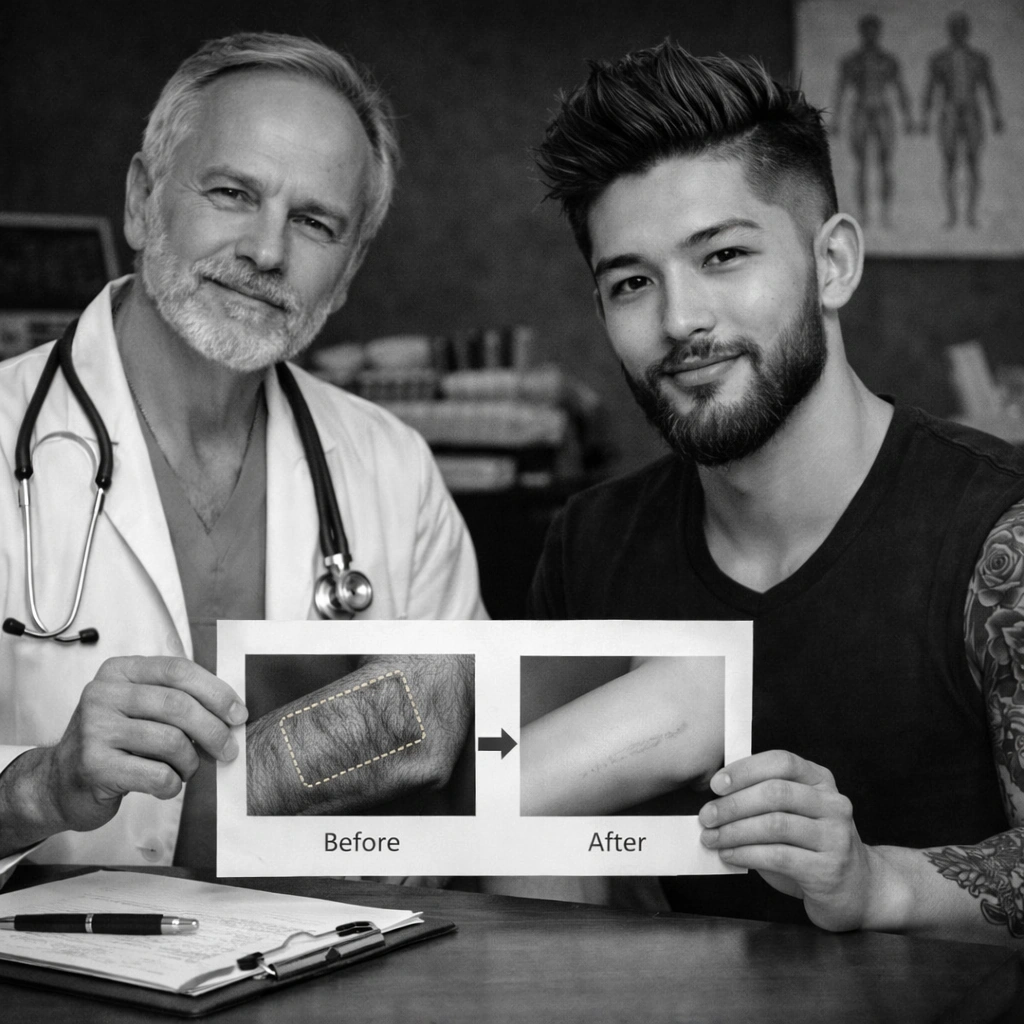
Start This Earlier Than You Think
If you take one thing from this page, take this. Hair removal is the longest lead item in the entire phalloplasty process, and it is almost always the thing that delays a surgery date.
Not the assessment. Not the referral. Not the waitlist. The hair.
Rainbow Health Ontario tells providers that permanent donor site hair removal can take up to a year. A forearm site usually runs shorter than a thigh site, since thigh hair is denser and the area is larger. That ordering is my own experience rather than a published figure, and anyone quoting you a precise number of months is guessing.
People find this out late, and then they find out that money does not fix it, which is the part that stings. You cannot compress the timeline by booking more sessions closer together. Hair grows in cycles and only a fraction of your follicles are in the phase where treatment does anything at all on any given day. The waiting between sessions is not padding, it is the mechanism.
So the honest advice is the boring one. Start before you have a surgery date. Start before you have a surgical consult, if you are reasonably sure of the direction you are heading.
What Actually Has to Be Cleared, and Why
Not all of it is cosmetic, and the distinction matters because one part of this is a medical requirement and the rest is preference.
The urethral strip, which is the non-negotiable part
Your surgeon builds a urethra out of a strip of your own skin. If that skin still grows hair, the hair grows inside the tube you urinate through, for the rest of your life, somewhere no razor can ever reach.
The complications that follow are the reason this requirement exists:
- Blockage and urinary obstruction
- Fistula formation, meaning an abnormal channel where urine escapes
- Retention of urine in the urethra
- Post-void dribbling
- Recurrent infection
- Stone formation, where mineral deposits build up around trapped hair
An honest counterweight, since this section frightens people. Not everyone with residual urethral hair has problems. A 2019 Amsterdam study found that patients with regrowth reported minimal urinary voiding complaints. Surgeons also observe that fine forearm hair behaves better than coarse pubic hair, and causes fewer stones. The risk is real and it is not a certainty.
What that changes is your attitude to a missed patch, not your attitude to the clearance itself. Do the work properly, and if a few hairs survive, do not panic.
The glans, which is cosmetic and most people want
Hair on the head of the penis. Nobody has to remove it. Almost everybody chooses to.
The shaft, which is entirely up to you
Some men want it bare. Some want it to match the rest of their body. Some want it left because body hair is part of the point. There is no medical argument either way, and I am not going to make an aesthetic one for you.
The Donor Sites, and What Each One Costs You in Time
RFF, the radial forearm free flap
The most common, and the shorter clock. Usually under a year of treatment, though nobody can give you a precise figure in advance.
The advantage beyond the timeline is the hair itself. Forearm hair is generally finer and sparser than thigh hair, which means fewer follicles to clear and less trouble if a few survive.
The trade is visibility. The donor site scar is on your forearm, where you and everyone else will see it.
ALT, the anterolateral thigh flap
Longer than a forearm. Thigh hair is denser and coarser and the area is larger, so there is more to clear and it takes more sessions.
The scar hides under trousers, which is why a lot of people choose it despite the extra time.
MLD and other flaps
Less common, and the requirement follows the same logic. If hair-bearing skin is forming the urethra, that skin gets cleared.
Metoidioplasty is a different conversation
This is where a lot of confusion lives, so let me be plain. Metoidioplasty does not automatically require donor site clearance the way phalloplasty does. It depends entirely on whether urethral lengthening is being done and what tissue your surgeon uses to do it. Some techniques use buccal mucosa from inside the cheek, which grows no hair at all. Some use local tissue that does.
Ask your surgeon this specific question: is any hair-bearing skin being used to build my urethra, and if so, where is it coming from. The answer determines whether you have a long clearance timeline or none at all.
The Ontario Position
Rainbow Health Ontario's clinical summary for providers is unambiguous. Surgical sites using hair-bearing skin for urethral formation require "meticulous permanent hair removal (electrolysis or possibly laser) from the donor site to be completed at least 3 months prior to phalloplasty," and it notes the process "can take up to a year."
Note the order of the two methods in that sentence. Electrolysis first, laser second, with "possibly" attached to laser. That is not an accident, and I will come back to why.
OHIP funds the surgery. OHIP does not fund the hair removal. This is the single most common unpleasant surprise in the whole process, and it lands on people who have already navigated an assessment, a referral and a waitlist. Budget for it as a private cost from the beginning.
Templates: Get Yours Before You Book Anything With Me
Surgeons publish donor site templates showing exactly which region has to be cleared and how large it is. They are not decorative. The urethral strip is a specific rectangle in a specific place, and clearing the wrong rectangle is a very expensive mistake to make over a course this long.
Get the template from your surgeon's office before your first appointment with me. Several surgical centres publish downloadable PDFs for RFF and ALT. If your surgeon has one, bring it. If they do not, ask for written dimensions and the anatomical landmarks they measure from.
I will work to your surgeon's template rather than to a general rule, and where the template is ambiguous I would rather write to their office and ask than guess.

Laser or Electrolysis, and the Honest Answer Is Both
The two get argued about as if you have to pick one. In practice the sensible plan uses both, in order.
What the numbers say
Gorgu and colleagues, writing in Dermatologic Surgery in 2000, found alexandrite laser reached 74 per cent clearance against 35 per cent for electrolysis, measured six months after the first treatment. That study treated underarm hair in twelve patients and gave the electrolysis side only four sessions, so it measures a truncated course on a site nothing like a donor template. Treat it as a signal, not a verdict.
Taken in context it is not, and here is why.
Where laser wins
Speed and area. A laser session runs fifteen to thirty minutes and covers a whole forearm. It thins dense hair fast, and on a large ALT donor site that is a genuine advantage measured in months rather than convenience.
Where laser cannot help you at all
Laser needs pigment. It targets melanin in the hair shaft. Grey, white, blonde and red hair have little or none, so the laser has nothing to aim at. It does not work poorly on those hairs, it does not work.
Laser also has to respect your skin tone. Higher Fitzpatrick skin needs longer wavelengths and more conservative settings, which is covered in the post on dark skin and the Fitzpatrick explainer.
Where electrolysis is the only answer
Electrolysis does not care what colour your hair is or what colour your skin is. Every follicle is treated individually with a probe. Electrolysis is conventionally described as permanent hair removal and laser as permanent hair reduction. That distinction comes from United States device labelling rather than from Health Canada. Yuan and colleagues, writing in Sexual Medicine in 2022, found this regulatory point is widely misrepresented, since clearance covers device safety rather than comparative effectiveness.
For a urethral strip, that matters more than it does anywhere else on a body. Ninety per cent clearance is a fine outcome on a back. On the tissue that becomes your urethra, the hairs the laser could not see are exactly the hairs that cause the problem in five years.
The plan I recommend
Laser first to thin, electrolysis to finish, then three clear months.
Laser reduces the density quickly and cheaply across the whole template. Electrolysis then clears what is left, including every pale hair the laser was blind to. That sequence costs less than electrolysis alone and clears better than laser alone, and it is what most people who have been through this end up doing whether or not anyone planned it that way.
What the Course Actually Looks Like
Sessions are spaced, not stacked. Laser needs roughly six weeks between sessions on a donor site. Electrolysis can run more often, since it treats what is visible today rather than waiting for a cycle.
Electrolysis sessions are long. One to two hours is normal for donor site work, and some people book longer. This is not a lunch break appointment.
The hair has to be visible for electrolysis. No waxing, no plucking, no epilator, no depilatory cream anywhere in the template area for the entire course. Shaving is fine and expected between laser sessions. Anything that pulls the hair out removes the thing I need to treat and resets that follicle's clock.
Budget realistically. Published estimates for donor site clearance run from around one thousand to twenty-five hundred dollars, and an ALT with dense hair can exceed that. I will give you a real estimate after I have seen the area and your template rather than a number off a page.
Three months clear before surgery. Your final session is not your finish line. The waiting period is where you and your surgeon confirm nothing came back. Build it into the plan rather than discovering it at your pre-op.
What I Need From You
The template, from your surgeon, before we start.
Your surgery date if you have one, and your honest expectation if you do not. The plan is built backwards from the date.
Every medication. Testosterone is the obvious one and it is not a problem for hair removal, though it changes what your hair does elsewhere on your body. What matters more is anything affecting bleeding, skin fragility or immunity. Blood thinners are a genuine issue for electrolysis specifically, since every insertion is a small controlled wound. The full picture is in the medications guide.
Anything on your skin in the template area. Scars, moles, eczema, keloid history. Moles get worked around rather than through, and I assess the area properly before I start, which is what the dermoscopy training is for.
Tell me if a session hurt more than you expected. Donor site work is a long course and there is a lot we can do about comfort. The pain map covers the general picture and the numbing cream guide covers the specifics, including the safety limits that matter when a large area is being treated.
What You Get From Me
Documentation your surgeon will accept. A written record of what was treated, when, with what method, and what the area looks like at the end. Surgical offices ask for this and a vague answer causes delays.
A plan built backwards from your date, with the three month clearance window already in it.
Consistency. Donor site clearance is a relationship measured in months, not a transaction. You will see the same person every time, and that person will remember where the difficult patch was.
No pretending. If your timeline does not work, I will say so at the consultation rather than eight months in.
Warnings and Hard Limits
Do not let anyone wax, sugar, pluck or epilate the template area, at any point in the process. This is the single most damaging thing that happens to donor sites, and it is usually done by somebody trying to be helpful before a beach holiday.
Do not stop testosterone or any other prescribed medication for hair removal. I will never ask you to, and I would want to know about anybody in this industry who did.
Nothing over broken skin, an active infection or a fresh tattoo in the area. Tattoos in a donor site are worth raising with your surgeon early, since ink in a flap is its own conversation and laser cannot go over it at all. The tattoos post covers why.
A practitioner who has never done donor site work before is not the right practitioner for this. Ask. The consequences of a poorly cleared urethral strip are permanent and they are not cosmetic.
Do not skip the three month clearance window because a surgery date came up sooner. Talk to your surgeon rather than assuming it can be waived.
Donor site clearance is the least glamorous part of phalloplasty and the part most likely to move your date. A forearm donor site usually runs shorter than a thigh, Rainbow Health Ontario tells providers to allow up to a year for either, and three clear months go on top of whichever you choose.
Laser first to thin, electrolysis to finish, and the urethral strip cleared properly rather than mostly. Get the template from your surgeon before anything else happens.
Start before you have a date. That is the whole strategy, and almost nobody does it.
If you are somewhere in the assessment or referral process and have not thought about hair yet, book a consultation now rather than later. Even if the answer is that you have time, knowing that is worth an hour.
Related reading: gender affirmation surgery and hair removal, hair removal for male to female surgery, the medications and hair removal guide, the pain map, what electrolysis is and the kind of people who come to see me.