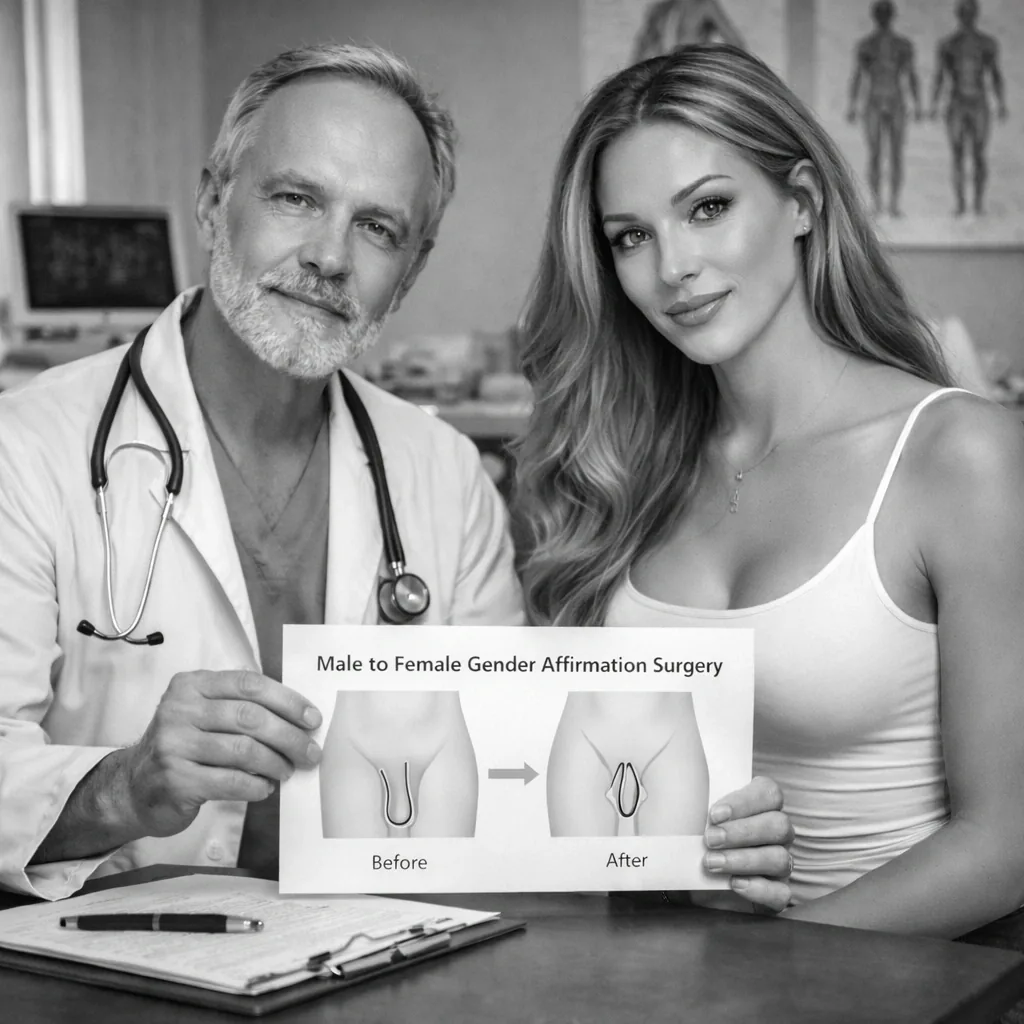
Two Separate Jobs, and People Conflate Them
Almost everyone arrives thinking about one of these and gets surprised by the other.
The face is the long relationship. It is the thing that affects how you are read every day, it takes years rather than months, and hormones will not do it for you.
The donor site is a project with a deadline. It exists only if you are having a vaginoplasty that uses hair-bearing skin, it has a defined finish line, and it is on your surgeon's clock rather than yours.
They need different methods, different session patterns and different budgets. Let me take them separately.
Part One: The Face
What hormones will and will not do
Estradiol and antiandrogens genuinely reduce body hair. Density drops, texture softens, and a lot of people find their arms, chest and back become a much smaller problem than they were.
Facial hair is far more stubborn, and this is the part that gets undersold. Terminal beard follicles established during a testosterone-driven puberty do not revert. Hormones may soften and slow them. They do not remove them.
How much you see depends heavily on genetics and on the age you started therapy, and the variation between people is enormous. Somebody who started at nineteen and somebody who started at forty-five are having two different conversations, and neither of them did anything wrong.
So facial hair removal is not a failure of your hormone therapy. It is a normal part of the process for most trans women, and expecting otherwise sets you up for a disappointment that is nobody's fault.
Why the face is mostly an electrolysis job
Beard hair is the deepest, coarsest and most stubbornly anchored hair on a human body. It is built to stay put.
Laser can help, and it cannot finish. Where hair is dark and skin is lighter, laser thins a dense beard quickly and it is a real time saver. What it cannot touch is grey, white, blonde and red hair, since it targets pigment and those hairs have little or none. That matters more here than anywhere else, because beard hair greys with age and because the hairs left standing after a laser course are disproportionately the pale ones.
Electrolysis works on every hair colour and every skin tone. For a face that needs to be genuinely clear rather than mostly clear, that is the difference. Electrolysis is conventionally described as permanent hair removal and laser as permanent hair reduction, though that wording comes from United States device labelling rather than from Health Canada, and Yuan and colleagues, writing in Sexual Medicine in 2022, found the point is widely misrepresented.
The usual sensible plan is laser to thin, electrolysis to finish and to maintain. That is the same logic as everywhere else on this site, and it applies with more force on a beard than anywhere.
What the course actually looks like
This is measured in years. Full facial clearance typically runs one to three years of regular electrolysis, and longer on a dense beard. Anybody promising you a face in six months is describing a thinning, not a clearance.
Sessions are long and regular. An hour at a time, often more, on a consistent schedule rather than whenever there is a gap.
The hair has to be visible. Shaving between sessions is fine and expected. Waxing, plucking, threading and epilators are not, since they remove the thing I need to treat and reset that follicle's cycle. Tweezing the same hairs for years also traumatises those follicles repeatedly, which makes them harder to clear when you finally do it properly.
It gets easier. The first sessions are the densest and the longest. Two years in, appointments are shorter and further apart, and most people describe maintenance as a different experience from clearance.
The pain map ranks the upper lip and chin near the top of the list, and it is honest about why: the deepest follicles on the body, thin skin over bone, and a face that moves every time you speak. The numbing cream guide covers what helps, including the safety limits that matter on repeated long sessions.
Part Two: The Donor Site
When it applies, and when it does not
This is the part where I most often correct an assumption, so let me be precise.
Penile inversion vaginoplasty lines the canal with penile and often scrotal skin, which is hair bearing. Peritoneal vaginoplasty uses peritoneum, which grows no hair at all, though it is usually combined with genital skin at the opening. Ask your surgeon which tissue is going where, since the answer changes how much clearance you actually need.
Vulvoplasty, sometimes called minimal depth or zero depth, generally does not carry the same requirement, since there is no canal being lined and the skin stays accessible. Hair removal afterwards remains possible.
Confirm which procedure you are having before you spend a year on this.
What has to be cleared
GrS Montreal publishes its own requirement: the skin of the scrotum plus a three centimetre wide strip between the scrotum and the rectum, stopping two centimetres short of the anus. That is a little over an inch, not two and a half. Zhang and colleagues, writing in Translational Andrology and Urology in 2016, go further and say perineal skin never needs treating before vaginoplasty. The perineum is exactly the detail to confirm with your own surgeon rather than assume, since guessing high here costs you real money.
Yours may differ. Get your surgeon's template or written dimensions before your first appointment with me, because clearing the wrong area over the course of a year is an expensive mistake.
How long it takes
Six to twelve months of treatment, plus a three month waiting period to confirm nothing regrows.
The reason it cannot be compressed is the hair cycle. Only about a quarter of follicles are in the active growth phase where treatment does anything, so the gaps between sessions are the mechanism rather than an inconvenience. Booking more sessions closer together does not buy you time.
What happens if hair is left inside
The reported consequences are chronic irritation, recurrent infection, hairball and stone formation, and a tugging, unpleasant sensation during intercourse.
None of that is reversible with a razor, since the tissue is not reachable. That is the whole argument for doing it properly beforehand.

The Ontario Position, Which Surprises People
Neither GRS Montreal nor Women's College Hospital requires pre-operative hair removal. That is worth stating plainly, because a lot of people arrive believing it is mandatory and are quietly panicking about a timeline.
Women's College Hospital does recommend it, describing permanent hair removal as the only way to ensure no vaginal hair growth, and it notes there is no permanent solution for removing hair after surgery. Post-operative management is manual and ongoing.
It is paid privately either way. OHIP funds the surgery and does not fund the hair removal. That is the most common unpleasant financial surprise in this process and it lands on people who have already been through an assessment, a referral and a waitlist.
So the decision is genuinely yours rather than a gate you have to pass. What I would say is this: the surgery is permanent and the hair is permanent, and the version of this you will be happiest with in ten years is almost always the one where the canal has no hair in it. Not required is not the same as not worth doing.
Laser or Electrolysis: Both, in Order
The numbers, and their limits
Gorgu and colleagues, writing in Dermatologic Surgery in 2000, found alexandrite laser reached 74 per cent clearance against 35 per cent for electrolysis, measured six months after the first treatment. That study treated underarm hair in twelve patients and gave the electrolysis side only four sessions, so it measures a truncated course on a site nothing like a donor template. Treat it as a signal, not a verdict.
What each one is actually for
Laser thins. Fifteen to thirty minute sessions covering the whole template, roughly six weeks apart. On dense scrotal and pubic hair that is a genuine advantage and it saves both time and money.
Laser cannot see pale hair at all. Grey, white, blonde and red hair have no meaningful pigment target. Those hairs survive a full laser course untouched, and on a donor site they are precisely the ones that end up inside you.
Electrolysis clears. Every follicle individually, any colour, any skin tone, one to two hour sessions. It is slower and it finishes the job.
The plan
Laser first to thin, electrolysis to finish, then three clear months. Cheaper than electrolysis alone, more complete than laser alone, and it is what most people converge on regardless of where they started.
What I Need From You
Which procedure, specifically. Penile inversion, peritoneal or vulvoplasty. The answer changes whether any of Part Two applies to you.
Your surgeon's template or written dimensions, before we begin.
Your date if you have one. The plan is built backwards from it, with the three month clearance window already included.
Every medication. Estradiol and antiandrogens are not a barrier. Spironolactone is common here and worth naming, since it reduces hair growth in the same direction I am working, which is useful. What matters more is anything affecting bleeding, skin fragility or immunity, and blood thinners are a real issue for electrolysis specifically, since every insertion is a small controlled wound. The full picture is in the medications guide.
Anything on the skin in the area. Scars, moles, keloid history. I assess the area properly before starting, which is what the dermoscopy training is for.
What You Get From Me
Documentation your surgeon will accept, recording what was treated, when, by what method, and the state of the area at the end.
A plan built backwards from your date, with the clearance window in it rather than discovered at your pre-op.
The same practitioner every time. Facial clearance in particular is a relationship measured in years. Continuity is not a nicety here, it is what makes the work efficient, since I will remember where the difficult patches are and what your skin does.
A calm room. Around ninety per cent of my clients are men and trans men and trans women, this is not an unusual booking, and nobody is going to make it one.
Warnings and Hard Limits
No waxing, sugaring, plucking, threading or epilating in any area we are clearing, for the entire course. This is the most common way people set their own timeline back, and it is nearly always done with good intentions.
Do not stop hormone therapy for hair removal. I will never ask you to. Anybody in this industry who does is telling you something about their training.
Nothing over broken skin, an active infection, or a genital piercing site that has not fully healed. Jewellery comes out before laser, every time, since metal absorbs and conducts heat efficiently.
Confirm the template before the first session, not after the tenth.
Do not skip the three month clearance window because a date moved up. That is a conversation with your surgeon rather than an assumption.
A practitioner who has not done donor site work before is not the right choice for this. Ask them directly. The consequences of an incompletely cleared canal are permanent and they are not cosmetic.
Two jobs, two clocks.
The face is a one to three year electrolysis relationship, sometimes preceded by laser to thin, and hormones will not do it for you. That is normal and it is not a failure of anything.
The donor site is six to twelve months plus three clear months, it applies to penile inversion vaginoplasty and partly to peritoneal vaginoplasty where genital skin is used at the opening, rather than to vulvoplasty, and Ontario surgeons recommend it rather than requiring it. Recommended is not the same as optional when the result is permanent.
Laser first to thin, electrolysis to finish, and the template from your surgeon before anything else.
If you are anywhere in the assessment or referral process and have not thought about hair yet, book a consultation now. Even if the answer is that you have plenty of time, an hour spent finding that out is an hour well spent.
Related reading: gender affirmation surgery and hair removal, hair removal for female to male surgery, the medications and hair removal guide, the pain map, an honest guide to numbing cream and the kind of people who come to see me.