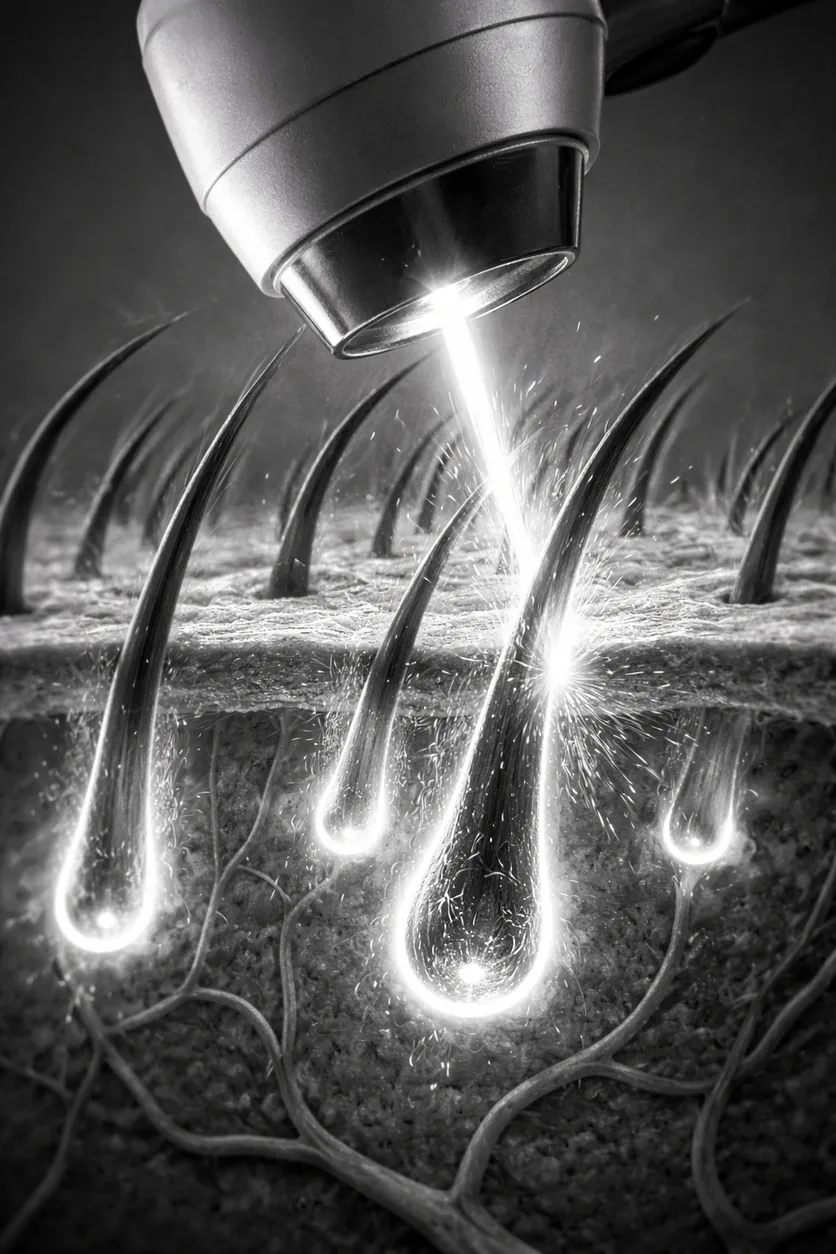
Paradoxical Hypertrichosis Why Laser Can Sometimes Stimulate Hair Growth
Paradoxical hypertrichosis is one of the least discussed and most misunderstood risks in laser hair removal. It refers to the stimulation of new, thicker, darker hair growth in or around treated areas following laser sessions.
It is uncommon, and how uncommon depends entirely on where you look. Inoue and colleagues, reviewing every patient treated at a single clinic in Aesthetic Surgery Journal in 2024, found it in 25 of 7,381 people, which is 0.34 per cent. Qeyam and colleagues, following Jordanian women through facial treatment and reporting in Lasers in Medical Science in 2025, found it in 16.2 per cent. Snast and colleagues, pooling 9,733 patients in the American Journal of Clinical Dermatology in 2021, put it at 3 per cent overall. The Endocrine Society's hirsutism guideline gives the reported range as 0.6 to 10 per cent.
Those numbers are not in conflict. They are measuring different things. The low figure is whole-body treatment across everybody who walked through the door. The high figure is facial treatment in women already prone to hirsutism. Which number applies to you depends on your hair, your hormones, and which part of you is being treated.
Understanding paradoxical hypertrichosis is essential for clients considering laser and for clinics that aim to practice responsibly.
What Is Paradoxical Hypertrichosis
Paradoxical hypertrichosis occurs when laser energy stimulates hair follicles instead of disabling them. Fine, soft hairs may become thicker and darker. Previously hair-free areas may begin producing visible terminal hair.
This effect is most commonly seen:
- On the face and neck
- Along the jawline and cheeks
- On upper arms and shoulders
- On upper thighs and abdomen
The condition is not permanent stimulation. It is follicular activation. Once stimulated, those hairs often require electrolysis for permanent removal.
Why It Happens, and a Correction I Owe You
This page used to tell you that settings which are too low are the cause. That is the standard explanation across the industry, it is the one I believed, and the best available evidence does not support it.
The theory was reasonable. Deliver enough heat to warm a follicle without destroying it, and you might stimulate it instead. It is a tidy story. The trouble is what happens when somebody counts.
Inoue and colleagues reviewed all 7,381 patients treated at their clinic and found 25 cases. Twenty-four of those 25 had been treated with alexandrite laser, the higher-fluence stamping modality, a difference significant at p less than 0.01. Low-fluence in-motion diode treatment was associated with a significantly reduced incidence. That is the opposite of what the under-treatment theory predicts.
Qeyam and colleagues approached it from the other direction and found the strongest associations were hormonal rather than technical: irregular menstrual cycles at 33.3 per cent against 12.6 per cent, and a family history of hirsutism at 27.8 per cent against 13.8 per cent.
There is a bigger study still, and it complicates both accounts. Snast and colleagues, in a systematic review and meta-analysis published in the American Journal of Clinical Dermatology in 2021, pooled 9,733 patients across two randomised trials and twenty cohort studies. They put the overall prevalence at 3 per cent, with a confidence interval running from 1 to 6.
Two of their findings matter more than the headline number. The condition was tied overwhelmingly to the face and neck, appearing in only 0.08 per cent of cases treated elsewhere on the body. On the question this section is about, they found that treatment modality and the interval between treatments had no effect on the rate at all.
That cuts against the old under-treatment theory and against reading too much into Inoue's alexandrite finding. The largest pooled dataset we have says the device matters less than where on you it is pointed. One piece of genuinely good news from the same review: in three of the four studies that followed it, the condition improved with continued treatment rather than worsening.
So the honest position is that nobody has established the mechanism. Sub-therapeutic energy remains one hypothesis among several. It is not a settled finding, and any clinic telling you flatly that weak settings cause it, including this one until now, is stating a theory as though it were a fact.
What the evidence does support is narrower and more useful. Hormonal factors matter a great deal. The face and neck are where it shows up. One protective factor also turned up that almost nobody mentions: daily sun protection. Inoue found it independently protective, with an odds ratio of 0.41. Wearing sunscreen on a treated face is the cheapest thing on this page.
Who Is Most at Risk
Certain clients are significantly more susceptible to paradoxical hypertrichosis.
Hormonal Conditions
Clients with underlying hormonal influences face the highest risk, including:
- Polycystic Ovary Syndrome
- Perimenopause and menopause
- Elevated androgen levels
This is the risk factor with the most evidence behind it. Qeyam and colleagues found facial paradoxical hypertrichosis in 33.3 per cent of women with PMOS against 14.1 per cent without, a difference significant at p less than 0.001, alongside the cycle and family history associations above. Worth noting what that study was: a single hospital in Jordan, in a population already flagged as higher risk. Read it as a warning rather than as a rate you should expect.
Fine or Borderline Hair
Laser is designed for coarse, pigmented hair. Fine hair carries risk.
High risk hair types include:
- Peach fuzz
- Thin facial hair
- Sparse hair with light pigmentation
Laser cannot reliably disable these follicles.
Facial and Hormone Sensitive Areas
The face is the most common site of paradoxical hypertrichosis due to its hormone responsiveness.
Highest risk areas:
- Cheeks
- Jawline
- Chin and neck
- Upper lip
Laser should be approached cautiously or avoided entirely in these regions for many clients.
Skin Tone and Hair Contrast
Low contrast between hair and skin increases risk. When the laser struggles to identify pigment clearly, effective follicle destruction becomes unreliable.

How Paradoxical Hypertrichosis Is Avoided
Avoidance begins before the first treatment.
Proper Candidate Selection
Not every client is a laser candidate.
Laser should be avoided when:
- Hair is fine or hormonally driven
- Facial hair is present with hormonal indicators
- Growth patterns are unstable
Electrolysis is often the safer starting point.
Correct Laser Settings and Technique
When laser is appropriate, precision matters.
Prevention requires:
- Adequate fluence to fully disable follicles
- Correct wavelength selection
- Limited overlap
- Conservative treatment zones
- Experienced adjustment by the technician
Add daily sun protection to that list, since it is the one protective factor that has actually been measured, and drop the idea that gentler settings are inherently the risk. The evidence does not carry it.
Avoiding Laser on the Face in High-Risk Clients
For clients with hormonal facial hair, laser often creates more problems than it solves. Electrolysis provides controlled, permanent removal without stimulation risk.
One Thing I Cannot Tell You
Every figure on this page comes from laser studies. Alexandrite and diode, mostly.
We treat with intense pulsed light, a SharpLight Formax running the 635 nm hair removal filter. I could find no published incidence figure for paradoxical hypertrichosis after IPL specifically. Not a low one, not a high one. Nobody has counted.
That means I cannot honestly tell you our risk is lower, and I am not going to imply it. What I can tell you is that Inoue's finding pointed toward the higher-fluence stamping approach rather than the lower-fluence in-motion one, and that we screen for the hormonal risk factors above before treating a face at all. The gap in the literature is real and you deserve to know it exists.
What to Do If It Happens
If paradoxical hypertrichosis occurs:
- Stop laser immediately in the affected area
- Do not increase session frequency
- Avoid chasing growth with additional laser
- Transition to electrolysis for permanent correction
Early intervention prevents widespread stimulation.
Laser vs Electrolysis in High-Risk Clients
Laser:
- Faster per session
- Effective for dense, coarse body hair
- Can stimulate hair in high-risk zones
- Not permanent for hormonally driven hair
Electrolysis:
- Treats each follicle individually
- No stimulation risk
- Permanent removal
- Ideal for facial and hormonal hair
In high-risk cases, electrolysis is not a fallback. It is the correct choice.
Final Takeaway
Paradoxical hypertrichosis is preventable. When it occurs, it reflects a mismatch between client biology and treatment choice, not a flaw in laser technology itself.
Responsible hair removal prioritizes biology over speed. Precision over volume. Long-term outcomes over short-term promises.
Choosing the right method from the beginning protects clients from years of unnecessary correction.
Worth reading alongside this. those bumps after a laser treatment, how to identify a skilled laser technician, how many laser sessions it really takes, choosing the right laser machine and why cheap laser costs more in the long run.