The Name Changed in May
Polycystic Ovary Syndrome (PCOS) is now Polyendocrine Metabolic Ovarian Syndrome (PMOS).
The reason is that the old name described something that is not there. Professor Helena Teede, who led the guideline work, put it plainly: there is no increase in abnormal cysts on the ovary. The structures being counted are follicles, and the name has been pointing at the wrong thing for decades.
The second reason is scope. Naming it after the ovaries reduced a whole-body hormonal and metabolic condition to a reproductive one, which is how everything else people actually live with ended up treated as a footnote. The new name leads with hormones instead.
The change was announced on 12 May 2026, led by the International Androgen Excess and PCOS Society, and endorsed by more than fifty patient and professional organisations including the Endocrine Society.
The condition has not changed. The diagnostic criteria have not changed. The treatment has not changed. Only the name.
Both terms will be used side by side for about three years, and PMOS becomes standard at the next international guideline update in 2028. I am using PMOS from here on.
Why This Matters for Hair
Excess hair growth is one of the features the old name buried.
When a condition is named after cysts and ovaries, the things that name does not mention get treated as side issues. Hirsutism is not a side issue. For a lot of people it is the part they think about every morning, and it is the reason they end up in a room like mine rather than a fertility clinic.
The new name puts hormones at the front, which is exactly where the hair comes from.
How Common This Is
PMOS affects 10 to 13 percent of people of reproductive age assigned female at birth.
The World Health Organization estimates that up to 70 percent of people who have it worldwide do not know.
Getting diagnosed is its own ordeal. Gibson-Helm and colleagues surveyed 1,385 women through PCOS support group websites, reporting in the Journal of Clinical Endocrinology and Metabolism in 2017 that 33.6 per cent waited more than two years for a diagnosis, 47.1 per cent saw three or more health professionals, and only 15.6 per cent were satisfied with the information they were given. It was an online self-selected sample drawn mostly from North America and Europe, so read it as a picture of people who went looking for support rather than of everyone with the condition.
If that has been your experience, it is not unusual and it was not you.
Why the Hair Happens
Androgens convert fine vellus hair into coarse terminal hair. It is the same process that produces a beard in adolescence, running in a body that did not ask for one.
Three things decide whether a given follicle makes the switch:
- how much androgen is present, and for how long
- how much 5-alpha-reductase activity there is locally, which converts testosterone into the far more potent DHT right at the follicle
- how sensitive that particular follicle is to androgen in the first place
That third one is why this is not evenly distributed. Face, neck, chest, back and abdomen are the androgen-sensitive sites. Your forearms are not, which is why nothing happens there.
Insulin matters too, and it is the part most people have never had explained. Hyperinsulinaemia lowers sex hormone binding globulin, and SHBG is what keeps testosterone bound and inactive. Less SHBG means more free testosterone reaching the follicle, from the same total amount.
The Score Your Doctor May Use
The modified Ferriman-Gallwey score rates terminal hair at nine sites, each from zero to four, for a maximum of thirty-six.
The sites are the upper lip, chin, chest, upper back, lower back, upper abdomen, lower abdomen, upper arms and thighs.
The current international guideline puts the threshold at 4 to 6 depending on ethnicity. An older and still widely used convention set it at 8 or above. If you have been scored under both, that is why the numbers did not match.
Two things the guideline says that are worth knowing before you go:
- self-treatment is common and limits what a clinician can actually assess, so tell them what you have been removing
- unwanted hair growth should be treated as important regardless of how severe it looks to someone else
Medication Slows New Growth. It Does Not Undo Old Growth.
This is the sentence I most often have to say out loud, and a 2024 Canadian Medical Association Journal review says it better than I can: medical treatment of hirsutism can reduce new hair growth but cannot reverse hair growth that was previously established.
Once a follicle has converted from vellus to terminal, it stays terminal. No pill turns it back.
What the medications actually do:
- combined oral contraceptives are first-line, and need a minimum of six months before anyone can judge whether they are working
- spironolactone is usually added only after six months of suboptimal response, and takes six to twelve months of its own to show a difference
- the 2023 international guideline recommends metformin primarily for metabolic features. The Endocrine Society hirsutism guideline of 2018 is the one that suggests against insulin-lowering drugs where hirsutism is the only reason for prescribing them. Those are two separate documents and they are often quoted as though they were one
- topical eflornithine slows growth rather than removing hair. The Endocrine Society hirsutism guideline, published by Martin and colleagues in the Journal of Clinical Endocrinology and Metabolism in 2018, puts noticeable results at six to eight weeks, with hair returning to pretreatment levels about eight weeks after you stop
Six months keeps coming up because that is roughly the hair growth cycle. Facial anagen runs about four months, so nothing you do to the hormones shows up faster than the hair is willing to reveal it.
What the Guideline Actually Says About Laser
It is more supportive than people expect, and more specific.
Laser and light therapies should be considered for reducing facial hirsutism, and explicitly for the depression, anxiety and quality of life that come with it.
Then the line that matters most here: a greater number of laser sessions may be required in this population than in idiopathic hirsutism. That is the published version of what clients tell me anyway, which is that it takes more than they were quoted.
Also from the guideline:
- laser is relatively ineffective on blond, grey or white hair
- adding a combined oral contraceptive, with or without an anti-androgen, may give greater reduction and better maintenance than laser alone
- IPL benefits may be less pronounced than laser
- there is no evidence supporting home IPL kits
The Paradoxical Hypertrichosis Question
Laser occasionally stimulates hair instead of reducing it. The honest answer on how often is that nobody agrees.
Reported rates run from well under one percent in a large 2024 series to about sixteen percent in a 2025 prospective study of facial alexandrite treatment. That is a fifty-fold spread, and it tells you the studies are measuring different populations rather than that one of them is lying.
The hormonal link is genuinely unsettled. The 2025 study found it in 33.3% of participants with PMOS against 14.1% without. The larger 2024 series found no significant difference related to hormonal imbalance.
What is not unsettled is the Endocrine Society's 2018 position, which suggests topical treatment or electrolysis over photoepilation for Mediterranean and Middle Eastern women with facial hirsutism. I wrote more about the phenomenon here.
What Permanent Actually Means
I have to correct something I previously had on this page.
Lasers are cleared for permanent hair reduction, and that is a defined regulatory term rather than marketing language. It means a long-term stable reduction in the number of hairs regrowing, measured at six, nine and twelve months after a treatment course. Fewer hairs. Not no hairs.
Health Canada uses the same framing and notes that most people need repeated treatments to get there.
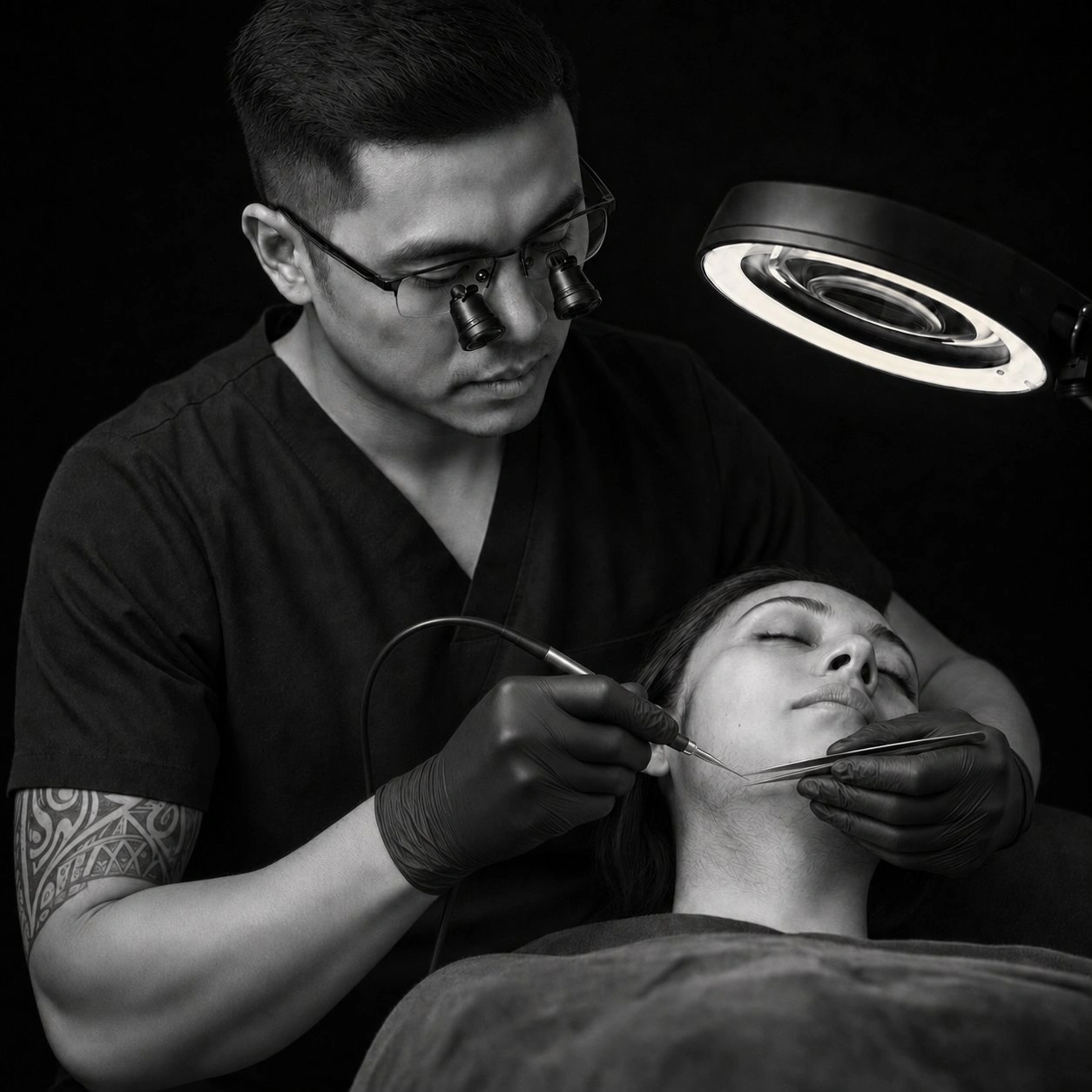
Electrolysis works differently. The needle epilator is defined in regulation as a device that destroys the dermal papilla, which is the structure that grows the hair. It does not depend on pigment, so hair colour and skin tone are irrelevant.
What I am not going to tell you is that a regulator has declared electrolysis the only permanent method. I went looking for that and could not find it, and I would rather say so than repeat something because it is convenient.
The American Academy of Dermatology puts the practical version well: laser is permanent on most areas of the body, and because of hormones, it is not permanent on a woman's face.
Where That Leaves You
For most people with PMOS, the sensible split is:
- laser for dense, dark, stabilised body hair, where it does real work quickly
- electrolysis for the face and neck, and for anywhere the hair is fine, red, grey or white
One more honest note. The international guideline does not mention electrolysis at all, in either direction. It is not endorsed and it is not warned against, and I would rather you heard that from me than discovered it yourself.
This Is Not Cosmetic, and the Guideline Says So
The mental health burden here is measured, not anecdotal.
A meta-analysis found odds of moderate to severe depressive symptoms more than four times higher, and moderate to severe anxiety symptoms more than six times higher, than in people without the condition. The Canadian review reports depression and anxiety at roughly two and a half times.
The guideline requires clinicians to screen for both.
It also says something I did not expect to read in a clinical document: policy makers should consider funding hair reduction therapy for people with this condition, to address the distress and the effect on quality of life, body image and psychological health.
That is a guideline calling this treatment, not vanity.
One Thing to Take to Your Doctor
If excess hair appears suddenly, or gets noticeably worse over a short period, that is worth raising promptly.
The guideline flags new-onset or rapidly worsening hyperandrogenism as needing investigation, because there are less common causes that need ruling out.
I cannot tell you what is causing anything. What I can do is notice a pattern, say so, and keep working on the hair either way.
Bottom Line
PCOS is now PMOS. The name changed, the condition did not, and both terms are correct for the next few years.
Medication can slow what has not happened yet. It cannot undo hair that has already turned terminal, which is why hair removal is a separate job rather than a backup plan.
Laser earns its place on dense dark body hair and may need more sessions here than the brochure suggests. Electrolysis is the one that does not care what colour the hair is, which is why it ends up doing the face.
None of this is vanity, and the guideline agrees with me for once.
If this is your situation, these go together. the medications and hair removal guide, hidradenitis suppurativa and hair removal, how hair biology determines your results, dormant hair cycles and why hair seems to come back and when hair removal stops working.