
Why Dark Skin Was Historically Treated Differently
Laser and light-based hair removal work by targeting melanin inside the hair follicle. Melanin absorbs light and converts it to heat, damaging the follicle and slowing or stopping regrowth. Anderson and Parrish described this principle, selective photothermolysis, in Science in 1983, and every hair removal device sold since works on it.
The challenge with dark and very dark skin is simple but critical:
there is more melanin in the skin itself, not just the hair.
Early laser and IPL systems did not distinguish well between melanin in the hair and melanin in the epidermis. This led to higher risks of:
- Burns
- Blistering
- Hyperpigmentation
- Hypopigmentation
As a result, darker skin types were often excluded, undertreated, or told laser hair removal was unsafe.
Technology, not biology, was the limitation.
The Fitzpatrick Skin Type Scale
The Fitzpatrick scale classifies skin based on how it responds to sun exposure and pigmentation.
- Type I–III: Light to medium skin tones with lower baseline melanin
- Type IV: Olive to light brown skin
- Type V: Brown skin
- Type VI: Very dark to deep brown or black skin
You will find Types IV to VI across people of African, Caribbean, South Asian, Middle Eastern, Indigenous, Latin American and Mediterranean background, and I want to be careful with that sentence. Ware and colleagues, writing in Cutis in 2020, found that clinicians routinely use Fitzpatrick type as a stand-in for race when it was only ever meant to predict burning. Your ancestry suggests where to look. Your burn history decides.
These skin types are not unsuitable for laser hair removal. They simply require controlled energy delivery and proper technology.
Why the Filter on an IPL Matters So Much on Dark Skin
Every IPL, ours included, starts as broad-spectrum flashlamp light. What separates a safe setup from a risky one on dark skin is the filter. Vaidya, Hohman and Kumar, in the StatPearls review of laser hair removal updated in 2026, describe IPL as polychromatic light from 500 to 1200 nm where filters narrow the emitted band. Unfiltered or shallowly filtered short wavelengths are readily absorbed by epidermal melanin, which heats the surface instead of the follicle. Our handpiece cuts everything below 635 nm.
When this happens, the skin heats faster than the hair root.
This is where complications occur.
Dark skin does not need stronger treatments.
It needs smarter ones.
How Sharplight Technology Addresses Dark Skin Safely
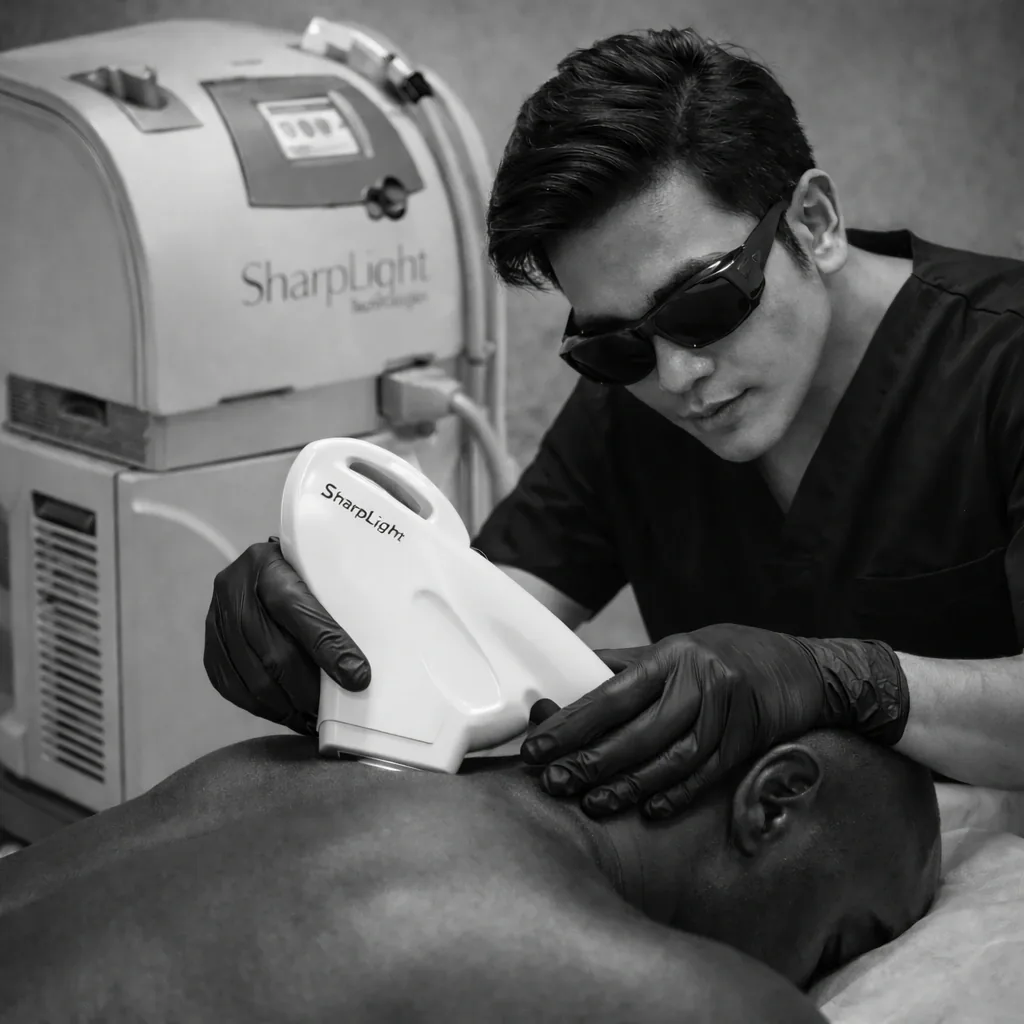
Sharplight Technologies developed IPL systems specifically designed to improve control, precision, and safety across all skin tones, including Fitzpatrick IV–VI.
Dynamic Pulse Control (DPC)
Sharplight's Dynamic Pulse Control refines how light energy is delivered.
Instead of one aggressive burst, energy is delivered in controlled pulse patterns that:
- Target the hair follicle effectively
- Reduce unnecessary epidermal heat
- Allow treatment customization based on skin tone and hair density
This precision is critical for darker skin, where managing surface heat is the primary safety concern.
Flow Mode Technology
Flow Mode is SharpLight's term for continuous movement during treatment rather than static stamping. Two caveats I owe you on their terminology. Dynamic Pulse Control and Flow Mode are the manufacturer's own names for how their systems shape and deliver pulses, and I have not found independent peer-reviewed studies testing either against a comparator, so take the mechanism as their account rather than as published evidence. Cooling is listed in the Formax clearance as an option rather than as standard on every handpiece, so ask any clinic, including mine, what cooling is actually on the head that touches you.
Benefits include:
- Even energy distribution
- Reduced heat buildup in one spot
- Improved comfort and consistency
This is especially important for dark skin, where overlapping pulses can increase risk if not properly controlled.
Advanced Cooling
Sharplight systems incorporate integrated cooling technologies that protect the epidermis while allowing effective follicle targeting.
Cooling is not just about comfort.
For dark skin, it is a safety mechanism.
Which Wavelengths We Actually Deliver
Everything above is about the technology in general. Here is what sits in our room, since you should be booking on facts rather than on a category.
We use the SharpLight Formax with the DPC hair removal applicator at 635 nm. That number is a filter wavelength rather than a model name, so the handpiece delivers light from 635 up to 950 nanometres. It is an intense pulsed light system, which is why this article talks about IPL rather than about a single-wavelength laser.
The part that matters most for you: the Formax is cleared by the FDA for permanent hair reduction in all six Fitzpatrick skin types, I through VI. That clearance names your skin type specifically. It is not a marketing line or a claim we are making about ourselves, and you can look it up.
One thing we will not do is let you assume something we do not have. The ladder below describes the laser wavelengths used across the industry, and it is here because it is genuinely useful for understanding why darker skin needs different handling. We do not operate an Nd:YAG laser. If a clinic has told you Nd:YAG is the only safe option for your skin, that is a real position held by real dermatologists and worth taking seriously. Our answer is that our device carries a clearance covering your skin type on its own merits, and that settings, cooling and the person holding the handpiece matter at least as much as the badge on the machine.
Wavelength Is the Other Half of the Answer
Pulse control and cooling manage the heat. Wavelength decides how much of it lands in the epidermis in the first place, and the ladder is well established.
- Alexandrite at 755 nm penetrates well and is best suited to lighter skin, types I to III.
- Diode at 810 nm goes deeper with less epidermal damage and is safer across a wider range.
- Nd:YAG at 1064 nm is the longest of the three. Vaidya, Hohman and Kumar describe it as offering better penetration, less epidermal damage and relatively less melanin absorption across skin types I to VI. They do not crown it the safest device outright, and neither will I.
That summary is not a manufacturer's claim. Vaidya, Hohman and Kumar set it out in the StatPearls review of laser hair removal, updated in 2026, and they add the reassuring point that most complications are preventable when fluence, spot size, wavelength and cooling are adjusted properly, and that getting those parameters right matters most in patients with intrinsically dark skin.
The Areas Where Settings Have to Change Again
Here is the part that almost never gets said, and it matters as much as skin type does.
Your skin tone is not uniform across your body. The groin, the perianal area, the underarms and the inner thighs are typically darker than the abdomen or the outer arm on the same person, and friction-related darkening in folds adds to it. I am describing what I measure on the skin in front of me rather than citing a published survey, since I could not find one that puts numbers on it by body site.
Our IPL cannot tell the difference between melanin in your hair and melanin in your skin. It only sees pigment, and that is as true of a filtered flashlamp as it is of any laser.
So a setting that is perfectly correct on one part of you can burn another part of you. Same person, same session, different skin. That is the whole answer to why a practitioner should be re-reading your skin at every area rather than dialling in one number at the start and working through the list.
What this means in practice on our device: fluence comes down and pulse structure changes as the area gets darker, cooling gets more aggressive, and a patch test on one area does not clear another. The wavelength band does not move, since the Formax hair removal handpiece is filtered at a fixed 635 nm, so everything else has to do the work.
The same reasoning underlies everything in burns, hyperpigmentation and scarring, and the skin-type framework itself is explained in the Fitzpatrick scale.
Effectiveness on Dark and Very Dark Skin
When used correctly, Sharplight IPL technology can achieve meaningful hair reduction on dark skin by:
- Slowing regrowth
- Reducing density
- Producing finer, lighter hairs over time
Results depend on:
- Hair thickness and pigment
- Hormonal influences
- Consistent treatment intervals
It is important to note that laser and IPL provide reduction, not guaranteed permanence. Resistant, light, or hormonal hairs may still require electrolysis for complete removal.
Who Is an Ideal Candidate
Intense pulsed light hair reduction on our SharpLight system can be done safely for the skin types below, and I want to be precise about what that means. Vaidya, Hohman and Kumar note in StatPearls that the best documented results still come from lighter skin with dark hair, because the contrast is greater. Your skin type is cleared and treatable on our device. It is not the easy case, and anyone who tells you otherwise is selling.
- Fitzpatrick IV–VI skin types
- Dark, coarse hair
- Large treatment areas
- Clients seeking long-term reduction rather than total elimination
A proper consultation and test spot are essential, especially for very dark skin.
Final Thoughts
Dark skin was never the problem.
Outdated technology was.
With a filtered IPL such as the SharpLight Formax, hair reduction can be performed safely and effectively on pigment-rich skin when proper protocols are followed.
Precision, control, and experience matter more than skin tone ever did.
Worth reading alongside this. burns, hyperpigmentation and scarring, and how to avoid them, hidradenitis suppurativa and hair removal, the pain map, every area ranked, how often you should actually exfoliate and those bumps after a laser treatment.