Hair Does Not Grow All at Once
Most people imagine hair growing evenly and continuously across the body.
It doesn’t.
Every follicle operates independently on its own schedule like tiny coworkers who completely ignore the company calendar.
Some are:
- actively growing
- slowing down
- shedding
- dormant and invisible
That last category is what confuses people most.
The Hair Growth Stages That Matter Here
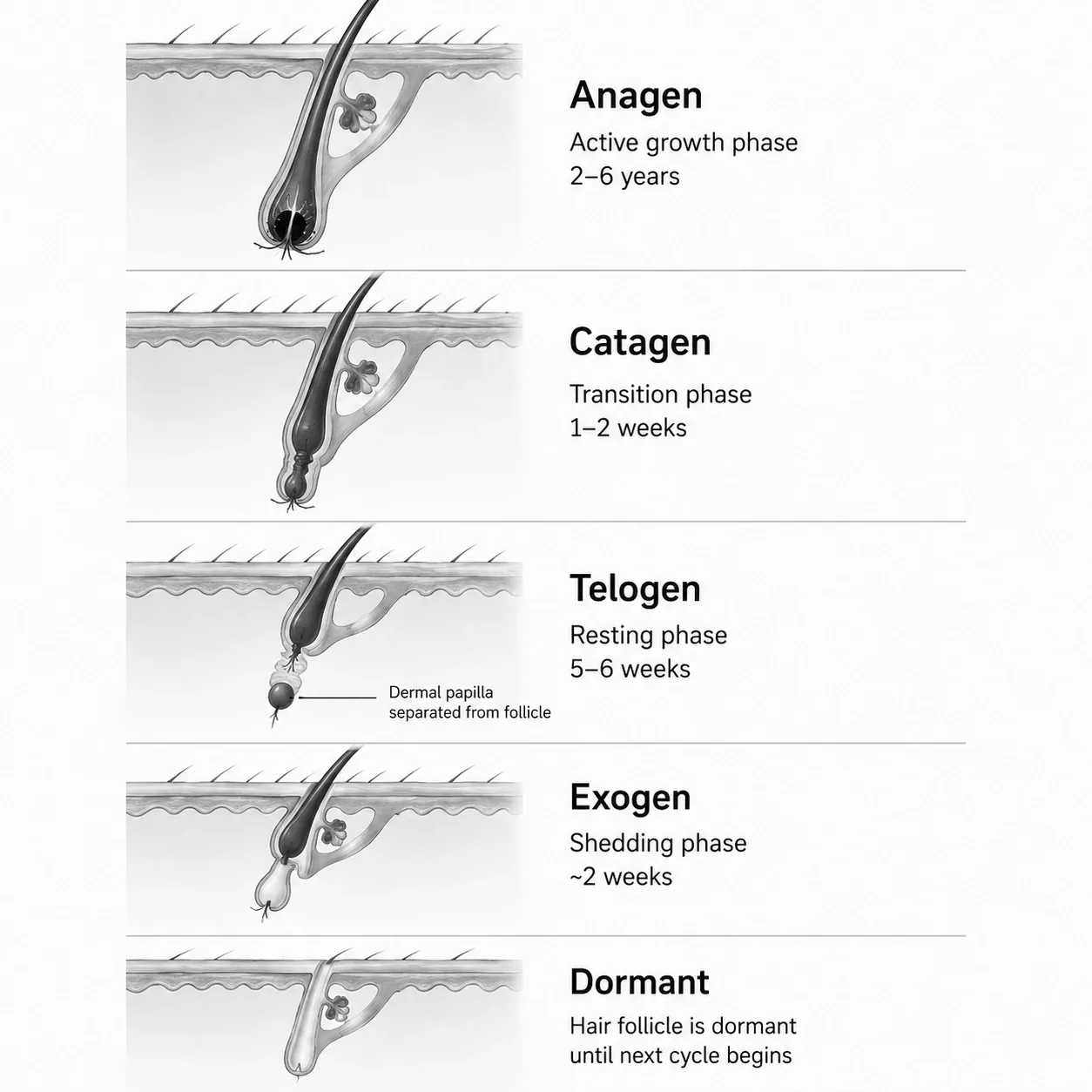
Anagen, catagen and telogen are the three everyone names. Two more are well described now and this post needs both: exogen, the shedding step Guarrera and Rebora separated out from telogen in 2017, and kenogen, the empty interval they named in 2002.
Anagen (Active Growth Phase)
This is the ideal treatment stage.
The hair is:
- attached deeply to the follicle
- actively growing
- rich in pigment and structure
Laser and electrolysis work best here because the follicle is fully connected and identifiable.
Catagen (Transition Phase)
This is the shutdown phase.
The follicle begins shrinking:
- growth slows
- the hair detaches from nourishment
- the follicle starts moving upward
This stage is brief and less responsive to treatment.
Telogen (Dormant / Resting Phase)
This is where the mystery happens.
In telogen the follicle stops producing and the finished hair usually sits anchored as a club hair, still visible. The genuinely empty stretch has its own name. Rebora and Guarrera called it kenogen in 2002, the gap after the old hair is shed and before a new one emerges, and in the ten men they followed for fourteen years it ran about four months and touched 80 per cent of hair cycles on the scalp. Kenogen is what people are picturing when they say a follicle was hiding, and it is why an area can look finished and then turn out not to be.
Eventually, it reactivates and begins producing a new hair.
So when people think:
“The hair grew back.”
Often what actually happened is:
a dormant follicle simply woke up.
Why Multiple Treatments Are Needed
This is why hair removal requires sessions spaced over time.
Treatment works best on hairs that are active and properly connected to the follicle. The picture is not airtight, and it is worth knowing why. Al-Haddab and colleagues waxed one armpit and shaved the other immediately before three laser sessions in twenty women and found no significant difference in reduction six months later, which is odd if an attached shaft were strictly required. That was a small pilot. It is enough reason for me not to state the rule harder than the evidence does.
Meanwhile:
- other follicles are sleeping underground
- waiting weeks or months to activate
So every treatment catches a different wave of hairs entering active growth.
Hair removal is less like mowing grass and more like trying to catch people exiting a subway station at random times.
Dormant Hair and Laser Hair Removal
The IPL I run here works by targeting pigment and heating the active follicle, the same principle as a laser with a broader, non-coherent beam. Sonoda and Omatsu argued in Lasers in Surgery and Medicine in 2026 that the two should not share a name, and they are right about that.
Dormant follicles:
- may not contain visible hair
- may not respond to the laser yet
- can emerge later between sessions
This is why laser packages involve multiple appointments instead of one miracle session that changes your life forever while angels sing in the background.
Biology ruins all infomercials.
Dormant Hair and Electrolysis
Electrolysis treats follicles one at a time and it is what I rely on for permanent clearance. Its published evidence is thinner than that reputation. The largest accounts, Richards and colleagues' series from 1986 and 1995, were uncontrolled and from one practice, and Haedersdal and Wulf's 2006 review of controlled trials found photoepilation outperformed electrolysis where the two were compared. Even electrolysis cannot treat a follicle that is inactive, invisible, or not yet producing hair.
This is why electrolysis clearance happens progressively over time.
You’re treating follicles as they become available to treat.
Hormones Can Wake Up Dormant Follicles
Some follicles can remain quiet for years before hormones suddenly activate them.
Common triggers include PCOS, testosterone therapy, the menopausal transition, aging and medication changes. I have left stress off that list on purpose. The research linking stress to hair runs toward shedding, not toward new terminal growth, and I have not found evidence that stress on its own wakes a dormant follicle.
This is why people sometimes suddenly notice:
- chin hair
- shoulder hair
- stomach hair
- thicker facial hair
- increased body hair later in life
The follicles were often already there. They simply got promoted from “inactive employee” to “full-time problem.”
Areas Most Affected by Dormant Hair Cycles
Some body areas are especially hormone-sensitive:
- face
- neck
- shoulders
- chest
- abdomen
- upper arms
These zones often feel endless because new dormant follicles continue activating over time.
This does not automatically mean treatment failed.
It usually means biology is still biology.
The Biggest Misunderstanding in Hair Removal
People often expect:
one treatment = permanent smoothness forever
In reality, professional hair removal works with your body’s timing, not against it.
Follicles cycle gradually. Treatments are designed around catching those cycles repeatedly and strategically.
That’s why consistency matters far more than rushing.
Bottom Line
Dormant hair cycles are one of the biggest reasons hair removal takes multiple treatments over time.
The hair you notice later is usually not regrowth. It was waiting beneath the surface for its turn. One exception deserves naming, since I treat a lot of faces. Snast and colleagues pooled 9,733 patients in 2021 and found paradoxical hypertrichosis, extra hair around a treated area, in about 3 per cent of people treated with laser or IPL, almost all of it on the face and neck. If new hair is appearing on your face and it does not look like your old pattern, tell me and we will look at it rather than assume.
Understanding this helps set realistic expectations and explains why proper hair removal is a process, not a single appointment.
If you want the why behind this. the full method comparison on time, cost and results, what actually happens during electrolysis, seasonal hair removal, how hair biology determines your results and when hair removal stops working.