What “Treatment Resistance” Really Means
Treatment resistance does not mean hair removal failed.
It means the method no longer matches the biology of the hair being treated.
Most clients who experience resistance are doing everything “right”:
- Consistent appointments
- Proper aftercare
- Quality equipment
Yet hair slows, thins, then stalls.
That plateau is not random.
The Hair Growth Cycle Problem
Hair responds best during anagen, the active growth phase, and appointment spacing is built around that. The word only is stronger than the evidence supports. Al-Haddab and colleagues waxed one armpit and shaved the other immediately before three laser sessions in twenty women and found no significant difference in reduction six months on, which is hard to explain if an attached, growing shaft were strictly required. That was a twenty-person pilot, so I treat it as a reason for humility rather than a new rule.
At any moment only a share of the hairs in an area are actually treatable, and that share is different on every part of the body. Seago and Ebling measured it on the thigh and upper arm in 1985 and found anagen lasting 54 days in men and 22 in women on the thigh, against full cycles of 151 and 84 days, which puts something like a quarter to a third of thigh follicles in growth at once. Anyone quoting you a single anagen percentage for the whole body is quoting a number nobody measured that way.
Common resistance causes:
- Appointments spaced too far apart cost you sessions that would have landed on growing hair. I want to be precise about why, since resetting your cycle alignment is a phrase the industry likes and the biology does not support it. Human body hair grows in a mosaic, with neighbouring follicles sitting at different stages at the same time, so there is no synchronized cycle to fall out of step with. What actually happens is simpler. You attend fewer appointments in the same stretch of time, so fewer hairs get caught in anagen.
- Treating dormant hairs repeatedly
Laser and electrolysis both work far better on an active follicle, which is the practical reason sessions are spaced the way they are. Saying a resting follicle cannot be destroyed at all goes past what anyone has shown. The honest version is that a resting follicle is a poor target, not an invulnerable one.
Timing matters more than intensity.
Hormonal Hair Is a Different Category
Some hair is hormone driven, not genetically programmed.
Common areas:
- Chin
- Jawline
- Neck
- Areola
- Abdomen
- Groin
Common triggers:
- PCOS
- Perimenopause or menopause
- Testosterone therapy
- Androgen sensitivity
Laser, including the IPL I run here, often reduces these hairs at first and then stalls.
This is not laser failure.
It is hormonal override.
Electrolysis becomes necessary when hormones keep recruiting new growth.
Pigment Limitations
Laser requires melanin to work.
Hair that resists laser:
- Blonde
- Red
- Grey
- White
- Very fine vellus hair
As hair lightens from treatment, laser effectiveness drops. This is expected.
Electrolysis does not use pigment, so hair colour does not limit it the way it limits light. The evidence behind that is weaker than the mechanism sounds. The largest clinical accounts are Richards and colleagues' uncontrolled single-practice series, one reporting improvement in 93 per cent of 281 women over 35,000 hours in 1986, and Haedersdal and Wulf's 2006 review of controlled trials found photoepilation outperformed electrolysis where the two were compared directly. On grey, white and blonde hair I still choose electrolysis, on mechanism and on what I see in this room.
Undertreatment vs Overtreatment
Resistance can come from both ends.
Undertreatment
- Energy too low for destruction
- Conservative settings repeated endlessly
- Hair sheds but regrows
This creates the illusion of progress without permanence.
Overtreatment
Overtreatment shows up as epidermal damage, pigment change and, at the far end, scarring, which is what Nguyen and colleagues catalogue in their 2026 review of energy-based device complications. My working explanation for why it does not buy better results is that the extra energy is spent damaging the surface rather than reaching depth, and I offer that as my reasoning rather than as something the literature has settled. Pain and redness are not evidence of a follicle destroyed.
Pain and redness do not equal effectiveness.
Precision does.
Machine Does Not Equal Outcome
Two clinics can use the same device and produce completely different results.
Why:
- Insertion angle
- Depth control
- Pulse timing
- Hair mapping accuracy
- Experience reading skin response
Hair removal is operator dependent, not just technology dependent.
Resistance often reflects a technique mismatch, not a device limitation.
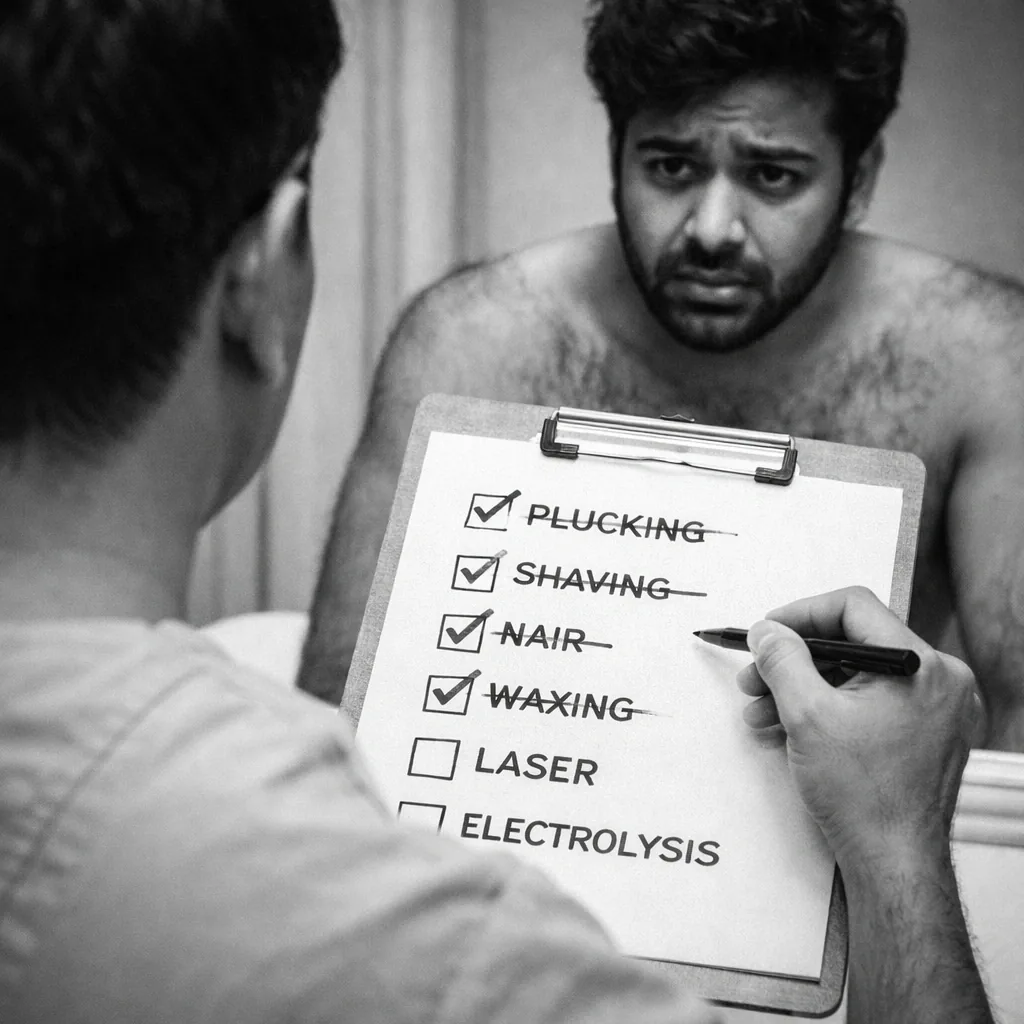
When Switching Methods Is the Answer
Resistance is a signal to reassess, not repeat endlessly.
Common transitions:
- Laser → Electrolysis for facial or hormonal hair
- Laser → Electrolysis for lightened or residual hairs
- Waxing or shaving → Laser or electrolysis for chronic ingrowns
Staying with the wrong method wastes time and money.
Psychological Fatigue Is Real
Treatment resistance creates frustration, self blame, and distrust.
Clients often assume:
- Their body is “broken”
- Hair removal does not work on them
- They need stronger treatments
In reality, they need better alignment between biology and method.
Final Thoughts
Hair removal is not linear. Plateaus happen when biology changes or limitations appear.
Laser reduces.
Electrolysis eliminates.
Hormones complicate.
Timing controls outcomes.
Understanding resistance early prevents years of stalled progress and unnecessary treatments.
Progress resumes when the method matches the hair.
If you want the why behind this. what actually happens during electrolysis, seasonal hair removal, laser on grey, white, red and platinum hair, how the electrolysis methods differ, how hair biology determines your results and paradoxical hypertrichosis, when laser makes hair grow.