
Most People Have Them, and Almost Nobody Asks About Them
If you have a few small soft growths in your groin, your armpits or around your neck, you are in the majority. StatPearls puts the figure at 50 to 60 per cent of adults developing at least one in their lifetime, rising to roughly two thirds by the fifth or sixth decade, affecting men and women about equally.
They come up constantly in my room at MAIR Care in the Beaches, and almost never in conversation. Clients notice them, decide they are embarrassing, and say nothing. Then I find them, work around them, and the client is surprised that it was never a problem.
It is worth understanding what they are, since they genuinely change how a treatment is performed, and since one particular pattern of them is worth mentioning to your doctor.
What a Skin Tag Actually Is
The clinical name is an acrochordon. Some papers call it a fibroepithelial polyp or a soft fibroma.
Structurally it is a small outpouching of skin on a narrow stalk. Under the microscope it is loosely organised collagen in the papillary dermis, dilated capillaries and lymphatic vessels, covered by ordinary epidermis, usually with no hair follicles or glands inside it. Most run 1 to 5 mm, occasionally up to a centimetre or two.
Two things follow from that description, and both matter to hair removal.
It has a blood supply. Those dilated capillaries are why a torn tag bleeds far more than its size suggests.
It has a stalk. A narrow neck holding a wider body is precisely the geometry that gets caught, gripped and pulled.
Why They Form Where They Form
They form where skin rubs skin. That is why the standard addresses are:
- the neck and under the jaw
- the armpits
- under the breasts and along the bra line
- the groin and the inner thigh
- the buttocks and the gluteal cleft
Every one of those is a fold that closes on itself, holds warmth and moisture, and moves against itself thousands of times a day. Friction, occlusion and time.
For the clients I see most, this lands squarely on the areas being treated. The groin crease, the scrotum and the perineum are high-friction zones on any man who walks, sits and wears clothes, which is all of them.
The Part Worth Telling Your Doctor
Here is the piece that no waxing site anywhere will tell you, and the reason I wanted this to be its own post rather than a paragraph buried in another one.
A significant crop of skin tags is a recognised cutaneous marker of impaired carbohydrate metabolism. It is the strongest and most consistently replicated association in the literature on them.
Rasi, Soltani-Arabshahi and Shahbazi, writing in the International Journal of Dermatology in 2007, ran a case-control study of 104 patients with at least three skin tags against 94 controls with none, and gave every participant a standard two-hour oral glucose tolerance test. Diabetes was found in 23.07 per cent of the skin tag group against 8.51 per cent of controls (p = 0.005). Among patients with more than thirty tags, 52 per cent had diabetes.
The detail that makes that study matter is in its design. The controls were matched for age, sex and body mass index. The authors found no correlation at all between the number of tags and BMI. This is not simply a finding that heavier people get more skin tags.
Tamega and colleagues, in Anais Brasileiros de Dermatologia in 2010, went at the same question from the insulin side. In 98 cases against 103 controls, multiple skin tags were directly associated with HOMA-IR, the standard index of insulin resistance. 31.1 per cent of the skin tag group had a raised HOMA-IR against 2.8 per cent of controls, and for a HOMA-IR above 3.8 the odds ratio reached 7.5. That association held after adjusting for diabetes, age, sex, skin phototype, family history of diabetes and waist-to-hip ratio.
More recently, Joseph Chandran and Nair, in Cureus in 2025, studied 150 patients with acrochordons against age- and sex-matched comparisons in South India and found a significant relationship with diabetes (p = 0.0073) at an odds ratio of 1.89, along with an association between how long someone had had the tags and how long they had had diabetes.
What this does and does not mean, stated carefully. These are association studies, not proof that one causes the other. Plenty of people with a few skin tags have entirely normal glucose handling, and a couple of tags on your neck at fifty is unremarkable. What the literature supports is narrower and more useful than the internet version: if a lot of them have appeared over a relatively short period, that is worth a sentence to your GP and a fasting glucose or an A1C.
That is a more valuable thing to take away from an appointment than the wax.
MY TWO CENTS
I am not diagnosing anybody. I am an electrologist, not a physician, and a skin tag is not a blood test.
What I am is someone who looks closely at the skin of several hundred people a year, under good light, on parts of the body most people never examine properly themselves. I notice patterns. When a client who had two tags eighteen months ago now has fifteen, I say so, once, without drama, and suggest they mention it at their next physical.
Several clients have come back and told me the bloodwork found something. That is the entire reason this section exists.
What It Means for Waxing
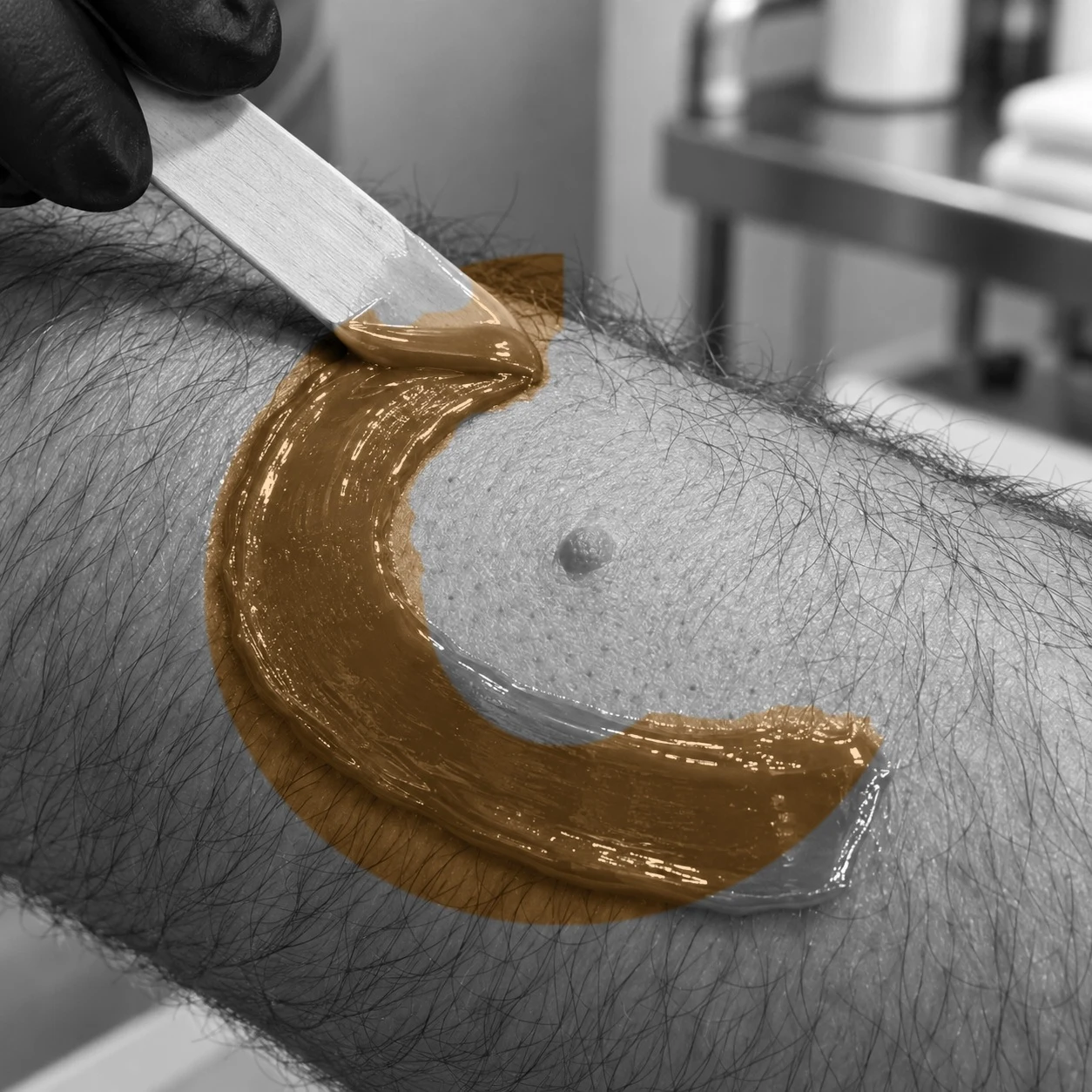
Tags can be waxed around. They should not be waxed over.
Hard wax is the specific hazard, which surprises people who have read that hard wax is the gentle one. It is gentler on skin, and that is exactly the problem here. Hard wax works by shrink-wrapping. It flows around anything three-dimensional, sets, and grips what it has surrounded. A soft protrusion on a narrow stalk is the ideal shape for it to take hold of.
Removed in that state, one of three things happens. The tag is pulled and stretched painfully. The tag is torn part-way and bleeds. Or the tag comes off entirely, which sounds like a bonus and is not, for reasons in the assessment section below.
Cream wax and strips carry the same risk in a different form, with the added problem that a strip covers a wider area, so the technician has less of a sense of what is underneath it.
How I actually handle it. I find them first, during the visual check before anything warm goes near you. Small ones get the wax kept off them, which is a matter of application angle and spreading direction rather than anything elaborate. Larger or more pedunculated ones get physically shielded. The area around them gets worked in smaller sections than I would otherwise use, since precision matters more than speed there.
That costs a couple of minutes. It has never cost a treatment.
If you have had one torn at another salon, you already know the failure mode: more blood than seems reasonable for something that size, and a technician who looks alarmed. It is not dangerous. It should also not have happened.
What It Means for Laser
Laser is mechanically easier here. Nothing touches the tag and nothing pulls on it, so the tearing problem disappears entirely.
The consideration shifts from mechanical to thermal. A pigmented skin tag is a pigmented target, and the laser cannot tell the difference between melanin in a hair and melanin in anything else. Firing over a darker tag concentrates energy into it and risks a burn, a blister or a lasting pigment change in that spot.
So pigmented tags get shielded, the same way any other pigmented lesion in a treatment field does. Pale ones matching your surrounding skin are generally not an issue.
This is also one more reason why settings in the groin, the perianal area and the underarms have to be set for that area rather than carried over from somewhere else on the same body. Those zones run darker on most people to begin with, and they are also where the tags are.
What It Means for Electrolysis
Electrolysis sits between the two. There is no wax to grip anything, and no light to be absorbed by pigment. There is a probe going into follicles at close quarters.
Tags in a treatment field are worked around. A tag sitting directly on top of a follicle I need to reach makes that follicle awkward to enter at the correct angle, which is an accuracy problem rather than a safety one. In practice it slows that patch down.
This is the main reason the timing advice below exists. On a long clearance plan, particularly pre-surgical work where the standard has to be genuinely complete, a scattering of tags in the field is a recurring obstacle across every single session rather than a one-off.
The Assessment That Comes First, and Why It Is Not Optional
Here is the part I will not skip.
Not everything that looks like a skin tag is one.
The published differential for an acrochordon includes ordinary things such as warts, seborrhoeic keratoses and melanocytic naevi. It also includes nodular melanoma, which can present as an exophytic growth, and which can be amelanotic, meaning it carries little or no pigment and therefore looks nothing like the dark asymmetric lesion everybody has been taught to watch for. In children, basal cell carcinomas presenting as apparent skin tags are a recognised sign of basal cell naevus syndrome. Perianal tags are a documented presenting feature of Crohn's disease, sometimes the first one anybody notices.
Now consider what removing one does. It destroys the thing a doctor would have wanted to look at. There is no getting it back and no second opinion available on tissue that has been cauterised or torn off.
That is why every treatment here starts with a full visual and dermoscopic assessment of what is actually in the field. It is what the dermoscopy training was for. Anything that looks wrong to me gets left completely alone and gets a referral, not a treatment. I have made that call more than once, and I would rather make it ten times unnecessarily than miss once.
A client occasionally finds that frustrating, since they came for hair removal and are leaving with a suggestion to see their doctor. It is the correct order of operations.
If You Would Rather Have Them Gone
The medical literature describes several established approaches, all of them performed in a medical setting: snip excision with scissors, radiocautery, electrocautery, cryotherapy with liquid nitrogen, carbon dioxide laser, and ligation techniques that cut off the blood supply. Local anaesthetic is usual, and most wounds heal without anything further.
The timing point is the one I care about, and it is genuinely useful. If they are coming off, it is far better done before a course of hair removal than during one. A healed flat field is quicker to wax, simpler to laser and more accurate to treat with electrolysis. Interrupting a clearance plan halfway through to deal with them means healing time in the middle of a schedule that is already long.
If that is something you want to pursue, it is a conversation to have at consultation rather than a decision to make on the table.
What you should not do is take them off yourself. The home kits, the ligation bands sold online and the string method all share the same two problems. You are working on tissue with a real blood supply in a warm, moist, bacteria-rich area, which is an infection risk that people routinely underestimate. More importantly, you are destroying a lesion nobody qualified has looked at. If it was not a skin tag, you have thrown away the evidence.
One Myth Worth Retiring
You may run into the claim that skin tags predict colon polyps, and therefore that having them means you should get a colonoscopy. It circulated widely in the 1980s and it still surfaces online.
Piette and colleagues settled it in Gastroenterology in 1988. In a prospective study of 100 asymptomatic patients they found no association at all between skin tags and colonic polyps. Their accompanying meta-analysis of the existing literature found a significant association among 777 symptomatic patients and none among 268 asymptomatic ones. Their conclusion was that skin tags flag colonic polyps only in patients who already had a clinical reason for a colonoscopy, so finding them in an asymptomatic person carries no diagnostic value.
The glucose association survived scrutiny. This one did not. Follow bowel screening guidance for your age and risk, and ignore what is on your neck.
Bottom Line
Skin tags are common, harmless in themselves, and a normal part of the field I work in. They are not a reason to avoid booking, and they are not something to be embarrassed about.
For waxing they are protected and worked around, never waxed over. For laser they are shielded if pigmented. For electrolysis they are an accuracy obstacle worth clearing first on a long plan.
Everything gets assessed visually and dermoscopically before anything is done, because the small risk that a lesion is not what it appears to be is not a risk worth taking with something that cannot be undone.
Two things to take away. Do not remove them yourself. If a lot of them have appeared recently, mention it to your GP, since the evidence connecting a crop of new skin tags to insulin resistance is real, repeated and worth acting on.
Related, if this is your area. what I look at before I treat anything, the full method comparison on time, cost and results, laser hair removal on dark skin, the Fitzpatrick scale, what your first Brozilian is actually like and that bump might not be an ingrown hair.