The Phone Call You Rehearsed
Most men who book this have already had the conversation twice. Once with their partner, and once in their head on the way to the phone.
The second one goes badly. There is no dignified way to say the sentence, you can hear yourself saying it wrong, and somewhere in the middle you decide to just say "a Brazilian, I guess" and hope the person on the other end works it out.
They do. I promise you they do. I have done a few thousand of these across my career, running at four to five a week on closed appointments, and I have never once needed the sentence to come out cleanly.
So here is everything, in the order you would actually ask it if you were not worried about how it sounded.
Nobody Told You This Is Normal
Before anything else, three numbers that ought to make the whole thing feel smaller.
Gaither and colleagues surveyed 4,198 American men in the American Journal of Men's Health in 2017. Half of them groom regularly. Of those who do, 87 per cent groom above the penis, 66 per cent the scrotum, 57 per cent the shaft, and among men aged 25 to 34, 24 per cent groom around the anus.
So the thing you are nervous about is not unusual. Two thirds of groomers already do their own scrotum. You are not nervous about the area being groomed. You are nervous about somebody else doing it, which is an entirely different and much more solvable fear.
Here is the number that should actually relax you. Walsh-Buhi and colleagues, in the same journal in 2024, found that of the men who remove pubic hair, 99.4 per cent do it with a razor or trimmer, and 4.2 per cent have ever been waxed professionally.
Read that again. Your anxiety is that everybody else understands how this works and you do not. The truth is the opposite. Ninety-six per cent of the men in that survey have never done this either. The only person in the room who has done it hundreds of times is me.
MY TWO CENTS
The most common thing men say on the way out is some version of "that was worse than I wanted and better than I feared."
I have never improved on that sentence and I have stopped trying. The anticipation is the hard part. The appointment is twenty-five minutes of mild swearing and a conversation about your holiday.
The Erection Question
This is the one you actually came here for, and I am going to answer it properly because the half-answers make it worse.
It happens. It is not an event. Nothing about it means what you are afraid it means.
The wiring
There are two entirely separate pathways to an erection, and one of them does not involve your brain at all.
The reflexogenic pathway runs as a spinal reflex arc. Touch to the genitals sends signals up the pudendal nerve to the sacral erection centre at S2 to S4, and the response comes straight back out through the parasympathetic nerves. Your brain is not consulted. It is a local circuit, like a knee jerk, and it is doing exactly what it evolved to do when that area is handled.
The psychogenic pathway is the one people think is the only one. Something arrives through your eyes or your imagination, gets processed in the brain, and descends to the same sacral centre.
Those are different roads to the same place, and the first one does not pass through anywhere that has an opinion.
Four separate proofs that it is not about arousal
Spinal cord injury. In men with complete lesions above the sacral segments the brain is physically disconnected from the genitals, and reflexogenic erection is preserved anyway, because the arc below the lesion is intact and still working. That is as clean as proof gets.
General anaesthesia. Intraoperative erection is a recognised nuisance in transurethral urological surgery. Unconscious patient, nothing psychogenic available, erection anyway. There is a 2024 randomised trial on how best to manage it, which tells you how routine it is.
Sleep. Healthy men have erections in clusters during REM sleep regardless of what they are dreaming about, so reliably that it is used diagnostically.
The mouse study. In the Nature paper above, firing Krause corpuscles optogenetically produced erections in five out of five animals. Nobody asked the mouse how it felt about the researcher. The receptor fired and the reflex ran.
So am I gay, or bi, or something
No. You are innervated.
The reflex does not know who is in the room, what they look like, or what you think about any of it. It knows that something is touching an area wired to respond to being touched. Men get erections from massage therapists, from urologists, from prostate examinations, from tight jeans on a bus, and from a physiotherapist working a hip flexor. None of it is a statement.
Straight men come to me and it happens. Gay men come to me and it does not. It is not a poll.
"I get nervous, surely that stops it"
Here is where I am going to give you the honest answer rather than the reassuring one, because the reassuring one falls apart the moment it matters.
The popular explanation is that nerves flood you with adrenaline and adrenaline is anti-erectile, so being anxious protects you. That is only half right.
Brien and colleagues, in the International Journal of Impotence Research in 2002, showed in an animal model that adrenergic stimulation sharply suppresses erection. So far so good.
Kane and colleagues reviewed the human experimental literature in the Journal of Experimental Psychopathology in 2019 and found something messier. Across non-clinical men, an equal number of studies found that anxiety increased, decreased, or had no effect on genital arousal. Timing mattered. Anxiety at the same moment tended to suppress. Anxiety beforehand sometimes increased the response.
The honest synthesis is that nerves are not a reliable off switch. Autonomic arousal is autonomic arousal and the body is poor at labelling which kind it is having. A man lying on a table with his heart rate up is in a state that can go either way.
Which is precisely why both of the things people say about this are wrong. "I was nervous, so it cannot have meant anything" is wrong. "It happened, so it must have meant something" is also wrong. Your body is not voting.
The part nobody tells you: it is sometimes helpful
I am going to say the least expected thing on this page.
An erection holds the skin tight, which is exactly what waxing needs.
Tight skin is the entire game. It is why the frog position exists, why I ask you to help hold, and why the back is done in child's pose. Slack skin means the pull drags the skin instead of releasing the hair, which hurts more and needs a second pass. On the shaft in particular, an erection does the stretching for me, and the wax comes off cleanly in one movement rather than two.
So the situation you have been dreading is, on the specific day, occasionally the easier version. I am not going to pretend that makes it less awkward the first time it happens. It does mean nobody in the room is unhappy about it, and it is worth knowing that the thing you were braced to apologise for is sometimes doing me a favour.
What should I actually do
Nothing.
Do not apologise. Do not explain. Do not offer to leave. Do not say anything at all unless you want to, and if you do want to, a short joke is the traditional choice and it is fine.
I have been doing this for twelve years. It registers with me at roughly the level of a client sneezing.
If you want the professional framing, here it is, and it is more interesting than you would expect. The College of Massage Therapists of Ontario publishes a standard on professional boundaries and preventing sexual abuse. I read the whole thing. It does not mention erections anywhere. Not once.
What it says instead, twice and unambiguously, is that given the power differential it is always the practitioner's responsibility to ensure abuse does not occur. The regulated framework is aimed entirely at the practitioner's conduct. The client's involuntary body is not the subject of the rule, because it was never a thing anyone thought needed regulating.
The clearest written line I found anywhere on this comes from a British waxing practice with an actual published policy, and it draws the distinction exactly where it belongs. An erection arising from nerves, temperature or involuntary physical response is acceptable. Deliberately attempting to become aroused is not, and ends the appointment.
That is the whole of it. One of those is your nervous system. The other is a decision. Nobody has ever had trouble telling them apart, least of all me.
What about precum, or more than that
Precum is under the same autonomic control and is equally involuntary. There is no clinical literature on it in a non-sexual context, so I am not going to pretend there is. It happens occasionally, there is a towel, and it is handled the way any other fluid in a treatment room is handled.
Ejaculation is genuinely rare and I am not going to build a section around it. If it happened, we would pause, you would have a moment, and we would carry on. Nobody is being asked to leave.
MY TWO CENTS
This is the section I most wanted to get right, and it is the one the rest of the industry handles worst, usually by not mentioning it at all and hoping the client does not either.
The reassurance a nervous man needs is not "it probably will not happen." That is a promise nobody can make and it leaves him worse off if it does. What he needs is "it is not an event." The difference between those two sentences is the difference between a man who is fine and a man who spends twenty-five minutes doing mental arithmetic.
The version of this job where the client and I both pretend to be robots is not safer. It is just colder and more awkward. People manage a difficult twenty-five minutes by talking, and meeting them there is most of the skill.
Does It Hurt
Yes. Less than you have decided, and not where you think.
There is no published ranking of pain by area down there. I looked for one properly. It does not exist, and any site presenting a neat table as though it were research is inventing it.
What follows is mine and the trade's, consistently reported across independent practitioners, and you should read it as experience rather than data. There is a shorter version of this ranking on the Brozilian page; this is the one with the reasoning attached.
Hardest, in my hands:
The pubic mound. Highest hair density, thickest roots, and a fixed pad of tissue underneath that gives you nothing. Maximum follicles per pull with no give in the skin.
The base of the shaft. Thin skin over bone, coarse roots, and hair growing in three different directions at once, which means passes from more than one angle.
Middle of the pack:
The crack and the inner cheeks. Tight skin, stubborn follicles, and the surprise factor, which is real.
The perineum. Thin skin, densely supplied with nerves.
Easiest, and this is the one that shocks people:
The scrotum. Consistently reported as the least painful part of the whole service.
Why the scrotum is not the worst
The intuition that the most sensitive area must be the most painful confuses two entirely different sensory systems.
A study in Nature in 2024 by Qi and colleagues identified Krause corpuscles as the specialised receptors concentrated in genital skin. They are low-threshold mechanoreceptors, exquisitely tuned to light vibration. Being brilliant at detecting a feather is a completely separate channel from reporting a hair being pulled out of the dermis.
The mechanical half is simpler. Scrotal skin is thin, loose and mobile with relatively fine hair, and it moves with the pull rather than resisting it. Less force reaches each follicle. The pubic mound does the opposite, which is why it hurts more.
That part is my reasoning from the anatomy rather than a published finding, and I would rather label it than let it sound like a study.
Can you take breaks
Of course. Say the word and we stop.
Has anybody ever quit partway through? No. Not once, in thousands of appointments. We take the extra time, we go back in, and it gets finished. The break is usually thirty seconds and a joke.
What Actually Helps With the Pain
This gets asked constantly and almost every answer online is wrong. Here is what the evidence actually says.
Ibuprofen: yes, and it is the best of the options. Moore and colleagues, writing for Cochrane in 2011, put the number needed to treat at 2.5 for ibuprofen 400 mg against 3.6 for paracetamol 1000 mg, meaning ibuprofen gets meaningfully more people to good relief. That fits the mechanism, since waxing produces immediate local inflammation and ibuprofen acts on exactly that. The AAD suggests taking it about thirty minutes beforehand.
The bruising worry about ibuprofen is overstated. Kelley and colleagues, in Plastic and Reconstructive Surgery in 2016, pooled four randomised trials and found bleeding complications in 3.5 per cent of patients given ibuprofen against 4.1 per cent given something else. Ibuprofen's effect on platelets is short-lived and reversible. Aspirin is genuinely different, since its effect lasts the life of the platelet, so that one is worth mentioning to me.
Paracetamol or Tylenol: second choice. It is the right answer if you cannot take an anti-inflammatory, and a weaker one if you can.
Coffee: the industry is wrong about this and I am going to say so. Every salon site tells you caffeine increases sensitivity or tightens your pores. I went looking for the source of that claim and there is no study behind it at all, and pores do not have muscles.
The real literature points the other way. Derry and colleagues, writing for Cochrane in 2014 across 7,238 participants, found that adding 100 mg or more of caffeine to a standard painkiller produced "a small but important increase" in the number of people getting good pain relief. Overstreet and colleagues, in Psychopharmacology in 2018, found that people with higher habitual caffeine intake had a higher pressure pain threshold, not a lower one.
A coffee with your ibuprofen is more likely to help than hurt. The only real reasons to skip it are that it can amplify jitteriness if you are already anxious, and that it is a diuretic, which is unhelpful during a forty-minute appointment you cannot pause conveniently.
Alcohol: skip it, and not for the reason you have been told. Thompson and colleagues, in the Journal of Pain in 2017, pooled eighteen experimental studies and found a blood alcohol level around 0.08 per cent cut pain ratings by roughly a quarter. So alcohol does blunt pain, and anybody telling you it makes waxing hurt more is wrong.
The reason I will not treat someone who has been drinking has nothing to do with pain. This is an intimate service. Someone who has been drinking cannot give unimpaired consent, is more likely to be disinhibited, and is harder to give aftercare instructions to that will actually be followed. That is the whole reason and it does not need dressing up as science.
Cannabis: same answer, same reason. The evidence is genuinely mixed. Wallace and colleagues, in Anesthesiology in 2007, found a therapeutic window where low doses did nothing, moderate doses reduced pain, and high doses increased it. The Anesthesia Patient Safety Foundation's 2025 guidance on elective procedures is blunt: postpone until the patient is clinically sober. Disinhibition matters more in this room than in most.
Two free things that do work.
Distraction, during rather than before. Kodvavi and colleagues, in Langenbeck's Archives of Surgery in 2023, pooled ten trials and found distraction significantly reduced pain during a procedure while doing nothing for the anxiety beforehand. Which is why there is a television in the room and why you get to pick.
Book the afternoon. Daguet and colleagues, writing in Brain in 2022, ran a 34-hour constant-routine study in twelve men and found pain sensitivity peaks in the small hours and is lowest in the afternoon, with about eighty per cent of that swing driven by the body clock itself. It is a small effect and it is free, and unlike most of the pre-appointment folklore it has a proper study behind it.
The Position, and Why It Is Not What You Are Dreading
Men brace for the wrong part of this.
Men brace for the leg-in-the-air version they have seen somewhere, and that is not what happens here.
I will not ask you to hold a leg up. Some clinics do. It is awkward, it is uncomfortable, it gains nothing clinically, and it is a balance exercise nobody signed up for, with every wobble transmitting straight into the pull. There are two better positions and I use both.
For the front, the frog position. On your back, knees bent and dropped out to the sides, heels together and drawn up toward you. It looks like nothing and it does the single most important thing in waxing, which is hold the skin taut. Tight skin releases the hair. Slack skin means the pull drags the skin instead, which hurts more and works less well.
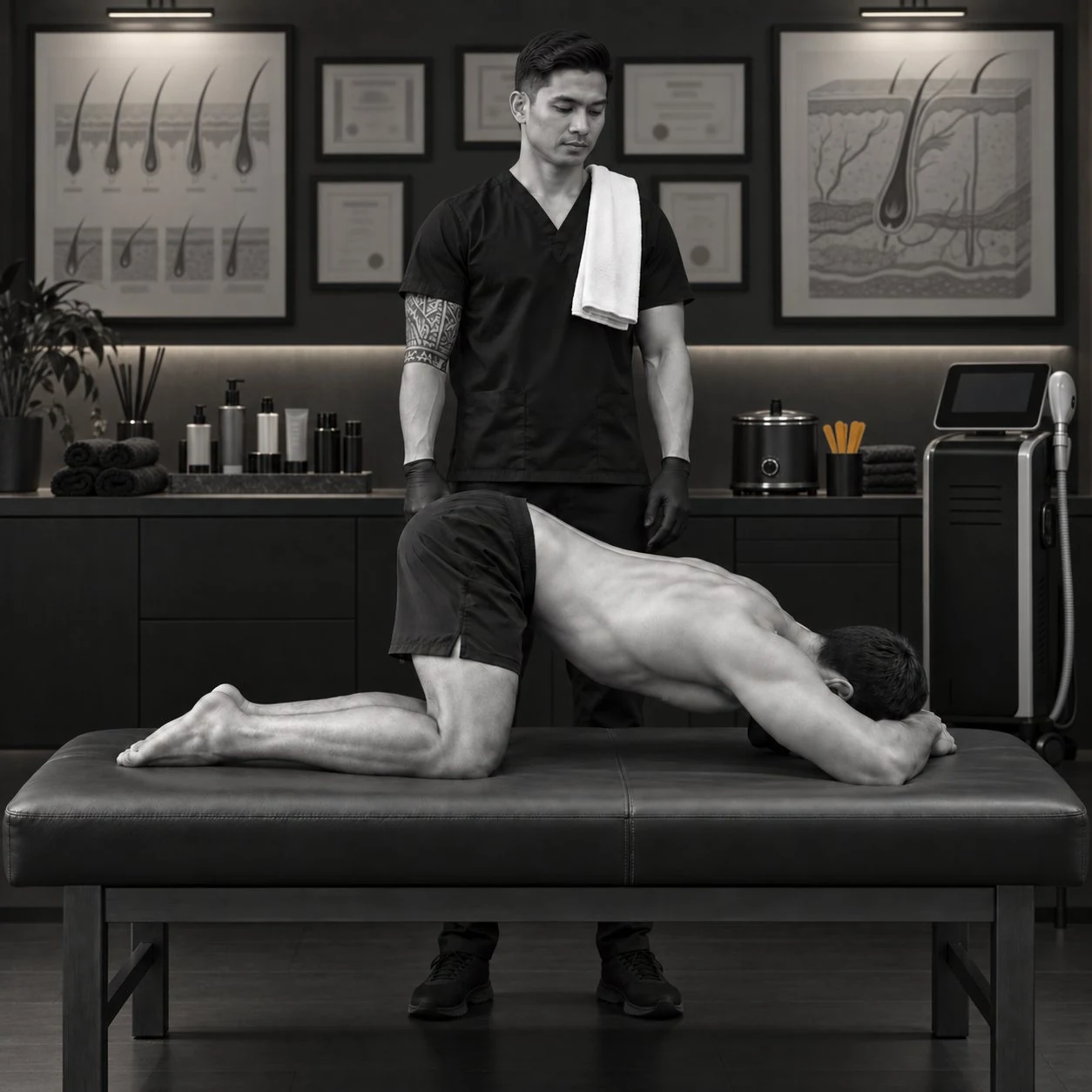
For the back, child's pose. Kneeling, chest and shoulders lowered toward the table, hips staying up. If you do yoga you will notice that keeping the hips high is technically Extended Puppy Pose, Uttana Shishosana, rather than true child's pose, and that high hip position is exactly why I use it.
What that gets us:
Tension without a second pair of hands. The pose does the stretching that would otherwise need somebody holding you.
Speed. The wax goes on and comes off faster, which means fewer seconds of it.
Stability. Nothing is being balanced, so nothing wobbles.
It is over first. The back of a Brozilian is genuinely the shortest part of the appointment.
This is a two-person job, and I will ask for your hands
Worth knowing in advance so it does not surprise you.
I will ask you to help hold and stretch the skin. Your own hands, on your own skin, in a couple of places where a third hand would make the difference between a clean pull and a repeat pass.
Most men find this genuinely helps with the experience rather than the opposite. Holding the skin yourself means you feel the tension before the pull, you know it is coming, and you have something to do with your hands other than grip the table. It also makes the whole thing faster.
Nobody is being asked to do anything strange. It is the same thing you would do if you were holding a plaster flat while someone taped over it.
"What Do Most Guys Get?" Is the Wrong First Question
It is what everybody asks, so here is the honest answer and then a better question.
If you are still working out what the word covers, a Brozilian is the whole intimate region front to back, a European is the groin only, and a bikini is the front sides. That distinction has its own page at what a Brozilian actually includes, which is the one to read if your question is about terminology rather than nerves. This page assumes you already know roughly what you are booking and are worried about everything else.
Fully bare is a minority position. In the 2024 survey, only 35.8 per cent of men who remove hair take it all off. The single most popular style is trimmed, at 43.9 per cent.
The "everyone is getting a Hollywood" premise is simply false, and it is worth knowing before you decide you have to.
What people actually book with me varies more than any list can capture. Everything gone. Shaft, scrotum and perineum only. Full buttocks, or just the crack. The groin left deliberately bushy with everything below it clear, which looks far better than it sounds. Shapes. Some men arrive with a chest and a back to match and some have almost nothing anywhere.
The better question is what you should do the first time, and my standing recommendation is to take everything off once and then dial it back.
You cannot know what you prefer until you have felt it, and neither can your partner. It is also cheaper and less painful to clear everything on day one and grow back what you miss than to do a partial, change your mind, and come back in three weeks to wax an area that has fallen out of sync with the rest.
You are also allowed to change your mind on the table. Plenty of men start with a plan and revise it halfway through, usually upward. There is no lecture and no extra charge for a bit of tidying at the edges.
Why men actually keep coming back
The stated reason for a first appointment is usually a partner, or hygiene, or a holiday. The reason men rebook is almost always something else, and it is worth saying out loud because nobody puts it on a price list.
Removing hair anywhere on the body leaves the skin more sensitive to touch, and in this area that is not a side effect. It is most of the point. Skin that is normally shielded by coarse hair is suddenly reporting everything, and the research on why is genuinely interesting: the specialised receptors concentrated in genital skin, identified by Qi and colleagues in Nature in 2024, are low-threshold mechanoreceptors tuned to light touch and vibration. Take away what is covering them and they have a much better view of the world.
If a partner is also hair-free, the effect compounds, since skin-on-skin is a completely different sensation from skin-on-stubble in both directions. A great many men who book this for a partner discover the benefit was mutual and stop framing it as a favour.
That is the honest answer to why this service exists at the volume it does, and why the six-week rebooking rate is what it is.
What I actually hear, and I hear it consistently. Men come back at six weeks and tell me their partner noticed the detail. Not the fact of it, the detail. The edges, the back, the parts that a razor never reaches properly and that most people assume nobody bothers with. I have had that conversation more times than I can count and I have never once had somebody come back to tell me they regretted it.
Shapes
Yes, I do them. Landing strips, triangles, arrows, letters, initials, and several things I will not describe in writing.
I have an artistic streak that does not get much exercise in this job, and this is where it goes. Bring a picture or describe it and I will tell you honestly whether it will read on your particular hair density, because a design needs coverage to hold its edges and some men do not have the material.
Wax, Laser or Electrolysis
The three do different jobs and the differences matter more here than anywhere else on the body.
Waxing takes the hair out at the root. Fastest route from hairy to smooth, works on any colour, lasts three to five weeks. It is not permanent and never will be, whatever anybody tells you about it thinning the hair over time.
Laser destroys the follicle by heating the pigment inside the shaft. Permanent reduction, which is the honest word. It needs pigment, which brings the catch below.
Electrolysis destroys the follicle with a probe, one at a time. The only genuinely permanent method, works on any colour and any skin tone, and slow.
The thing nobody in this industry volunteers
Laser does not work on grey, white, blonde or red hair. Not poorly. At all. There is no pigment for the light to find.
The UCSF transgender care guidelines state it plainly, and so does the peer-reviewed protocol paper on genital laser hair removal. Both say the same thing: for light or grey hair, electrolysis instead.
If you are in your forties or fifties and your pubic hair has started to go, a laser package will clear the dark hairs beautifully and leave the grey ones standing there like the last four people at a party. You will be back, and you will be annoyed.
Which leads to the most useful piece of advice in this entire post, and it applies to every part of your body.
If you are ever going to do laser, do it while you are young. Laser needs pigment, and pigment is the one thing you are guaranteed to lose. Every year you wait, a few more follicles go over to grey or white and become permanently invisible to the machine.
A man of twenty-eight has a full complement of dark hair and gets the best results laser is capable of. The same man at fifty-five has a partially grey field, gets a partial clearance, and finds that finishing the job now means electrolysis and considerably more chair time. The window closes on its own schedule and it does not reopen.
Nobody in this industry tells young men this, because a twenty-eight year old is not currently unhappy about his hair. It is still the truth.
I would rather tell you that before you buy the package. The right answer for most men in that position is laser for the bulk and electrolysis to finish, and there is a whole post on grey, white, red and platinum hair if that is you.
Can you laser and do electrolysis on the scrotum
Yes to both, and this is not fringe.
Zhang and colleagues published the clinical protocol for genital laser hair removal in Translational Andrology and Urology in 2016, describing treatment of the penile shaft and the entire scrotum as standard preparation before vaginoplasty, with anaesthesia, settings and follow-up. It is done in hospitals.
Electrolysis on the scrotum works particularly well, and the reason is counterintuitive. Scrotal hair tends to be coarse, which makes the follicle easy to find and easy to treat properly. Fine hair is the harder target, not the thick stuff.
The timing trap that costs men a month
If you are thinking about laser later, do not wax now.
Laser needs the hair root present to destroy it. Waxing takes the root out, so a lasered follicle with nothing in it is a wasted pulse. Zhang's protocol says no waxing or plucking for at least four weeks before laser. Shave instead.
Men move from waxing to laser constantly and almost nobody tells them this, so they wax on the Tuesday, laser on the Thursday, and buy a session that could not possibly have worked.
How Long Before It Grows Back
Roughly, and individuals vary enormously.
- Shaving: stubble the next day. Genuinely the next day. It is cut, not removed.
- Trimming: no bare phase at all, so it depends entirely on how short you went.
- Depilatory cream: two to four days, since it dissolves the shaft slightly below the surface.
- Waxing: three to five weeks to the point where you want it done again. The hair comes back finer at first because you are seeing new growth rather than a cut end.
- Laser: shedding over one to three weeks after each session, then a genuinely clear window that lengthens with each round. Sessions six weeks apart.
- Electrolysis: treated follicles are gone. What returns is the follicles that were dormant on the day, which is why it takes a course rather than a session.
Hard Wax, Not Strip Wax
For anything intimate, I use hard wax, and the reason is mechanical rather than a preference.
Hard wax contains polymers that shrink-wrap around each hair shaft as they cool. It grips the hair rather than the skin, it sets into its own removal strip, and it can be applied to the same area twice if a section needs another pass.
Soft wax bonds to the hair and to the top layer of skin cells, which is why it exfoliates. Exfoliation is a feature on a shin and a liability on a scrotum.
There is a real study underneath this, though it is not about hard versus soft. Pany and colleagues, in Skin Pharmacology and Physiology in 2018, measured what hair removal does to the skin barrier and found decreased stratum corneum thickness after waxing along with increased permeability. Waxing genuinely thins the outer layer.
That single finding is the reason for every aftercare rule further down, and it is the argument for using the wax that grips less skin in the place where you can least afford to lose any. There is more on the difference in hard wax versus cream wax.
Before You Come In
Do not trim
Never. This is the instruction clients break most often and it costs them the appointment.
Hard wax works by wrapping around the hair shaft. Too short and there is not enough shaft to grip, so the hair snaps at the surface instead of coming out at the root. That is a failed wax, and worse, a hair cut off below the surface with a sharp tip is the exact mechanism that produces an ingrown.
The American Academy of Dermatology puts the workable window at one quarter to three quarters of an inch, which is wider than the trade usually admits. There is such a thing as too long as well.
If it is too long, I will trim it. That takes me forty seconds and I will do it to the length I actually need, which varies by region. Your mound, your shaft and your perianal hair are almost never the same length on the same man, and one pass with clippers at home flattens all three to whatever number you guessed.
Moisturise, and drink water
Heavily, in the days before. This is my instruction rather than a published one, and I am going to be straight about that: there is no study showing that well-hydrated skin waxes better. I checked, including the professional wax manufacturers, and none of them makes the claim either.
What I have is a few thousand appointments' worth of noticing that dry, tight skin lifts more easily and complains more loudly than supple skin does. Take it as experience.
The one exception, and it matters: nothing on the skin on the day. No lotion, no oil, no sunscreen. Product on the surface stops the wax gripping the hair properly. Moisturise up to the night before and arrive clean.
Exfoliate
Yes, before. Gently, one or two days ahead, not the morning of.
No, not immediately after. Waxing is already an exfoliation, and after laser the skin is sensitised. Give it a week.
For the exfoliant itself, the evidence favours chemical over mechanical. Ogunbiyi, reviewing treatment of ingrown hairs in Clinical, Cosmetic and Investigational Dermatology in 2019, found support for glycolic acid and salicylic acid, with glycolic proposed to work by reducing the curvature of the hair itself. Scrubbing with a loofah has no such support, and on barrier-thinned skin it is plausibly counterproductive.
Shower first, and be thorough about it
I am going to be direct about this because it makes the appointment better for both of us, and because nobody says it.
Shower before you come, and wash properly between the buttocks. Soap, water, and actually get in there rather than letting the water run past. This is the single most common gap I see, and I would rather say it plainly on a web page you can read in private than raise it in the room.
I have no survey to cite for that one. What I have is twelve years of doing this job, and it comes up often enough that I now mention it to everybody rather than singling anyone out.
If you are uncircumcised, retract and wash underneath. There is a real study on this one. O'Farrell and colleagues, writing in the International Journal of STD & AIDS in 2005, found that 26 per cent of uncircumcised men did not always retract the foreskin and wash the whole penis, against 4 per cent of circumcised men. Among men presenting with balanitis the figure was 42 per cent.
The 2022 European guideline on balanoposthitis lists non-retraction alongside poor hygiene as a predisposing factor, and it adds a useful caution in the other direction: over-washing and soap on inflamed skin are also risks. Daily, gentle, thorough. Not scrubbing.
None of this is a judgement. It is the same instruction a dentist gives about flossing, and about as commonly followed.
Afterwards, shower too, and then leave your skin alone. If you want to put anything on it, coconut oil and nothing else. No scented lotion, no aftershave, no "soothing" product with alcohol or fragrance in it, no exfoliant.
Numbing cream, honestly
Some numbing creams are genuinely good. The ones sold for tattoos work well, and there is nothing wrong with the product itself. My position is not that they are useless. It is that you probably do not need one here, for two reasons.
The first is depth. Topical anaesthetic numbs the epidermis and the upper dermis. Waxing pain does not come from the surface, it comes from traction on a follicle that sits deeper, and for coarse hair in this region deeper still. Published figures for how far these creams actually reach disagree with each other by a factor of two, which tells you nobody is certain. What is certain is that nobody has ever run a trial of numbing cream for body waxing. Not one. Everything you will read recommending it is written by somebody selling either the cream or the wax.
The second is time. These creams need sixty to ninety minutes under occlusion to do anything at all. A Brozilian takes twenty-five to forty minutes. You would spend longer preparing than being treated, for a benefit nobody has measured.
If you still want to use one, here are the rules that actually matter, and they exist because people have died.
The US Food and Drug Administration issued a public health advisory in 2009 after two women died using numbing creams before laser hair removal, and warned again in March 2024 about high-strength over-the-counter products. The specific things it tells you not to do are apply it heavily, apply it over a large area, and wrap the treated skin in plastic.
A male intimate wax is every one of those at once. Large area, thin skin, and the area where absorption is fastest. A 2019 case series in the International Journal of Legal Medicine describes three women poisoned before laser hair removal, one of whom used 140 grams where sixty is the maximum, presenting with cardiac toxicity, neurological toxicity and methaemoglobinaemia.
So: a modest amount, a sensible strength, a limited area, and nothing gets wrapped. Talk to me first and we will agree it. There is a full post on numbing cream.
Medications that change the answer
Two matter enormously and there is a whole medications and hair removal guide for the rest.
Isotretinoin. No waxing while on it and for six months after finishing. This is not caution. Isotretinoin changes how firmly your epidermis is attached, and there is a published case of a teenager waxed three weeks after a dose increase who was left with linear erosions where the wax had been. The skin came away with the strip. Laser is a different question and the guidelines clear it, which is covered in that post.
Topical retinoids, including any retinol night cream, off the area five to seven days before.
Blood thinners, tell me. Waxing on an anticoagulant is a bruising conversation rather than a bleeding one and it is usually fine. Electrolysis needs your prescriber's agreement in writing.
Poorly controlled diabetes or immunosuppression is a genuine contraindication that essentially no clinic lists. There is a case report in Clinical Infectious Diseases from 2007 of a young woman with badly controlled type 1 diabetes who developed a life-threatening genital infection after a routine Brazilian, involving both Streptococcus pyogenes and herpes simplex. One patient, badly immunocompromised, and exactly the right patient to warn.
An active cold sore, wart or molluscum lesion means we reschedule that area. Dragging wax across molluscum is a mechanical autoinoculation device, and there is a published case series where every one of fourteen patients with pubic molluscum had removed hair beforehand.
Never Use a Depilatory Cream Down Here
This one is short and it is not negotiable.
No Nair, no Veet, no Magic Shave, nowhere in this region, and above all not inside the buttocks.
These products work by dissolving the chemical bonds that hold keratin together. Hair is keratin. So is the outer layer of your skin. The product cannot tell the difference, and the instructions exist only to make sure you rinse it off while it is still ahead on the hair.
Coarse hair is the problem. The thicker the hair, the longer people leave the cream on trying to get it to work, and the hair inside the buttocks is about as coarse as it gets on a human being. Leave it on longer and the chemistry does not politely stop at the hair.
Alkaline burns are also the worse kind of chemical burn. An acid burn forms a crust that blocks itself from going deeper. An alkali burn does the opposite: it liquefies protein and turns the fat in your skin to soap, which removes the barrier rather than building one, so it keeps going deeper for as long as it is on you and for a while after.
I have seen the result of this. You do not want to spend two or three weeks nursing a chemical burn in that particular location, sitting down for a living, and explaining it to anybody.
If you want something at home between appointments, shave or trim. Those are the options.
Can I Shave or Trim Down There Myself
Between appointments, yes.
Bring your own clippers if you want a trim at the studio. I would rather you used your own on that area, and most men prefer it too.
I keep single-use five-blade razors for a proper close shave if that is what you want, and they are excellent. Know what you are buying, though: a shave is cut, not removed, and there will be stubble tomorrow. Not in a few days. Tomorrow.
A warning worth having. The AAD explicitly recommends leaving Brazilian waxing to professionals because of how delicate the skin is. That is a dermatology body saying do not do this one yourself, and the injury data backs it up. Whatever else you do at home, do not attempt the crack with a razor and a hand mirror.
After
The rules, and the one finding they all rest on
For 24 to 48 hours after waxing:
- No sex. Friction on freshly de-corneocyted skin with every follicle open.
- No gym, no sauna, no hot yoga. Sweat and friction.
- No swimming and absolutely no hot tub.
- No hot showers. Warm.
- Loose clothing and cotton.
- Nothing scented on the area.
For 24 to 48 hours after laser, the same list, plus heat avoidance for longer.
Every one of those follows from the Pany finding above: waxing measurably thins the stratum corneum and makes the skin more permeable. The barrier is temporarily down. That is the whole reason, and knowing it makes the rules sound like sense rather than superstition.
Honestly about the 48 hours: nobody has randomised men to sex at twelve hours versus forty-eight. The number is convention. The mechanism is real.
The hot tub one has a named organism behind it
This is the aftercare rule with actual evidence, and it is worth the detail.
Hot tub folliculitis is caused by Pseudomonas aeruginosa, which survives in warm water despite chlorination by forming biofilms. Incubation is eight hours to five days. The distribution is the part that matters: it preferentially affects the buttocks and the areas covered by swimwear, with pustules centred on hair follicles.
So: a bacterium that lives in warm water, lands on follicles, and picks the buttocks. Combining that with a service that has just opened every follicle on your buttocks is a bad idea for reasons that do not require a study.
Sun, after laser
Six weeks either side. Not three days.
Zhang's protocol paper specifies strict sun avoidance for a minimum of six weeks before and after each treatment. Clinic sites systematically understate this, and a tan between sessions is how people get burned.
Bumps, spots and reactions
Some pinkness and a few small bumps at the follicles for a day or two is normal and is your skin objecting to having been handled.
What is not normal, per the AAD: redness or swelling still there more than two days later is worth showing a doctor. Blistering, spreading warmth, weeping, or a fever is a same-day medical problem rather than a wait-and-see.
Do not pick at anything. Ogunbiyi is explicit that picking and digging worsen inflammation, and that plucking leaves hair fragments under the skin which start a foreign body reaction of their own. There is more in that bump might not be an ingrown hair and in burns, hyperpigmentation and scarring.
"Does this make me more likely to catch something?"
Asked more often than you would think, and the honest answer has two halves.
Groomers do report more infections. Osterberg and colleagues, in Sexually Transmitted Infections in 2017, surveyed 7,580 people and found an odds ratio of 1.8 overall.
Nobody has shown grooming causes them. The study is cross-sectional with no order of events, and there is a tell buried in it: grooming was associated with more pubic lice, odds ratio 1.9. Lice need pubic hair to live in, so if grooming caused infection by breaking skin, removing the habitat should have reduced lice rather than increasing them. The simplest reading is that people who groom are having more sex. Luster and colleagues, in PLOS ONE in 2019, used laboratory-confirmed infections instead of self-report and found no support for grooming as a risk factor at all.
The risk that is real and measured is mechanical injury, and it concentrates almost entirely in DIY grooming with a razor, not in professional waxing. I am not going to quote those numbers at you as though they described this appointment.
The Crack, and the Part With an Actual Medical Reason
The gluteal cleft is a genuinely different anatomical problem, not just the awkward bit. Coarse hair, a deep occlusive fold, constant friction from sitting, moisture that does not clear, and loose shed hairs from elsewhere on your body collecting in it.
That combination is the mechanism behind pilonidal disease, which is two to three times more common in men and peaks between twenty and forty.
If you have had pilonidal surgery, this is the part of the service with real evidence behind it. A 2024 systematic review of three randomised trials, published in Cureus, found laser hair epilation cut recurrence with an odds ratio of 0.319, roughly 68 per cent lower odds of it coming back. Read that narrowly: it is about recurrence after surgery, not about preventing pilonidal disease in somebody who never had it.
For ordinary ingrowns in that area, chemical exfoliation between appointments and hands off. The full version is in that bump might not be an ingrown hair, and the neighbouring problem is covered in fistulas in the buttocks.
Why Laser Settings Change Down There
One fact, and it is the most important laser fact on this page.
The laser cannot tell the difference between melanin in your hair and melanin in your skin. It only sees pigment. Genital and perianal skin is typically darker than the thigh or abdomen on the same man, and friction-related darkening in the groin and the cleft is extremely common on top of that.
So a setting that is perfectly correct on a pale abdomen can burn the same man's scrotum. Same man, different skin. That is the whole answer to "why would I get burned," and it is not bad luck.
What is done about it is a longer wavelength, a lower fluence and aggressive cooling. Nd:YAG at 1064 nm is the safest across all skin types because epidermal melanin absorbs it less. Most complications in the literature are described as preventable with the right settings.
If your skin is darker overall, laser hair removal on dark skin and the Fitzpatrick scale both apply here directly.
"Does Lasering My Balls Give Me Testicular Cancer?"
No. Four independent reasons, briefly.
It is the wrong kind of radiation. These wavelengths are non-ionising. A 1064 nm photon carries about 1.2 electronvolts and ionising a biological molecule takes on the order of 10. It is not close.
The mechanism is heat, not chemistry. Selective photothermolysis destroys the follicle by heating pigment. There is no route by which it alters DNA.
It does not reach the testes. These wavelengths penetrate a few millimetres, which is the depth of a hair bulb and the entire design intent.
It is already done deliberately. Laser clearance of the entire scrotum is standard preparation before vaginoplasty, published with protocol and follow-up in a peer-reviewed urology journal.
Where the evidence stops, honestly: no study has measured testicular temperature, sperm parameters or cancer incidence after scrotal laser. There are no case reports either, and there never will be a trial. The full version of this argument, including the 1930s X-ray salons that make the fear historically reasonable, has its own page.
Skin Tags
If you have them down there, you are in the majority. Skin tags affect 50 to 60 per cent of adults at some point, and the groin is one of their favourite addresses, because they form where skin rubs skin.
You can still be waxed, carefully. Hard wax grips anything that protrudes, so I protect them and work around them. Laser is easier, since nothing touches you. If you would rather have them gone than worked around, that is a conversation to have before a course of hair removal rather than during one.
One genuinely useful thing no waxing site will tell you. A sudden crop of new skin tags is a recognised marker of insulin resistance. If a lot of them have appeared recently, mention it to your GP. That is worth more than the wax.
One caution as well. Not everything that looks like a skin tag is one. I do a full visual and dermoscopic assessment before I touch anything, which is what the dermoscopy training was for, and anything that looks wrong gets a referral rather than a treatment.
Bring Someone, or Bring a Distraction
Yes, you can bring your partner. There is a chair in the room for exactly this and it comes up more often than you would guess, particularly for a first appointment.
If you would rather be distracted than accompanied, there is music, a TV and a film, and you are welcome to pick. A lot of men find that having something to look at that is not the ceiling does more for the pain than anything pharmaceutical would.
MY TWO CENTS
People want to be comfortable, and a lot of them get comfortable by talking. Somebody nervous and half-undressed will very often talk their way through a difficult service, and it works. Jokes about the situation, questions they already know the answer to, a running commentary on how much it hurts.
The industry instinct is to read all of that as something to shut down. My view is that the instinct does more harm than good. Warmth is most of what makes a first appointment survivable, and a practitioner who answers every attempt at conversation with clinical silence makes an awkward twenty-five minutes considerably worse.
Some men want to talk the whole way through and some want nothing said past the instructions. Reading which one is in front of you is a real skill rather than a personality trait, and neither one is a problem.
Do Not Let Somebody Practise On You
This is the part of the post I feel most strongly about, and it is the opposite of a sales pitch. I would rather you went to somebody good than to me.
Do not book this with an esthetician who is unwilling, nervous, or has not done many. Not out of loyalty to anybody, and not because they are bad people. The reason is how many ways this particular service can go sideways.
Here is the actual list.
Wax too thick or left too long on scrotal skin, which is thin, mobile and does not behave like a shin. Done wrong it lifts skin rather than hair.
Pulling against the skin instead of parallel to it, the single most common technical error and the one that bruises and lifts.
Wax at the wrong temperature, on skin warmer, thinner and more vascular than anywhere else they have practised.
Not knowing the hair-growth directions. The base of the shaft has hair going three ways. Somebody who has only done bikini lines will pass over it once, get half of it, and go over the same skin again to catch the rest. Two passes over freshly waxed genital skin is how you get a lift.
Freezing at the back. The perianal area is where an inexperienced or uncomfortable practitioner slows down, hesitates and second-guesses, which is exactly when an appointment goes from twenty-five minutes to an hour and from uncomfortable to genuinely unpleasant.
Not protecting a skin tag or a mole, which hard wax will grip and tear given the chance.
Not knowing what to do when you get an erection, which is a training and composure problem rather than a clinical one, and which turns a non-event into the most awkward forty minutes of your year for both of you.
Not asking about isotretinoin, which is the one question that prevents a genuine injury and which somebody who learned this from a video will not think to ask.
This is a separately trained competency. A British Columbia Human Rights Tribunal decision in 2019 established that in Canadian law, holding that a provider cannot be required to wax a type of genitals they are not trained for, on expert evidence that the training genuinely differs and that an untrained practitioner could cause serious injury.
So ask. How many of these do you do a week, and how long have you been doing them. A confident answer takes four seconds. A vague one has told you everything, and there is no shame in either of you deciding this is not the right booking.
If the person seems reluctant at all, go somewhere else. Somebody working on you who would rather not be is bad for you and worse for them, and the next section is about why that situation exists at all.
The Same Person, Every Time
This one matters more than anybody expects it to, and it is the thing I would want to know if I were booking.
At most places you get whoever is on the rota. Chains in particular rotate staff, and a lot of them will not let you request a specific therapist at all. So the first appointment goes reasonably well, you book again, and a stranger walks in.
Which means you start from zero. The bashfulness, the explaining, the describing what you want while lying on a table with a towel, the whole opening ninety seconds you were dreading the first time. Every visit.
Here it is me, every single time.
What that actually buys you, in order of how much it matters:
You only have to be embarrassed once. Appointment two is not appointment one again. By the third you will walk in, say hello, and get on with it.
Your style is on file in my head. Whatever you settled on, however specific, however much it took to explain the first time. You will not have to describe it again, and you will not get somebody else's interpretation of a note in a system.
I know how your skin behaved last time. Which areas needed a second pass, where you bruise, what your regrowth does at four weeks versus six, whether your perianal hair is coarser than the rest of you. That is a working file that only builds if the same person is holding the wax.
I know whether you want to talk. Some men want to chat the entire way through. Some want nothing said past the instructions. Both are completely fine, neither is a problem, and neither ever has to be said twice. After the first appointment it is simply expected and delivered without anybody mentioning it.
Requests stop being awkward. The shape you want, the bit you want left, the area you changed your mind about. Asking a stranger for something specific is a conversation. Asking somebody who did it last time is a sentence.
Rapport is not a nice extra in this particular room. It is most of what makes the appointment comfortable, and it only exists if the person is the same one.
You Get What You Pay For
I will be blunt, since everything else on this page has been.
This is not the job you do to yourself in your own bathroom. It is not a razor, a hand mirror, a hopeful angle, and three days of regrowth that itches. It is a trained pair of hands, a professional-grade hard wax, a technique that comes off the skin cleanly rather than tearing at it, and a result that is even, complete and lasts three to five weeks.
The difference shows. The edges are clean. The back is actually done rather than approximated. Nothing is missed in the places you cannot see, which are precisely the places somebody else will. A home job and a professional job are not the same service at different prices. They are two different things.
It costs what it costs for the reason every skilled trade does. Time, training, product, and somebody who has done this thousands of times rather than twice.
Why Is It So Hard to Find Someone Who Does This
A lot of men have already been turned down somewhere before they reach me, so it is worth a short answer.
It is a separately trained competency, and Canadian law says so. A British Columbia Human Rights Tribunal decision in 2019 held that a provider cannot be required to wax a type of genitals they are not trained for, on expert evidence that the training genuinely differs and that an untrained practitioner could cause serious injury.
The structural reason is specific to Ontario. A Registered Massage Therapist has a College, a Standard of Practice, and a rule that it is always the practitioner's responsibility to prevent abuse of the client. Esthetics here is not a regulated health profession at all. No college, no licensing, no complaints tribunal. So a woman offering this service has neither side of that framework: nothing protects her client from her, and nothing whatsoever protects her from her client.
That asymmetry explains the scarcity far better than any story about squeamishness, and the full version is in why some salons will not wax men.
Trans Clients
Yes, and with experience rather than willingness.
Genital and donor-site hair removal is a real clinical requirement before several gender-affirming surgeries, and it is not cosmetic. Hair-bearing skin relocated into a urethra or a neovagina causes obstruction, retention, stone and debris formation, recurring infection and poor satisfaction. It is documented properly and it is the reason surgeons require clearance.
I do pre-surgical and post-surgical clearance for both trans women and trans men, including donor sites, and I understand the timelines, which are not negotiable and involve more sessions than anybody expects. The relevant point from above applies with force here: laser will not clear light or grey hair, and electrolysis is what finishes the job. The UCSF guidelines say exactly that.
Start the conversation early rather than close to a surgical date. There is more in the posts for trans women and trans men.
What Actually Happens on the Day
Before. Moisturise in the days beforehand, nothing on the skin that morning, shower, arrive. Do not trim.
Talking first. Two minutes on what you want off, what stays, where anything is that I should know about, and what you are on. You will not have to produce a clean sentence.
Front. On your back. Hard wax, small sections, one pull at a time.
Back. The pose above, and it is the fastest part.
After. Cleaned up, soothed, dressed, and a two-minute version of the aftercare list with the reasons attached.
The whole thing. Around twenty-five to forty minutes depending on coverage and how much we are removing. Longer for a first appointment, because everything is longer when nothing is synchronised yet.
The second appointment is nothing like the first. Partly because the hair is finer and the cycles are synchronised, and mostly because you already know what the room is like.
MY TWO CENTS
Four or five men a week come through here for this and have done for years. A few thousand of them across my career, and about a third of everything this business has ever done has been intimate work.
What that buys you is not skill exactly. It is that nothing surprises me. Not the hair, not the anatomy, not the erection, not the question you have been rehearsing, not the thing you are embarrassed about that eleven people have already asked me about this month.
Most of what makes a first appointment hard is the belief that you are an unusual case. You are not. You are Tuesday.
The Short Version
Do not trim. Moisturise for days beforehand and put nothing on the skin that morning. Take everything off the first time and dial it back afterwards.
It hurts most on the mound and the base of the shaft, and least on the scrotum, which is the opposite of what you are bracing for.
If you get an erection, nothing happens. It is a spinal reflex that does not consult your brain, it is not a statement about anything, and you do not have to say a word about it.
Forty-eight hours off sex, gyms, swimming and hot tubs, because waxing genuinely thins the outer layer of your skin and every follicle is open.
Laser will not touch grey or white hair. If that is you, electrolysis is the answer and I would rather say so before you buy a package.
It does not cause cancer, it cannot reach anything that matters, and it is done on scrota in hospitals.
Ring, or book online, and say whatever comes out. It will be fine.
The Short Answer, If You Skipped To The End
The whole thing is smaller than the version in your head.
You will not have to say the sentence properly. I have heard every version of it and I have never needed a good one.
You are allowed to ask for less than everything, and most men who remove hair do exactly that. Bare is a choice rather than the default, and nobody tells you that before you are on the table.
The parts you are dreading are not the parts that are hard. The pose for the back takes ninety seconds and is over first. The scrotum is the least painful area on the list. The erection, if it happens, is a spinal reflex that never asked your opinion and does not require one from me either.
The things that genuinely matter are the unglamorous ones. Do not trim. Never use a depilatory cream in this area. Shower properly first. Tell me about isotretinoin, blood thinners and anything your immune system is doing. Stay out of the hot tub for two days. If you are thinking about laser at all, the best time to start is while your hair still has colour in it.
Come in and talk to me first if you would rather. I would sooner spend twenty minutes answering the questions than have you spend three weeks rehearsing them.
Related reading. What a Brozilian actually covers, erections in the treatment room, that bump might not be an ingrown hair, the medications and hair removal guide, numbing cream, aftercare that actually helps healing, burns, hyperpigmentation and scarring, laser on grey, white, red and platinum hair, hard wax versus cream wax and who my clients actually are.