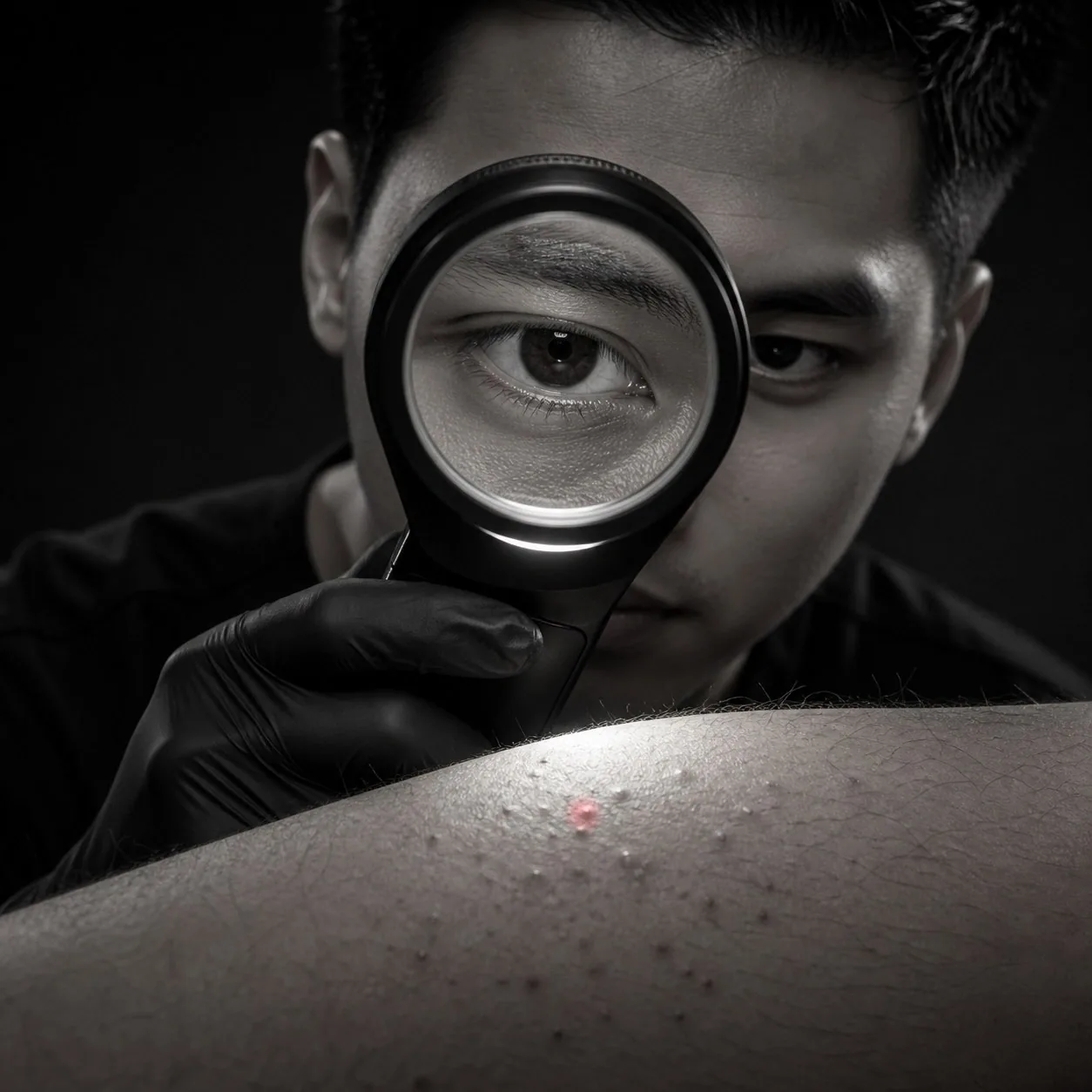
Almost Every Bump Gets Called an Ingrown Hair
Very few of them are.
The word has become a catch-all for anything raised, sore or unwelcome that turns up on skin that gets waxed, shaved or lasered. Some of it genuinely is an ingrown hair. A lot of it is something else that looks similar, behaves completely differently, and needs a completely different response.
A few of them are not my department at all.
Here is how to tell them apart.
Start By Looking For the Hair
This one test settles about half of it.
A true ingrown hair usually shows a visible loop or a dark speck of hair sitting just under the skin. You can often see it. Sometimes you can see the whole curl.
Nothing else in this article does that.
If there is no hair visible, you are probably looking at something else.
Bumps With a Hair Involved
Ingrown hair. The hair grows back, curls, and re-enters the skin instead of leaving it. Raised, swollen, sometimes a pustule, often with darkened skin around it. It burns and itches more than it hurts. It resolves as the hair works its way out, and there is more on what to do about one you already have and on exfoliation between appointments.
Razor bumps. Properly called pseudofolliculitis barbae. The same mechanism, but plural and chronic, in areas that get shaved close. Small firm papules rather than pus-filled spots. Most common on the beard and neck, and far more common in people with tightly coiled hair.
Folliculitis. An infected follicle rather than a trapped hair. Pustules with actual pus, often in clusters, often after shaving. The hot tub version shows up as an itchy rash a day or two after a poorly maintained pool or tub, and usually clears on its own.
The useful distinction: razor bumps are papules, folliculitis is pustules. One is mechanical. The other is bacterial.
Painful Lumps That Come to a Head
Boil. A deep infection of a follicle. Starts as a red tender lump, grows, becomes painful, fills with pus, eventually points and drains. Bigger and considerably more painful than folliculitis.
Carbuncle. Several boils joined together under the skin. Larger, deeper, often with more than one opening. Usually comes with feeling genuinely unwell.
Abscess. A walled-off pocket of pus. Hot, swollen, exquisitely tender, and it does not resolve on its own.
Epidermoid cyst. Often miscalled a sebaceous cyst. A smooth, firm, mobile lump under the skin, frequently with a tiny dark central pore you can see. Not painful unless it becomes inflamed. It can sit there for years doing nothing.
The distinction that matters: a cyst is a structure, a boil is an infection. A quiet cyst is not urgent. A boil that is growing and hot is.
The One at the Top of the Buttocks
This is pilonidal disease, and it deserves its own section because it is routinely mistaken for a stubborn boil.
It sits in or just above the natal cleft, the crease at the top of the buttocks. It presents as a painful swelling, sometimes with a small opening or pit that discharges, and it has a habit of settling down and then coming straight back in the same spot.
It is caused by hair working its way into the skin and setting up a chronic tract. It is far more common in men, in people with coarse body hair, and in people who sit for long stretches.
If a lump keeps returning to that exact spot, this is what it probably is, and it is a surgical problem rather than a skincare one.
There is a great deal more to say about it, and I say it further down, because this is one of the few conditions where hair removal is not a cosmetic decision.
The One That Keeps Coming Back in the Same Place
Hidradenitis suppurativa, usually shortened to HS.
Recurring painful lumps in the armpits, groin, under the breasts or between the buttocks. They come up, they discharge, they heal, they come back. Over time they can leave tunnels and scarring.
It is very commonly mistaken for "I just get a lot of boils."
If you have had repeated abscesses in the same folds of your body, that phrase is worth taking to a doctor, because HS is a recognised condition with real treatments and it is very frequently missed for years.
Small Pale Bumps That Are Not Spots
Milia. Tiny, firm, white, usually on the face. Keratin trapped under the surface. They do not squeeze out like a whitehead and trying will just damage the skin.
Fordyce spots. Small pale or yellowish bumps on the lips, inner cheeks, shaft of the penis or the labia. They are ordinary sebaceous glands sitting where you can see them. Completely normal, present in most adults, not an infection, not contagious, nothing to treat.
Sebaceous hyperplasia. Small soft yellowish bumps with a slight dip in the middle, usually on the forehead and cheeks in adults. Enlarged oil glands. Harmless.
Keratosis pilaris. Rough goosebump texture on the backs of the upper arms and thighs. Extremely common, entirely benign, genetic, and not caused by anything you did.
Skin tags. Soft, floppy, on a small stalk, in areas that rub. Neck, armpits, groin, under the bust. They get worked around rather than waxed over, and a sudden crop of them is worth mentioning to your doctor.
Whiteheads and Blackheads
Whitehead. A blocked pore that has closed over. A small pale bump with no visible opening.
Blackhead. The same blockage, but the pore is open at the surface.
The important part, and the one that gets misreported constantly: a blackhead is not dirt. It is not a hygiene failure and scrubbing harder will not fix it. The dark colour comes from what happens to the plug once it is exposed at the surface.
Moles
A mole is a cluster of pigment cells. Most are entirely benign and most people have several.
What matters is change. The standard warning signs are ABCDE:
- Asymmetry
- Border, irregular or ragged
- Colour, more than one, or uneven
- Diameter, or Different from your others
- Evolving, changing in size, shape, colour or sensation
One thing worth knowing that almost nobody says out loud: moles in the genital area are often naturally irregular. Larger, less even in colour, less tidy than the ones on your arm. That is normal for that location. It does not mean it is fine, and it does not mean it is sinister. It means it should be looked at by someone who specifically knows genital skin rather than judged against a chart written for a shoulder.
The Ones That Are Contagious
Molluscum contagiosum. Small, firm, dome-shaped, pearly bumps with a dimple in the centre. Viral. Spreads by contact, and spreads further on skin that has been broken.
Warts. Rough or cauliflower-textured growths, viral, also spread by contact.
Herpes simplex. Clustered small blisters that break down into painful shallow sores, usually preceded by tingling or burning in the same spot.
I do not treat over any of these, and neither should anyone else. Waxing, lasering or probing through a viral lesion is a good way to spread it across the whole area you were trying to tidy up.
So Can You Still Get Waxed?
This is the question I actually get asked, and here is the honest answer in three lists.
I will not treat over these until they have cleared. No exceptions, and this is the standard for every reputable practice in Ontario:
- any active infection: folliculitis with pus, a boil, a carbuncle, an abscess
- active herpes, including the tingling stage before anything appears
- molluscum or warts anywhere in the treatment area
- an inflamed or infected cyst
- an acute pilonidal flare or an actively inflamed HS lesion
- sunburnt, broken or irritated skin
- anything undiagnosed that is changing, bleeding, or refusing to heal
These are fine, and I simply work around the spot itself:
- moles
- skin tags, seborrhoeic keratoses, lipomas
- a quiet, uninflamed cyst
- Fordyce spots and sebaceous hyperplasia
- milia, blackheads and whiteheads that are not inflamed
- tattoos
And a few worth telling me about before we start:
- if you scar or keloid easily
- if you get cold sores or genital herpes
- if you take, or recently took, oral acne medication such as isotretinoin, which means waiting six to twelve months before waxing
- if you use a topical retinoid, which means stopping three to four weeks before
- if you are diabetic or immunosuppressed
- if you have recurring abscesses in the same fold of your body
That last one is not idle curiosity. It is the single most useful thing you can tell me, because it is how HS gets caught.
Where Hair Removal Is Actually the Treatment
For two of the conditions above, permanent hair reduction is not a cosmetic choice. It is part of the medical management, and the evidence is now good.
Pilonidal disease. Minneci and colleagues, in JAMA Surgery in 2024, ran a randomised controlled trial of laser epilation added to standard care against standard care alone, with a year of follow-up. Recurrence was 10.4% in the laser arm against 33.6% with standard care alone, a difference of 23.2 percentage points (95% CI 13.1 to 33.2, p < 0.001).
Two caveats on that trial that you will not find in the headline. It enrolled 302 patients aged 11 to 21 at a single children’s hospital, so it is evidence about adolescents and young adults rather than about every adult with the condition. One-year follow-up was also available for only 63.6% of the laser group against 88.7% of the standard care group, which is a large and lopsided gap in a trial this size. It remains the best evidence available. It is not the last word.
Pronk and colleagues, in Techniques in Coloproctology in 2018, reviewed 14 studies covering 963 patients and pooled recurrence by what was done about the hair after surgery:
- laser hair removal, 9.3%, or 34 of 366 patients
- no hair removal at all, 19.7%, or 85 of 431
- razor shaving or depilatory cream, 23.4%, or 36 of 154
Shaving the area came out worse than doing nothing. That is a striking result and it is worth raising with your surgeon if you have been keeping the area shaved on someone’s advice. I will be straight about how much weight it carries. Only two of those fourteen studies were randomised, the rest were cohort and case-control studies, and the reviewers themselves concluded that the sample sizes and methodological quality were limited enough that a high-quality randomised trial is still needed. Pooled observational data of that kind cannot rule out that the people reaching for a razor were the hairier and more troubled cases to begin with.
Hidradenitis suppurativa. North American clinical guidelines recommend Nd:YAG laser for HS, and the Canadian Dermatology Association lists laser hair removal among its treatments, on the basis that destroying the follicle helps prevent new lesions forming.
It is not a cure and it is not for an actively inflamed flare. It is for the quiet periods, alongside a dermatologist rather than instead of one.
Razor bumps and keratosis pilaris also generally improve with permanent reduction, for the obvious reason that a follicle that is no longer producing hair cannot produce an ingrown one. That is what electrolysis is for.
And One Honest Note in the Other Direction
Laser hair removal is not risk-free, and there is a condition called Fox-Fordyce disease, an itchy follicular rash of the armpits and pubic area, that the literature reports can be triggered by it.
It is uncommon. I am telling you because you will not read it on most clinic websites, and you should hear about the small risks from the person doing the treatment rather than from a forum afterwards.
When to See a Doctor Instead of Me
Book with a physician, not a treatment room, if:
- a mole is changing, or looks different from your others
- a lump keeps returning to the same spot
- a sore has not healed in a few weeks
- anything is bleeding, ulcerating, or growing steadily
- a lump is hot, spreading, and you feel unwell with it
- the skin in an intimate area has become white, thin, fragile or intensely itchy
That last one covers lichen sclerosus, which is routinely missed and does need proper treatment.
I am very good at hair. I am not a doctor, and the honest version of this job includes saying so at the right moment.
Bottom Line
Look for the hair. If you can see it looping back into the skin, it is an ingrown hair and it will sort itself out.
If you cannot, work through the rest of the list before you start attacking it with tweezers.
Anything painful, spreading, recurring in the same place, or changing gets a doctor. Anything benign and boring, I will happily work around.
And if you have been getting the same lump in the same crease for years and calling it a boil, please read the pilonidal and HS sections again. Those two are the reason I wrote this.
If this is your situation, these go together. how often you should actually exfoliate, body shaving and trimming as a service, hidradenitis suppurativa and hair removal, the pain map, every area ranked and seasonal hair removal.