You Know What It Is. Now What.
There is already a post here about telling one bump from another, because most things people call an ingrown hair are something else. This one assumes you have done that, you are looking at an actual ingrown hair, and you want to know what to do about it tonight.
The short version, which you will not like: for most of them, nothing.
The longer version is worth your time, since the difference between an ingrown that clears in a week and one that leaves a dark mark for six months is almost entirely down to what you do in the first few days.
The First Rule Is the Hardest One
Most ingrown hairs resolve on their own. The hair works its way out, the inflammation settles, and the skin recovers.
What turns a self-resolving bump into a problem is picking at it. Every dig with a fingernail or a pair of tweezers does three things: it breaks the skin barrier in a warm moist area full of bacteria, it drives inflammation deeper, and it raises the odds of the outcome that actually lasts, which is post-inflammatory hyperpigmentation, the dark mark left behind.
That mark is the part people come to me about months later. The bump was never the problem.
If you take one thing from this page: leave it alone for a week. Most of them will have sorted themselves out.
Why It Happened, and Why It Is Not Your Fault
Ogunbiyi, writing in Clinical, Cosmetic and Investigational Dermatology in 2019, sets the mechanism out plainly. Shaving or plucking leaves the hair with a sharp tip. A curved follicle sends that growing tip back down toward the skin rather than out of it. The tip penetrates the surrounding skin, your immune system correctly identifies it as a foreign body, and you get the papules, the pustules and the pigment change.
Two details from that paper are worth knowing.
The first is that it runs in your genes. People carrying a single nucleotide substitution in K6hf, a keratin gene specific to the hair follicle companion layer, have a sixfold increased chance of developing it. It is more frequent in men of African and Asian descent, and the follicle curvature that drives it is inherited.
Nobody gets ingrown hairs because they are unhygienic. That belief is common, it is wrong, and it stops people asking for help.
The second is the cure, stated in one sentence. Ogunbiyi puts it this way: stopping shaving, or removing the involved follicles, usually ends it. Everything else on this page is management. Those two are the only things that actually stop the mechanism.
When to Extract, and When Not To
Here is where most advice online goes wrong, so I will be specific.
Do not extract if:
- you cannot see the hair
- the bump is closed over with no visible loop or dark speck
- it is red, hot, swollen or filled with pus, since that is folliculitis or worse and digging into it spreads infection
- it is in the groin, the buttocks or the gluteal cleft, where the bacterial load is high and the consequences of a deep infection are serious
- you have already tried twice
You may gently free it if, and only if:
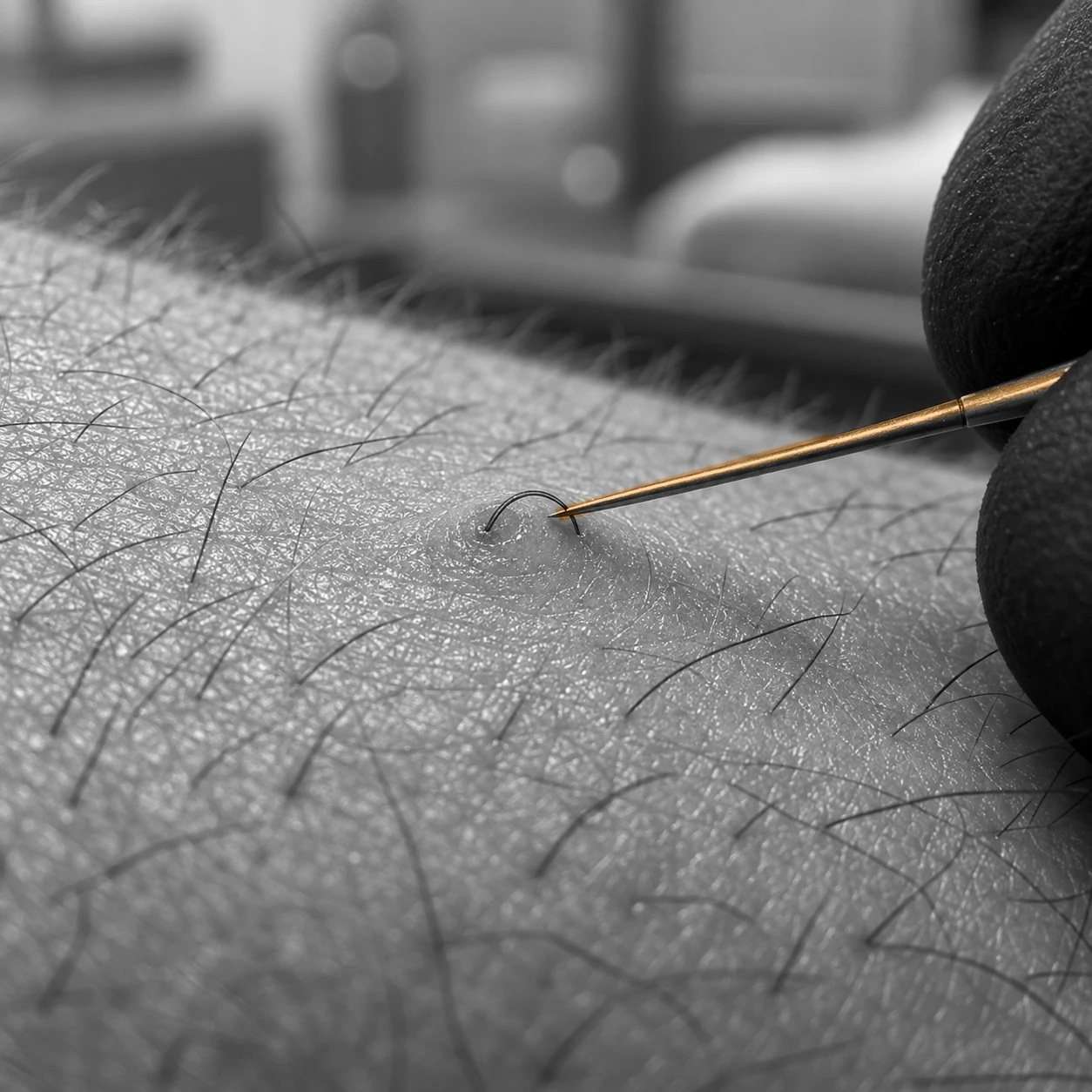
- you can clearly see a loop of hair sitting just under the surface
- the skin over it is intact and not inflamed
- it comes free with almost no pressure
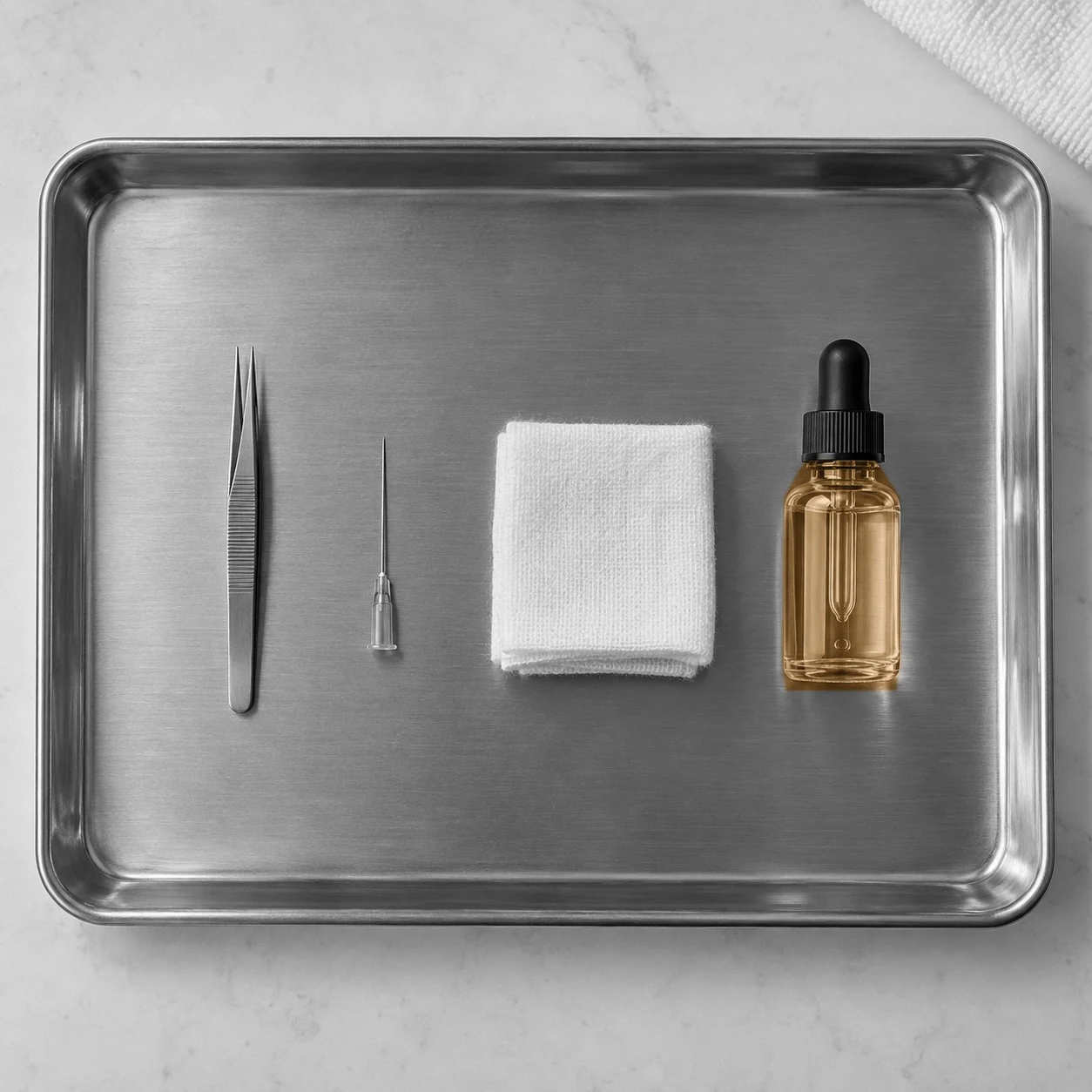
How, if you have met all three. Warm compress for five to ten minutes first to soften the skin. Clean the area. Use a sterile needle or the tip of clean tweezers to lift the loop of hair out of the skin, and then stop. Do not pull the hair out. Do not squeeze. Do not go hunting.
The reason you leave the hair in place surprises people. Once the tip is freed from the skin, the foreign body reaction ends and the inflammation resolves. Pulling the hair out gives you a fresh sharp tip in an already irritated follicle, which is the exact setup that caused the problem. You have bought yourself the next one.
If it does not lift easily, it is not ready. Warm compress twice a day and try again in a few days, or leave it entirely.
MY TWO CENTS
I have watched a lot of people do this to themselves, and the pattern is always the same. The bump appears, it is annoying, they attack it for three days, and then it is a scab, then a scar, then a dark patch they are still looking at next summer.
The single most useful thing I tell clients is that an ingrown hair is a self-limiting problem and picking is what makes it permanent.
If you find that genuinely impossible to do, and plenty of people do, that is worth knowing about yourself rather than fighting every week. It is also a reasonable argument for getting the follicles gone for good, since you cannot pick at a hair that is not growing.
What Actually Helps Between Appointments
Dalia and colleagues, reviewing the treatment literature in Clinical and Experimental Dermatology in 2023, conclude that effective management needs a multifaceted approach targeting several parts of the mechanism at once, and that topical therapies remain the mainstay. Their catalogue of what has evidence behind it covers preventive measures, keratolytics, topical antibiotics, corticosteroids, chemical depilatories and laser.
In practical terms, for the areas I treat:
Chemical exfoliation, two or three times a week. Not a scrub. Salicylic acid or glycolic acid, which loosen the plug of dead skin over the follicle so the hair can find its way out. There is more on how often to exfoliate and why less is more, and the short answer is that daily scrubbing makes this worse rather than better.
Do not exfoliate the day before or the day after a wax. The skin has had enough.
Loose clothing over a treated area. Friction is half the mechanism. The Brozilian that goes wrong is usually the one that went straight back into tight jeans.
A topical retinoid, if your doctor or pharmacist agrees it suits your skin. It changes how the follicle keratinises. Worth knowing: retinoids must be stopped three to four weeks before waxing, since skin on them lifts.
What I would not bother with. Scrubbing harder, alcohol-based aftershaves, and the various "ingrown hair serums" that are salicylic acid at four times the price. Read the label and buy the acid.
If You Shave, Change How
This is the highest-yield change available to anyone not ready to stop shaving altogether.
- Shave with the grain, never against it, and never stretch the skin taut to get closer. Closer is the problem.
- Fewer blades, not more. A multi-blade cartridge is engineered to lift the hair and cut it below the surface, which is precisely the geometry that causes this.
- Shave at the end of a warm shower, when the hair is softened.
- Replace the blade far sooner than feels reasonable. A dull blade tears rather than cuts and leaves a worse tip.
- If you can tolerate it, leave a little stubble. A hair that never gets cut below the skin surface cannot grow back into it.
For body shaving and trimming as a service, that is much of what you are paying for: a technique that does not set up the next round of bumps.
It Is Different by Area
Face and neck. The classic site, and the one with the most evidence behind it. This is where the condition has a name, pseudofolliculitis barbae, and where the scarring and pigment consequences are most visible. Also where keloids can form in people prone to them.
Groin and Brozilian. Coarse curly hair, a deep occlusive fold, constant friction, and moisture that does not clear. Everything about the area works against you. This is the one where I would push hardest toward permanent removal rather than management.
Gluteal cleft. Read the pilonidal section before you do anything here. A recurring lump in that exact spot is a different problem with a surgical answer, and hair removal there is part of the medical management rather than a cosmetic choice.
Legs and arms. Usually the easiest. Finer hair, less friction, responds well to exfoliation alone.
Back and shoulders. Hard to see, hard to reach, and therefore usually left until they are inflamed. Worth having someone look.
When Management Stops Being the Answer
If you are getting them constantly, in the same place, year after year, you are managing a mechanism rather than solving it. Ogunbiyi's line applies: removing the follicles ends it.
Laser and IPL. Amer and colleagues, in Dermatologic Therapy in 2021, randomised 20 men with pseudofolliculitis barbae to either long-pulsed Nd:YAG or chemical peeling, up to five sessions. The laser group had a significantly greater reduction in papules and pustules along the jaw and neck, both at the end of treatment and at three-month follow-up.
Two honest qualifications on that, since you should have them. Twenty patients is a small trial, and that study used an Nd:YAG laser, which we do not operate. We treat with intense pulsed light, a SharpLight Formax at 635 nm. The mechanism of benefit is the same, which is thinning and eventually eliminating the hair that drives the inflammation, though I am not going to pretend a different device is the one that was studied.
Dalia and colleagues are similarly measured, calling laser a promising long-term option while noting that more work is needed on how permanent it proves.
Electrolysis. Treating each follicle individually destroys it outright, which is the only thing that satisfies Ogunbiyi's "removal of the involved follicles" in the literal sense. It is slower and it is the right answer for fine or light hair that light-based treatment cannot see, and for people who want the problem gone rather than reduced.
A caution worth stating. Treating actively inflamed skin is not on. Anything infected, weeping or acutely flared gets left alone until it settles, whichever method we are using.
When to See a Doctor Instead
- the lump is hot, spreading, and you feel unwell with it
- a lump keeps returning to the same spot, especially at the top of the buttock crease
- you get recurring painful lumps in the armpits, groin or under the breasts, which may be hidradenitis suppurativa rather than ingrowns
- a bump has not healed in several weeks
- anything is bleeding, ulcerating or steadily growing
- the marks left behind are the thing bothering you, since pigment has real treatments and they are a dermatologist's department
Dalia and colleagues make a point in that review that deserves repeating. This condition predominantly affects people with skin of colour, and they describe a prominent disparity in how well it gets managed. If you have been dismissed about this before, that is a documented pattern rather than your imagination, and it is worth asking again.
Bottom Line
Leave it alone for a week. Most ingrown hairs resolve without help, and picking is what turns a bump that would have gone into a mark that stays.
If you can see a clear loop of hair under intact skin, warm compress, lift the loop free, and stop there. Leave the hair in place, since cutting or pulling it gives you a fresh sharp tip and the next one.
Chemical exfoliation two or three times a week, looser clothing, and shaving with the grain with fewer blades will handle most of what is left.
If you are still getting them in the same place year after year, you are managing a mechanism that has a permanent answer. That is a conversation worth having rather than another decade of tweezers.
Related, if this is your problem. that bump might not be an ingrown hair, how often you should actually exfoliate, folliculitis and what it actually is, hidradenitis suppurativa and hair removal, fistulas and pilonidal disease and skin tags and how they change a treatment.