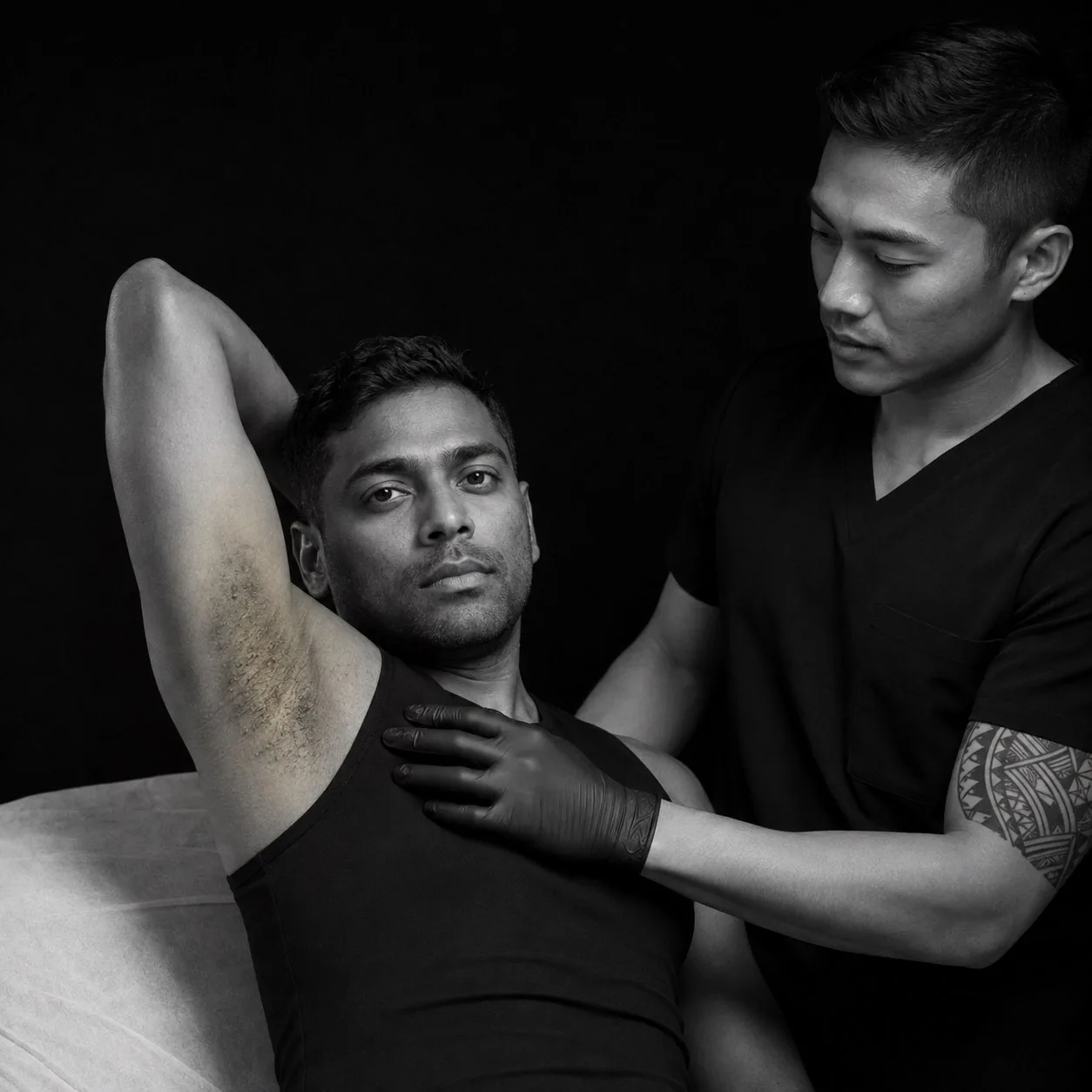
The Post Almost Nobody in This Industry Writes
Most people with hidradenitis suppurativa have already been turned away by somebody like me.
Sometimes politely. Sometimes with a look. Occasionally they were not turned away at all, which was worse, because they were waxed by a practitioner who did not know what they were looking at and spent the next three weeks paying for it.
So I want to be useful here rather than cautious. HS is a follicular disease. Hair removal is not a cosmetic afterthought bolted onto the side of it. Destroying the follicle is one of the few things in this whole field where the mechanism of a hair removal treatment lines up exactly with the mechanism of the disease, and there are randomised controlled trials to show for it.
There are also methods that make HS measurably worse, and one of them is the single most common thing a salon will offer you.
Here is all of it, with the sources named so you can check me.
The Eleven Questions I Actually Get Asked
Short answers first. The detail is underneath, and every one of these is expanded further down the page.
How do you get it?
You largely inherit the tendency. Roughly a third of people with HS have a family history of it, and the underlying problem is a follicle that occludes, ruptures and provokes an immune response out of all proportion to the trigger. Smoking and higher body weight are both strongly associated. Hormones play a part, which is why onset clusters after puberty and why many people flare with their cycle.
You did not get it from being unclean, from shaving, from a gym, from a pool or from another person. I need that said before anything else, because a lot of people arrive having been told otherwise.
When do you get it?
After puberty, usually in your twenties. Peak prevalence is ages 30 to 39, at 172 per 100,000. It is uncommon in childhood. Onset after 60 is unusual enough that it should prompt a proper look for something else.
The gap between first symptom and diagnosis is notoriously long. Years of "recurring boils" is the standard story, and there is a number on it further down that is worse than most people guess.
Is it contagious?
No. Not by contact, not by towels, not by sharing a bed, not by anything. It is not a sexually transmitted infection, despite living in the groin. It is not even primarily an infection. Bacteria arrive after the follicle has already ruptured and make an existing problem worse.
How is it treated?
In layers, and usually several at once:
- Topical. Clindamycin 1 per cent, and antibacterial washes containing benzoyl peroxide or zinc pyrithione.
- Oral antibiotics. Doxycycline or minocycline for mild to moderate disease, clindamycin with rifampicin for more severe disease.
- Injected. Intralesional triamcinolone into individual stubborn lesions.
- Biologics. Adalimumab, secukinumab and bimekizumab.
- Oral targeted therapy. Povorcitinib, a JAK1 inhibitor, reported positive phase 3 results this year.
- Surgery. Deroofing for a recurrent localised tract, wide excision for established disease.
- Adjuncts. Laser hair removal, smoking cessation, weight management.
What makes it worse?
Friction is the big one. Skin rubbing skin, skin rubbing seams, tight waistbands, tight bra bands, tight underwear. Then heat and sweat, which is why summer and the gym are hard. Then weight, smoking, hormonal cycling, and stress.
On the hair removal side specifically: waxing, sugaring, epilators, tweezing and depilatory creams all make it worse on skin HS is currently affecting. Careless shaving does too, though careful shaving does not.
Does wax or laser help or hurt?
This is the cleanest answer in the whole post. Laser helps. Wax hurts.
Laser hair removal has randomised controlled trial evidence in HS, with each patient's untreated side used as the comparison, and the treated sites did measurably better. Waxing rips the hair out of a follicle in a disease defined by follicular rupture, which is why the American Academy of Dermatology's public guidance is "never wax."
One thing to be straight about on that last point. The AAD line is real and I agree with it, and it is expert opinion on a patient-education page rather than a trial finding. No study has tested waxing in HS. The mechanistic argument is strong. It is reasoning, not evidence, and you should know which of the two you are being handed.
I will not wax an area HS is currently affecting. I will laser it, in the right window, with the right wavelength.
There is a second half to that answer which almost nobody gives you. Waxing can become possible later. I have a client whose underarms I wax now and could not have waxed a year ago, and what changed in between was three sessions of laser. Laser first, control second, waxing considered afterwards if the area has genuinely settled. The full reasoning is further down.
Is there medication that can be taken?
Yes, and considerably more of it than there was five years ago. Three licensed biologics, an oral JAK inhibitor with phase 3 results, plus antibiotics, intralesional steroid, and off-label use of metformin, spironolactone, dapsone, acitretin and isotretinoin depending on the picture. HS went from a neglected condition to an active drug-development area in about a decade.
Can you have hair removal while on the medication?
Usually yes, with conditions.
- Biologics and JAK inhibitors. Yes, with your prescriber's written agreement. They are immunosuppressive or immunomodulating, so my infection control matters more than usual. Never stop your biologic to have hair removal.
- Doxycycline and minocycline. Yes for laser at 755, 810 and 1064 nm. Their photosensitivity is a UVA phenomenon, roughly 320 to 400 nm, and those wavelengths sit well outside it. IPL is the exception, since it overlaps.
- Isotretinoin. No waxing for six months after finishing, which is the mechanical epilation rule and it stands. Laser is a different question, and the position I used to hold on it has not survived contact with the guideline. Detail further down.
- Spironolactone, metformin, GLP-1 medications. Not a barrier.
Full detail is in the medications and hair removal guide.
Is it for life?
Honestly, usually. HS is chronic and relapsing, and I am not going to tell you otherwise.
The kinder half of that answer is that the course changes. Activity commonly declines after menopause. Kromann and colleagues, in the British Journal of Dermatology in 2014, followed patients for a median of 22 years and found 39 per cent reported remission, with remission commoner among non-smokers and among those who were not obese. Modern biologics have moved a lot of people from constant disease to long quiet stretches.
Read that study for what it is. It is a postal survey of what people reported about themselves. It shows non-smokers remitting more often. It does not show that quitting cleared anybody, and I am not going to dress it up as though it did.
What does not reverse on its own is structural damage already done. Established sinus tracts and scarring need a procedure, not patience. That is an argument for treating early rather than an argument for despair.
Does having less hair help?
Yes, and that is the entire reason this post exists. The hair follicle is where the lesion starts. Fewer follicles means fewer things that can occlude and rupture, less friction in the fold, and a smaller bacterial reservoir held against the skin.
This is not a theory. In the trials, sites cleared of hair by laser improved while the untreated sites on the same person did not.
Is it treatable?
Very. It is not usually curable, and those are two different words that get confused constantly.
The distance between untreated HS and well-managed HS is enormous. Most of the suffering I see is not from a condition that resisted treatment. It is from a condition nobody named for years.
What HS Actually Is
It is not a sweat gland infection. The name is a nineteenth century mistake that stuck, and it stuck because the early pathologists were looking at late lesions. Boer and Weltevreden settled it in the British Journal of Dermatology in 1996 by biopsying lesions within three days of onset: the primary event is an occluding folliculitis, with the apocrine glands involved only secondarily. The sweat gland is a bystander rather than the culprit.
So HS begins with occlusion of the hair follicle, which then ruptures into the surrounding tissue and triggers a disproportionate inflammatory response. Bacteria show up afterwards and make things worse. They are not the cause. This is why antibiotics help some people and cure almost nobody.
It is not a hygiene problem. I want that stated flatly, because a large share of people with HS have been told or made to feel otherwise, often by a healthcare professional. Washing harder does not fix follicular occlusion. Washing harder is friction, and friction is a trigger.
It is not contagious, and it is not an STI. It shows up in the groin and under the arms, and people draw the obvious wrong conclusion.
It is common, and badly underdiagnosed. Garg and colleagues, in JAMA Dermatology in 2017, analysed a 48-million-patient sample and put prevalence at about 98 per 100,000, roughly one in a thousand people. That figure counts people who reached a coded diagnosis, so it is a floor rather than a true prevalence, which if anything strengthens the point.
The delay before anybody names it is the worst number in this post. The VOICE project, published by Garg and colleagues in the Journal of the American Academy of Dermatology in 2020 with Toronto co-authorship, put the mean gap between first symptom and diagnosis at 10.2 years, with 63.7 per cent of patients seeing a physician five or more times before being diagnosed. The same survey found 61.4 per cent rating their recent pain moderate or worse.
Who gets it. Women at about 137 per 100,000 against men at 58, a ratio near 3 to 1 in Western populations. Peak prevalence sits in the thirties, at 172 per 100,000 for ages 30 to 39. Onset is usually after puberty, in the twenties. Von der Werth and Williams, in the Journal of the European Academy of Dermatology and Venereology in 2000, found 38 per cent of patients reporting a family history.
This next part matters enormously for what device I reach for. In the same American dataset, prevalence among African American patients was 296 per 100,000 and among patients recorded as biracial 218 per 100,000, against 95 for white patients. That is roughly three times the rate. HS disproportionately affects darker skin, and the practitioner sitting across from you needs to have thought about Fitzpatrick type before they turn anything on. If you have not read it, my post on laser hair removal on dark skin and the Fitzpatrick scale explainer both apply directly here.
Where It Shows Up
HS lives in intertriginous skin, which is a technical way of saying the places that fold, rub and stay warm. Those happen also to be where the apocrine glands sit, which is where the old name came from. The distribution is apocrine. The lesion is follicular.
- Underarms
- Groin, including the mons and the inner fold of the thigh
- Buttocks and the perianal area
- Inner thighs
- Under the breasts and the inframammary fold
- Vulva, scrotum and perineum
- Back of the neck, and occasionally behind the ears
That list is not the same for everybody, and the difference runs along sex lines. Revuz, reviewing the condition in the Journal of the European Academy of Dermatology and Venereology in 2009, notes that axillary and inguinal involvement is commoner in women while perianal and gluteal disease is commoner in men. So the overlap between where HS lives and where people book hair removal lands differently depending on who is in the chair.
Look at that list, then look at the list of areas people most commonly book hair removal for. They are almost the same list. That overlap is the entire reason this post exists.
The Hurley Stages, and Why Your Stage Decides Everything I Do
Hurley staging is crude, it comes from a surgical textbook chapter published in 1989, and nearly forty years later it is still the fastest way for me to know what I am dealing with.
Hurley Stage I
Abscesses or inflammatory nodules, single or multiple, with no sinus tracts and no scarring. Many people at this stage have never been diagnosed. They think they get bad ingrown hairs, or recurring boils.
Hurley Stage II
Recurrent abscesses with sinus tract formation and scarring, but the lesions are still separated from one another, with normal skin in between.
Hurley Stage III
Diffuse involvement, with multiple interconnected tracts and abscesses across an entire anatomical area. There is very little unaffected skin left in the region.
Why I said crude, and why it is not an insult
Ovadja and colleagues, in the British Journal of Dermatology in 2019, put fifteen raters in front of thirty photographs and measured how often they agreed. Agreement was only moderate overall, and it was worst of all for Stage I.
Stage I is the stage I most often treat. So a referred Stage I label is the least reliable piece of information that will ever reach me, and that is one of the reasons I want to look at the area myself rather than book off a word in an email.
IHS4, the more useful number
Hurley describes the worst thing present and never improves on paper even when you are having a good month. Zouboulis and colleagues built and validated the International HS Severity Score System in the British Journal of Dermatology in 2017, and it counts what is actually there today: nodules count 1, abscesses count 2, and draining tunnels count 4. A total of 3 or under is mild, 4 to 10 is moderate, 11 or more is severe.
Their own paper found only fair agreement between IHS4 and Hurley, which is the point rather than a flaw. The two scores are measuring different things.
I care about IHS4 because it moves. Someone can be Hurley II forever and still walk in on a day when their IHS4 is 2, and that day is a day I can work.
Why Hair Removal Is Part of the Treatment Conversation At All
The logic is unusually clean.
The lesion starts in the follicle. Hair removal lasers destroy the follicle, or damage it enough that it stops producing terminal hair. Remove the follicle and you have removed the structure that occludes, ruptures and starts the whole cascade.
There are three separate benefits stacked on top of each other:
1. Fewer follicles left to occlude. The direct mechanism.
2. Less friction. Coarse hair in a skin fold is an abrasive. Skin-on-skin in a hairless armpit moves more easily than skin-on-stubble.
3. Lower bacterial load. Hair holds bacteria against the skin, and reduced follicular density reduces the reservoir.
This is why the medical literature treats laser hair removal in HS as adjuvant therapy, a real part of management rather than a cosmetic extra. Alikhan and colleagues, writing in the Journal of the American Academy of Dermatology in 2019 for the United States and Canadian Hidradenitis Suppurativa Foundations, place Nd:YAG among the procedural options for HS rather than among the cosmetic ones.
It is adjuvant. It is not a cure, and it does not replace your dermatologist. Anybody who tells you laser will fix your HS is selling you something. What the evidence supports is meaningful reduction in inflammatory lesions in treated areas, in people who are also being managed medically.
The Evidence, Plainly
I am going to give you the actual numbers and the actual papers, because you will not find either on most clinic websites and you deserve to judge them yourself.
Nd:YAG 1064 nm, the strongest case
Tierney and colleagues, in Dermatologic Surgery in 2009, ran the foundational study: a prospective randomised controlled trial in 22 patients with Hurley Stage II to III disease, using a long-pulsed 1064 nm Nd:YAG at monthly intervals for three sessions, with untreated control sites on the same patients.
Overall improvement was 65.3 per cent. Broken down by area: inguinal 73.4 per cent, axillary 62.0 per cent, inframammary 53.1 per cent. The untreated control sites showed no meaningful change over the same period. That contralateral control design is what makes this convincing, since each patient is their own comparison and you cannot blame the result on a good month.
Their own conclusion is the argument this entire post rests on, and I would rather quote the investigators than paraphrase them: the effectiveness of Nd:YAG, a hair epilation device, supports the primary follicular pathogenesis of the condition. The laser worked, and the fact that it worked tells you what the disease is.
A companion study from the same group supplies the proof under a microscope. Mahmoud and colleagues, in the Journal of the American Academy of Dermatology in 2010, ran four monthly sessions in another 22 patients and took biopsies alongside the clinical scoring, finding an inflammatory infiltrate around hair shaft remnants. That is direct histological evidence that what the laser had done was destroy the follicle. Their control side received topical benzoyl peroxide and clindamycin rather than nothing, so it is Tierney's trial and not this one that gives you the untreated comparison. Two studies, two designs, same answer.
Two meta-analyses have since pooled this literature, and one of them is Canadian. Jfri and colleagues at McGill, in Frontiers in Medicine in 2020, pooled the randomised Nd:YAG trials and found significant improvement in disease severity. Shipman and colleagues, in Lasers in Surgery and Medicine in 2024, pooled ten studies covering 227 patients and put the standardised mean difference for long-pulsed Nd:YAG at -1.68, with adverse effects limited to mild pain and redness.
Both sets of authors are careful, so I will be too. The samples are small, the outcome scales differ between trials, and Shipman's Nd:YAG pool rests on three studies. The direction of the effect is consistent across everything published, and the evidence base underneath it is thin. Those are both true and you should hear both.
There is also a multicentre, prospective, randomised, intra-individual comparative trial by Naouri and colleagues in the Journal of the American Academy of Dermatology in 2021. I mention it for completeness rather than as confirmation, since it drew a published critical response from the group behind the two trials above and I have not read both sides closely enough to tell you who has the better of it.
Alexandrite 755 nm, good evidence, narrower window
Sidhom and colleagues, in JAAD International in 2024, ran four monthly treatments to one side of the body with the contralateral side as an untreated control. At week 24, eight weeks after the final session, HiSCR (the standard clinical response measure in HS) was reached by 75 per cent of treated sites against 33.33 per cent of controls, p = 0.0046. By site: 72.73 per cent axillary, 70 per cent inguinal, 100 per cent inframammary.
Read those tidy percentages with the denominator in mind. This was a small trial and the authors say so. A figure of 100 per cent inframammary means every one of a handful of sites rather than a hundred out of a hundred, and the confidence interval is correspondingly wide. It is a real result. It is not a large one.
A separate Italian trial points the same way. Molinelli and colleagues, in the Journal of the American Academy of Dermatology in 2022, reported 50 per cent of patients reaching HiSCR at 15 weeks, rising to 70 per cent by week 30, in mild to moderate disease treated as an adjuvant. Different investigators, different country, different patients. Two independent trials agreeing is worth considerably more than one trial read twice.
Sidhom's own conclusion is worth quoting for what it includes: the laser was effective both at resolving existing lesions and at preventing new ones. Prevention is the part clients care about most and the part most treatment plans never promise.
The catch is skin type. Alexandrite at 755 nm has strong melanin absorption, which is exactly what makes it effective and exactly what makes it a poor choice on Fitzpatrick V and VI. Given who HS disproportionately affects, this is not an academic point.
Diode 810 nm
The workhorse of commercial hair removal, and the wavelength with the least HS-specific published evidence of the three. That is a gap in the literature rather than a demonstrated failure. Diode sits between alexandrite and Nd:YAG on melanin absorption and is a defensible choice for lighter and mid-range skin types, though if you want the treatment that has actually been tested on your disease, it is not this one.
IPL
IPL has some HS literature, including combination work with radiofrequency, and a broad-spectrum output that overlaps far more of the melanin absorption curve. On the skin types HS most commonly affects, that is a liability. This is the one modality where I think the evidence and the demographics point in opposite directions, and I would not choose it for HS.
CO2 laser
Worth knowing about even though it is not hair removal. CO2 is used in dermatology for deroofing sinus tracts and excising diseased tissue. That is a surgical procedure performed by a physician. It is not something a hair removal studio does, and if somebody offers you CO2 for HS in a salon setting, leave.
Electrolysis, and the honest answer
I searched for this properly, because I am an electrologist and I wanted there to be something.
There is no peer-reviewed evidence for electrolysis in hidradenitis suppurativa. No trials, no case series worth the name. Shipman's 2024 meta-analysis screened the field down to ten studies and not one of them involves electrolysis. What exists is clinic marketing, some of it mine-adjacent, asserting a benefit by analogy with laser.
The analogy is not unreasonable. Electrolysis destroys the follicle permanently and works on any hair colour and any skin tone, which sidesteps the entire melanin problem that constrains device choice in exactly the population most affected. It is also slow, it involves inserting a probe into individual follicles, and the areas involved are the ones where inserting anything into inflamed tissue is a bad idea.
So here is my position. Electrolysis has a real role here, and I am not going to present it to you as a treatment for your HS. If you want hair gone permanently in a region the laser cannot safely reach, or your hair is grey, white, red or blonde and the laser has nothing to target, electrolysis is the answer to that question. It is not an answer to the HS question, and I am not going to pretend otherwise to make a sale.
Method by Method: What I Will and Will Not Do
Shaving
The realistic default for most people with HS, and the AAD's own guidance treats it as acceptable when done carefully rather than as something to avoid. Its virtue is that it does not extract anything from the follicle.
If you are shaving affected skin:
- Wash first with an antibacterial cleanser containing benzoyl peroxide or zinc pyrithione. Both are recommended in HS self-care to reduce surface bacterial load.
- Use a proper shaving gel, never a dry pass and never soap.
- Sharp blade, single pass, with the grain. Repeat passes and against-the-grain shaving are how you turn a shave into a series of micro-injuries.
- Never shave over a nodule, an abscess or a tunnel. Go around it.
- Rinse, dry properly, do not apply an alcohol-based product.
Trimming, which is underrated
A guarded trimmer taking the hair down to two or three millimetres removes most of the friction and almost all of the trapped bacteria, and it never touches the skin. For active disease, or for the week before a flare settles, trimming is very often the correct answer and nobody suggests it.
That length is my own rule of thumb rather than a published figure, and I would rather say so than let it read as a standard. Nobody has studied trim length in HS.
Waxing and sugaring
No. Not on skin that HS is currently affecting, at any Hurley stage.
The AAD's public guidance on HS says "never wax," and the reasoning is the reasoning of the disease itself. Waxing rips the hair out of the follicle, traumatising the follicular unit and the surrounding tissue in a condition defined by follicular rupture and disproportionate inflammatory response. It also strips the stratum corneum in skin that already sits warm, moist and occluded.
Sugaring is the same mechanical event with a different medium. The lower application temperature and the with-the-grain removal make it gentler on ordinary skin, and it is still epilation. It is still pulling hair out of a follicle that is inflamed.
I know this is the hardest section to read, since waxing is what most people book. If HS is currently affecting an area, I will not wax that area.
Unaffected areas are a separate conversation. HS in the groin does not make your legs off limits.
Waxing is not where you start. It can be where you end up.
Here is the part almost nobody tells you, and it is the reason I wrote this post as a pathway rather than a list of refusals.
I have a client whose underarms I now wax, and I could not have waxed them a year ago. What changed in between was three sessions of laser. The flares settled, the follicular density dropped, and the same skin that would have reacted badly to a strip became skin that handles one without incident.
The mechanism is not mysterious. Waxing harms HS skin because epilation traumatises the follicle in a disease defined by follicular rupture. A laser course removes a large share of those follicles and reduces flare frequency, which is precisely what the trials measure. Wax that area afterwards and the mechanical event is smaller, on fewer and finer hairs, in tissue that is no longer inflamed. The risk that created the rule has partly been engineered out of the way.
Three sessions is worth noting on its own. Tierney's Nd:YAG trial ran three monthly treatments and reported 65.3 per cent overall improvement. My own experience landed at the same number without my planning it that way, which is the sort of agreement between a study and a treatment room that makes me trust both a little more.
Two honest qualifications.
This is my clinical observation, not published evidence. No trial has looked at waxing after laser clearance in HS. I am telling you what I have seen rather than what has been demonstrated, and you should weigh it accordingly.
The area matters more than the person does. Someone can have a groin that will never be a candidate and an underarm that has been quiet for a year. Those are two different answers on the same client, on the same day.
So the sequence I offer is laser first, control second, and waxing considered afterwards if the area has genuinely settled. It is earned rather than requested, it is assessed area by area, and it is never a substitute for the laser course that made it possible.
Depilatory creams
No. Nair, Veet and everything in that family work by chemically dissolving the keratin bonds in the hair shaft using thioglycolate salts at a strongly alkaline pH. They irritate normal skin routinely. In an intertriginous fold, on skin that is already inflamed, with occlusion from clothing and a warm moist environment holding the product against the skin, the risk of a chemical burn goes up sharply and the barrier damage is exactly what you do not need.
Being straight about this one. No study has tested depilatory creams in HS, in either direction. The whole argument above is mechanism and chemistry rather than evidence. I covered the failure modes in the medications and hair removal post.
Epilators, threading and tweezing
All epilation, all the same objection as waxing, and tweezing has an additional problem specific to HS. Chasing an individual hair with forceps traumatises the same follicle repeatedly over months. Repeated follicular trauma is the last thing this disease needs.
Laser, and how I choose the wavelength
Given everything above, my order of preference for HS is:
1. Nd:YAG 1064 nm. The best HS evidence, and the safest wavelength on Fitzpatrick IV to VI, which is the population most affected. This is my default.
2. Alexandrite 755 nm. Strong HS-specific trial data, appropriate for Fitzpatrick I to III with fine or lighter hair where Nd:YAG would struggle for a target.
3. Diode 810 nm. Reasonable, well tolerated, thin HS-specific evidence.
4. IPL. Not for this.
What Actually Happens If You Book With Me
Before you arrive
I want to know four things, and I would rather have them in writing than remember them in a room:
1. Have you been diagnosed, and by whom. A dermatologist's diagnosis and a self-diagnosis from the internet are both useful information. They are not the same information, and I will treat them differently.
2. Your stage, if you know it, or a description of what is actually there: nodules, abscesses, tunnels, scarring, and whether anything is currently draining.
3. Everything you take. Biologics, antibiotics, isotretinoin, metformin, spironolactone, hormones, GLP-1 medications, supplements. The dose and how long you have been on it.
4. Where you are in the cycle of it. Flaring, settling, or genuinely quiet.
What I will treat
Hurley Stage I, and Stage II in a quiet window, I will treat with laser.
By quiet window I mean no active abscess, nothing draining, and no new inflammatory nodule in the treatment area for at least a couple of weeks. This is where IHS4 beats Hurley. Your stage is a permanent label; your quiet window is a real thing that comes and goes, and it is what I am actually booking around.
Hurley Stage III is a conversation rather than a booking. Come in and let me look at it. At Stage III there is very little unaffected skin left in the region and the tissue architecture is genuinely altered, so I want to see the area myself and I will often want your dermatologist's view before we start. What I am not going to do is turn you away by email on the strength of a label, since the people with the most advanced disease are also the people with the fewest options and the most experience of being refused.
What I will not touch
Anything actively draining, or the skin immediately beside it. An open tunnel is a wound. Firing a laser at the edge of a wound in a warm, occluded fold is asking for a complication I have no business creating.
Fresh surgical sites. Deroofing heals by secondary intention over weeks. Wide excision takes longer. I want the site fully closed and the dermatologist's clearance before I go near the margins.
An area during a flare, even a mild one. We reschedule. There is no version of this where pushing through a flare produces a better outcome.
The sessions
Every published HS protocol I trust runs at monthly intervals, which is closer together than a standard cosmetic hair removal course. Tierney's Nd:YAG trial ran three monthly sessions. Sidhom's alexandrite trial ran four. In Molinelli's Italian series the response kept improving between week 15 and week 30, well after the last treatment, which tells you the benefit accumulates rather than arriving all at once.
Plan for a course, not a session. Plan on assessing at four sessions rather than deciding after one.
What to expect afterwards
Some perifollicular erythema and swelling for a day or two, as with any laser hair removal. The thing to watch for in HS specifically is whether treatment provokes a flare in the treated area. Shipman's 2024 meta-analysis found adverse effects across the pooled studies limited to mild pain and redness, and individual experience varies. If it happens to you, tell me and we change the plan.
Medications: What HS Clients Are Usually On
This deserves its own section because HS is one of the most heavily medicated dermatological conditions there is, and several of those medications change what I can do.
Biologics
Three are licensed for HS in the United States: adalimumab (a TNF inhibitor, Humira and its biosimilars), secukinumab (IL-17A, Cosentyx) and bimekizumab (IL-17A and IL-17F, Bimzelx), the last of these approved there in late 2024. Check your own coverage rather than taking a licensing statement off any website, mine included. Canadian authors, at Ottawa and Toronto, published a systematic review and meta-analysis of real-world biologic outcomes in HS this year.
All three are immunosuppressive. That does not mean I cannot treat you. It means any breach of the epidermis carries more weight than it would otherwise, my infection control has to be beyond reproach, and I want your prescriber to have signed off in writing. That is the same standard I published in the medications and hair removal guide for immunosuppressants generally, and I am applying it here consistently.
Do not stop your biologic to have hair removal. I have never asked anyone to do this and I never will. Interrupting an HS biologic to book a laser appointment is a bad trade in every direction, and with TNF inhibitors specifically there is a real risk of losing response on restart.
JAK inhibitors, the new arrival
Povorcitinib, an oral selective JAK1 inhibitor, reported positive phase 3 results in the STOP-HS1 and STOP-HS2 trials, published by Porter and colleagues in Nature Medicine this year across 1,227 patients. Both 45 mg and 75 mg doses beat placebo on HiSCR50 at week 12, with treatment continuing to week 54.
Here are the actual numbers, since I promised you those. Roughly 40 to 42 per cent of patients on the drug reached HiSCR50 at week 12, against 29 to 30 per cent on placebo. That is a real result and it met its endpoint. It is also a margin of ten to twelve percentage points, and a placebo response of nearly a third, which is worth knowing before you read a headline about it. An oral option still matters a great deal to people who do not want an injectable.
If you are on it, treat it the way I treat the biologics: it is immunomodulating, tell me, and I want the prescriber's agreement.
Antibiotics
Topical clindamycin 1 per cent, oral doxycycline or minocycline for mild to moderate disease, and clindamycin with rifampicin for more severe disease.
The tetracyclines carry a photosensitivity warning, which is the one clinics get wrong most often. Doxycycline photosensitivity is a UVA phenomenon, roughly 320 to 400 nm. Alexandrite at 755 nm, diode at 810 and Nd:YAG at 1064 all sit well outside that band. The blanket "you are on doxycycline, no laser" rule is not supported by the physics for those wavelengths. IPL is the exception, since its output spans roughly 500 to 1200 nm and does overlap. That is one more reason IPL is not my choice here.
Label that argument honestly. No trial has tested hair removal laser on somebody taking doxycycline. What I have given you is established photobiology applied to known wavelengths, which I think is sound, and it is inference rather than evidence. The full reasoning is in the medications post.
Isotretinoin, and a position I have changed
Isotretinoin thins the epidermis and impairs wound healing, and the standard advice everywhere is to wait six months after the course before having anything done.
I hold that for waxing. Six months clear, and I am comfortable with it, since mechanical epilation has never been cleared by anybody and the mechanism of harm is obvious.
Laser is a different question, and I used to get it wrong. The ASDS Guidelines Task Force, writing in Dermatologic Surgery in 2017, reviewed the evidence and found insufficient grounds to delay non-ablative lasers, hair removal lasers and lights explicitly included, in patients currently or recently on isotretinoin. An Indian task force reached the same conclusion independently that year and said the practice should be discontinued. The six-month rule everybody quotes for laser comes from the drug's package insert rather than from data.
So my position now is that I will treat with laser on your dermatologist's agreement rather than making you sit out a calendar that was never based on anything. The wax hold stands. Those are two different rules for two different mechanisms, and lumping them together is what I was doing before.
Everything else
Intralesional triamcinolone for individual lesions, plus metformin, dapsone, acitretin and hormonal treatment depending on the picture.
Spironolactone shows up frequently in HS clients who also have PMOS, and the overlap is measurable rather than impressionistic. Garg and colleagues, in the Journal of Investigative Dermatology in 2018, found polycystic ovary syndrome in 9 per cent of HS patients against 2.9 per cent of those without, roughly twice the odds. The literature still uses the older name, so search for PCOS if you go looking.
GLP-1 medications are increasingly part of HS management, since weight reduction genuinely reduces flare frequency for many people. They are not a hair removal problem in themselves. Rapid weight loss changes skin laxity, which changes how well I can hold skin taut, which changes what waxing feels like in unaffected areas. Worth mentioning at intake.
Surgery, and the Hair Around It
Many people with established HS have had incision and drainage (high recurrence, largely out of favour as a definitive step), deroofing or wide local excision.
Deroofing has the numbers behind it. Van der Zee and colleagues, in the Journal of the American Academy of Dermatology in 2010, deroofed 88 lesions in 44 patients and found 83 per cent had not recurred at a median of nearly three years, with median patient satisfaction of 8 out of 10. The tract is opened and left to heal from the base, and it is the best evidence-based procedure for a recurrent lesion that keeps returning in the same spot.
Two things follow for hair removal.
Scar tissue does not behave like skin. It has different vascularity, different sensation, sometimes none, and different heat dissipation. I treat around a mature scar rather than through it unless there is a specific reason.
Hair at the margins is worth clearing. Recurrence at the edge of an excision is common, and the follicles at that margin are the same follicles that started the problem. Clearing them once the site is fully healed is one of the most defensible things laser can do in this disease.
Aftercare in Skin That Folds
Standard laser aftercare assumes an arm. An armpit or a groin is a different environment: warm, moist, occluded, in constant motion and rubbing against itself.
The protocol below is mine, built from general laser aftercare and the specific problem of a fold. It is practice rather than published evidence, and I would rather tell you that than imply a study behind every line.
- Cool, not cold. No ice directly on the skin.
- Loose clothing for 48 hours. Cotton. Nothing with a seam sitting in the fold.
- No gym, no sauna, no hot tub, no swimming for 48 hours. Sweat and chlorine both.
- No antiperspirant on treated underarms for 24 hours. Deodorant without aluminium salts is fine after the first day.
- A bland, fragrance-free moisturiser, not an occlusive ointment sitting in a fold.
- Do not shave the area for at least 3 days. Trim if you must.
- Watch for the difference between post-laser erythema and a flare. Post-treatment redness fades over a day or two. A flare builds, becomes tender and deep rather than surface-warm, and does not settle. Message me either way and I will tell you which one it is.
Warnings and Hard Limits
If it is draining, it is a wound. No laser, no probe, no wax, no cream. This is not negotiable and it is not a scheduling preference.
Do not let anyone laser through an active abscess. The energy goes into inflamed tissue with a compromised barrier and you have gained nothing.
Post-inflammatory hyperpigmentation is a real risk here, more so given the skin types HS most commonly affects. Inflamed, previously inflamed and recently healed skin pigments more readily. Conservative fluences, appropriate wavelength, and a test patch that I actually wait to read.
Long-standing HS carries a small but genuine squamous cell carcinoma risk, particularly in perianal, perineal, groin and buttock disease of many years' duration. Abu Rached and colleagues, reviewing the cancer literature in Annals of Medicine in 2024, found malignant change in up to 4.6 per cent of cases in severe, long-standing disease in those regions. Read that figure with the qualifier attached: it applies to severe disease of many years, not to HS generally.
I raise it not to frighten anyone but because I do a full visual and dermoscopic assessment of the treatment area before I start, and if something in a chronic HS field looks wrong to me I am going to tell you and send you to a dermatologist. That is what the dermoscopy training is for.
Lymphoedema. Chronic HS in the groin can obstruct lymphatic drainage. A limb with established lymphoedema needs medical input before I treat it.
Piercings, and jewellery in the field. Genital, navel and nipple jewellery all come out before laser, for the same reason all metal does. In HS specifically, a piercing tract in or near an affected area is another epithelialised channel in skin that already makes too many of them.
If you are flaring, we reschedule, and I will not charge you a late cancellation fee for it. I would rather lose the slot than treat you on the wrong day.
What I Need From You, and What You Get From Me
From you: tell me before the appointment, not on the table. Tell me the diagnosis, the stage if you have one, every medication with the dose and duration, and where you are in the cycle of it today. Photograph the labels if it is easier. I am not going to judge you and I am not going to refuse you for being honest. The only thing that gets someone refused is an active flare, and that is a rescheduling problem rather than a rejection.
From me: a clear answer on what I will treat and what I will not, the reasoning behind it, the wavelength I have chosen and why, the source for anything I claim as evidence and a plain statement where I am reasoning instead, a written note to your dermatologist if you want one, and no pretence that I am curing anything.
You have probably had enough of being told this is your fault. It is not, it never was, and there is a version of hair removal that helps rather than harms.
Hidradenitis suppurativa starts in the follicle, which is the one thing in this field I am actually equipped to remove. That is why laser hair removal appears in the HS literature as adjuvant therapy with randomised controlled trial support, and why waxing appears in the patient guidance as something to never do.
The short version: Nd:YAG first, monthly, in a quiet window, alongside your medical treatment and not instead of it. No wax, no sugar, no depilatory cream and no epilator on skin HS is currently affecting. Shave carefully or trim while you are managing it at home. Electrolysis has a place at the borders and on grey or fair hair, and I will not oversell it.
Then, once the area has genuinely settled, the door reopens. Waxing is not the way in. It can be the destination, and getting somebody there is the most satisfying thing I do.
Book a consultation before you book a treatment. I will look at the area properly, tell you what I think, and if the answer is that today is not the day, I will tell you that too.
Related reading: laser on dark skin, the Fitzpatrick scale, medications and hair removal, PMOS and unwanted hair, folliculitis and what those bumps are, ingrown hairs and aftercare.
If this is your situation, these go together. the pain map, every area ranked, the diabetes and hair removal guide, acne, folliculitis and hair removal, fistulas in the buttocks and how often you should actually exfoliate.