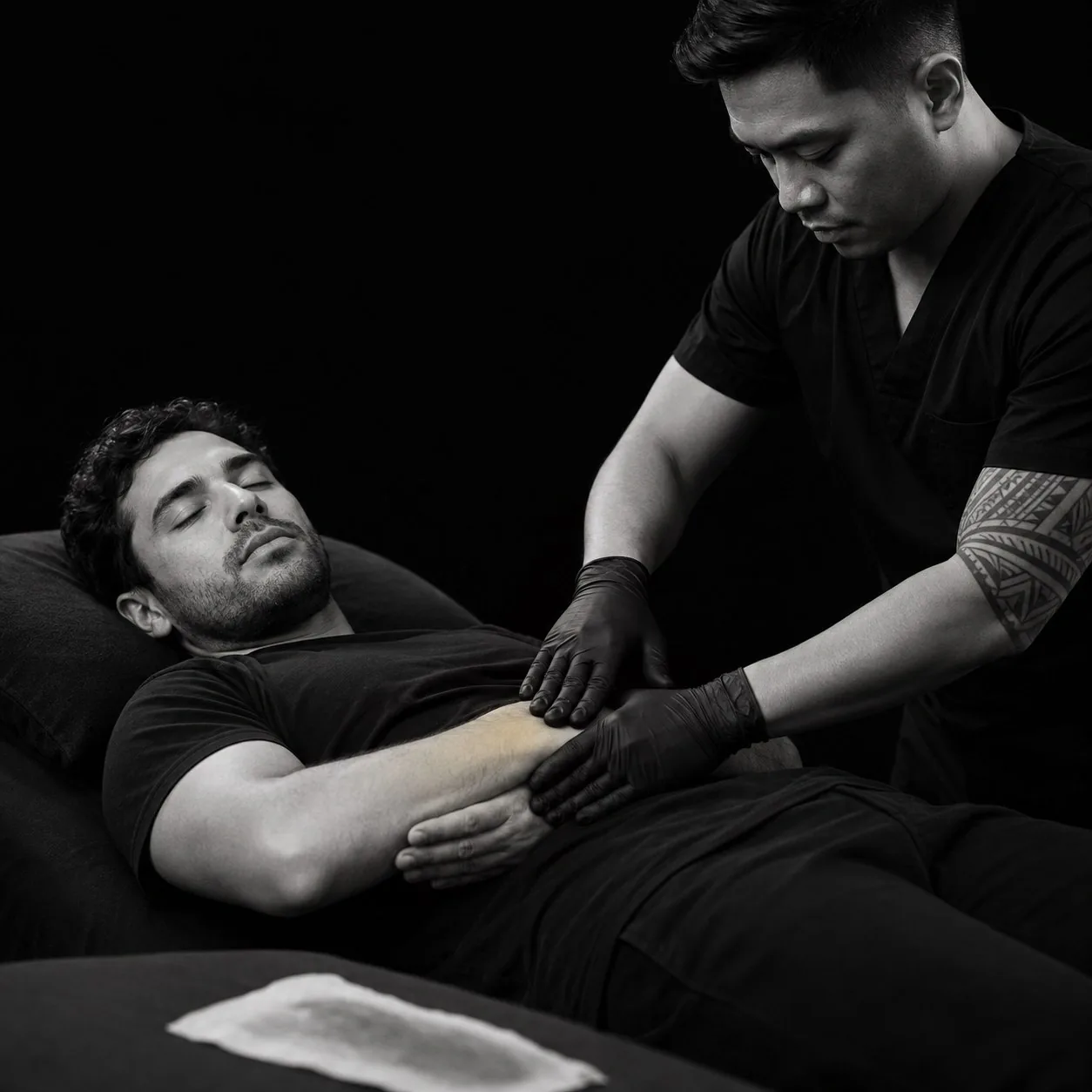
Everyone Asks. Almost Nobody Answers Properly.
"Does it hurt" is the first question, and the honest answer is that it depends far more on where than on what. The same wax strip that barely registers on a shin is a genuinely different event on an inner thigh.
So here is the whole map, ranked, with the reason for each position. At the end is the part that matters more than the ranking: what actually reduces it, what makes it worse, and why I work the body in the order I do.
One thing before the list. This is a general ranking, not a prediction about you. Pain is not a fixed property of a body part. It moves with your hair, your skin, your sleep, your cycle, your mood and what you took this morning. The ranking tells you the shape of the day. It does not tell you your number.
The Six Things That Actually Decide It
Nerve density, and not the one you think. The most heavily innervated skin on the body is the fingertip, where two points can be told apart at about 2 to 3 millimetres. On the back it takes 40 to 50 millimetres before you can tell two points apart at all. That is a twentyfold difference across one body. What matters here though is the innervation around the follicle, not the touch map, which is why fingers sit near the bottom of this list despite being the most sensitive skin you own. Almost no terminal hair grows there.
Skin thickness, and what is underneath it. Thin skin lying directly on bone has nothing to absorb the shock. Shin, sternum, upper lip, brow ridge, ankle and tailbone all hurt more than the soft tissue an inch away, and it is the same skin.
Hair density and calibre. Waxing removes every hair in the strip at once. Each follicle is a separate signal arriving simultaneously, so a dense area is not slightly worse than a sparse one, it is arithmetically worse. The pubic area, beard and underarms carry the coarsest and densest terminal hair on the body.
How deep the hair is anchored. Beard, pubic and scalp follicles run deeper and hold harder than the fine hair on a forearm. Hair in its active growth phase is anchored more firmly than hair that is already on its way out, which is one reason the same area varies between sessions.
Whether the skin can be held taut. This is the one clients never think about and practitioners think about constantly. Skin that cannot be stretched flat does not release the hair cleanly. The pull drags instead of snapping, and dragging is what actually hurts. Loose, mobile or thin skin is the problem, and I will come back to it.
What is going on in your head. Anticipation is not a soft factor. Expecting pain measurably increases the pain you get, and catastrophising is one of the strongest predictors of how intense a painful event feels. This is a real mechanism, not a character judgement, and it is the single biggest reason the order of a session matters.
What Changes With Laser
Laser pain runs on a different engine, and the awkward truth is that it hurts most on the people it works best on.
Melanin is the target. The laser is absorbed by pigment in the hair, converts to heat, and destroys the follicle. More pigment means more absorption, more heat, and a stronger sensation. So dark, coarse, dense hair produces the best results and the sharpest snap. Fine, pale hair barely registers, and it barely responds.
The other pigment in the room is yours. Melanin in the epidermis competes for the same energy, which is why higher Fitzpatrick skin feels more surface heat, and why the answer there is a longer wavelength and a more conservative fluence rather than pushing through. That is covered properly in the Fitzpatrick piece and in the post on dark skin.
Three practical consequences:
- A tan or a sunburn is not a minor complication, it is more chromophore sitting on the surface. More pain, and a real risk of a burn. Same for self tanner, which is why that has its own rule in the medications guide.
- The first session is the worst one. Density is at its highest and every hair in the beam is absorbing. By the third or fourth, there is measurably less to heat.
- Contact cooling changes the experience more than anything else in the room. A chilled tip or cryogen spray fires immediately before the pulse, and it is doing two jobs: protecting your epidermis, and giving the nerve a competing signal.
What Changes With Waxing
Waxing is mechanical. Nothing is being heated into the follicle. Several hundred hairs are being pulled out of it at once.
That means the variables are different:
- Hard wax versus soft wax. Hard wax shrink-wraps the hair and grips the hair rather than the skin. Soft wax grips the skin and takes a layer of it with the strip. On thin, intimate or fragile skin, hard wax is not a preference, it is the correct choice. The full comparison is in hard wax versus cream wax.
- Hair length. Around a quarter of an inch is the target. Too short and the wax cannot get a grip, which means going over the same skin twice, and a second pass over the same area hurts far more than the first. Too long and every hair tugs before it releases.
- The angle and speed of the pull. Fast, low, close to the skin and against the growth. Lifting the strip up and away is what produces the yelp, and it is also what lifts skin.
- Tension. Skin held properly taut can drop the sensation dramatically. Skin that is loose cannot.
What Changes With Electrolysis
Electrolysis is neither of the above. It is a single follicle at a time, with a probe following the hair down and a controlled amount of energy placed at the base.
The sensation is a brief heat rather than a snap, and the number that matters is not intensity but duration. One insertion is nothing. Nine hundred of them across an upper lip is a different conversation, which is why the ranking below shifts slightly for electrolysis: the areas that punish you are the dense ones, because dense means long.
Blood thinners, bruising and the areas that bleed more are covered in the medications guide.
The Ranking, Least to Most
1. Eyebrows
Sharp, and over in about four seconds. The brow sits on bone and the area is well supplied with nerves, so it does register, though there are very few hairs and the whole thing is finished before your nervous system has organised a response. Brevity is doing the work here.
2. Fingers
The fingertip is the most sensitive skin on your body. The back of the finger, where the hair actually is, is not. Sparse, fine hair over reasonably thick skin, and a handful of follicles in total.
3. Toes
The same as fingers with even less hair. Most people are surprised this is on the list at all.
4. Nose, the outside
The bridge and the tip. A few hairs, thick sebaceous skin, done in seconds.
The inside of the nostril is a separate conversation, and a more nuanced one than the internet usually allows.
People wax and pluck nasal hair constantly. Salons offer it, kits sell by the pallet, and the overwhelming majority of the time nothing whatsoever happens. That is true and it deserves saying plainly before anything else.
What is also true is that the nasal vestibule, the first centimetre or so inside the nostril, is unusual. It is the only hair-bearing skin on your body lined this way, roughly a third of perfectly healthy people carry Staphylococcus aureus in there, and its venous drainage runs back toward the base of the skull.
The realistic risk is not the dramatic one. It is nasal vestibulitis, an infected follicle inside the nose. The Cleveland Clinic describes the mild form as quite common and readily treated with a topical antibiotic, and the severe form as rare. Cellulitis, abscess and cavernous sinus thrombosis sit at the far end of that list. They are real, they are why the standard advice exists, and they are rare enough that they should shape your technique rather than frighten you out of the room.
So, the practical version:
- Trimming beats both waxing and plucking, and that is what clinicians actually advise.
- Of the other two, waxing the rim is the lower risk. A nose wax takes the protruding hair at the entrance in a single pull. Tweezing chases individual hairs deeper and traumatises the same follicles over and over.
- Stay at the rim. Nothing beyond the hair you can see.
- Never on skin that is already sore, crusted or scabbed, and not during a cold when you have been blowing your nose raw.
- Extra care with diabetes or anything else affecting immunity and healing.
- Watch the following few days. A hot, tender, spreading swelling at the tip of the nose or on the upper lip is a same-day doctor visit rather than a wait-and-see.
5. Hands
Thicker skin, sparse hair, generous soft tissue over the back of the hand.
6. Feet
The tops of the feet and the toes. Slightly more sensitive than hands because the skin is thinner over the tendons, still comfortably in the easy tier.
7. Arms
Forearms are among the most forgiving areas on the body. Low density, hair lying at a shallow angle, decent skin thickness.
One thing inside this entry. The inner upper arm is a different animal from the forearm. Thin, soft, rarely exposed, and considerably more sensitive. If your arms are getting done, that is the bit you will notice.
8. Ears
Small, quick, and awkward more than painful. The cartilage means there is no give, so it is a firm sensation rather than a soft one.
The same rim rule applies here as the nose. The outer ear, the lobe, the helix and the visible hair at the entrance are all straightforward. The ear canal is not, and it is not squeamishness that makes the difference. Canal skin is extremely thin, sits directly on cartilage and bone with almost no cushioning underneath, and it damages easily. There is also a quirk of anatomy worth knowing: a branch of the vagus nerve runs through the ear canal, which is why poking about in there makes some people cough involuntarily and, occasionally, feel faint. Neither is what you want happening mid-treatment.
Visible hair at the opening, yes. Inside the canal, no.
9. Legs
The largest area most people book and one of the easiest. Calves and outer thighs have thick, resilient skin over muscle, and the hair is usually less dense than it looks.
Shins are the exception inside this entry. Bone sits directly under thin skin with nothing between them, so the same strip that is unremarkable on a calf is noticeably sharper an inch away on the front.
10. Cheeks
Soft tissue, moderate density, and the reassurance of watching what is happening. On men with a full beard the cheeks climb the list considerably, since density is the variable and beard density is high.
11. Buttocks
The outer curve is fatty, well padded and easy. The inner cheek and the crease are neither, and they climb sharply. Two very different experiences under one word, which is why I treat them as two areas.
12. Back
Broad, thick and the least sensitive skin on the body by two-point discrimination. On a dense male back the volume of hair adds up, though per square inch this is a comfortable area.
The lower back and tailbone are the exception. Thin skin over the sacrum, and it climbs.
13. Shoulders
Coarse hair on many men and the bone of the acromion sitting close to the surface at the outer edge. Manageable, and a step up from the back it joins onto.
14. Stomach
The soft middle is easy. Two things inside it are not.
The navel and the line running down from it carry coarser, denser hair than the skin around them.
The ribs and flanks are thin skin over bone, and they are ticklish, which produces an involuntary flinch. Flinching is the enemy of a clean pull, and it is the reason this area often needs to be done in smaller sections.
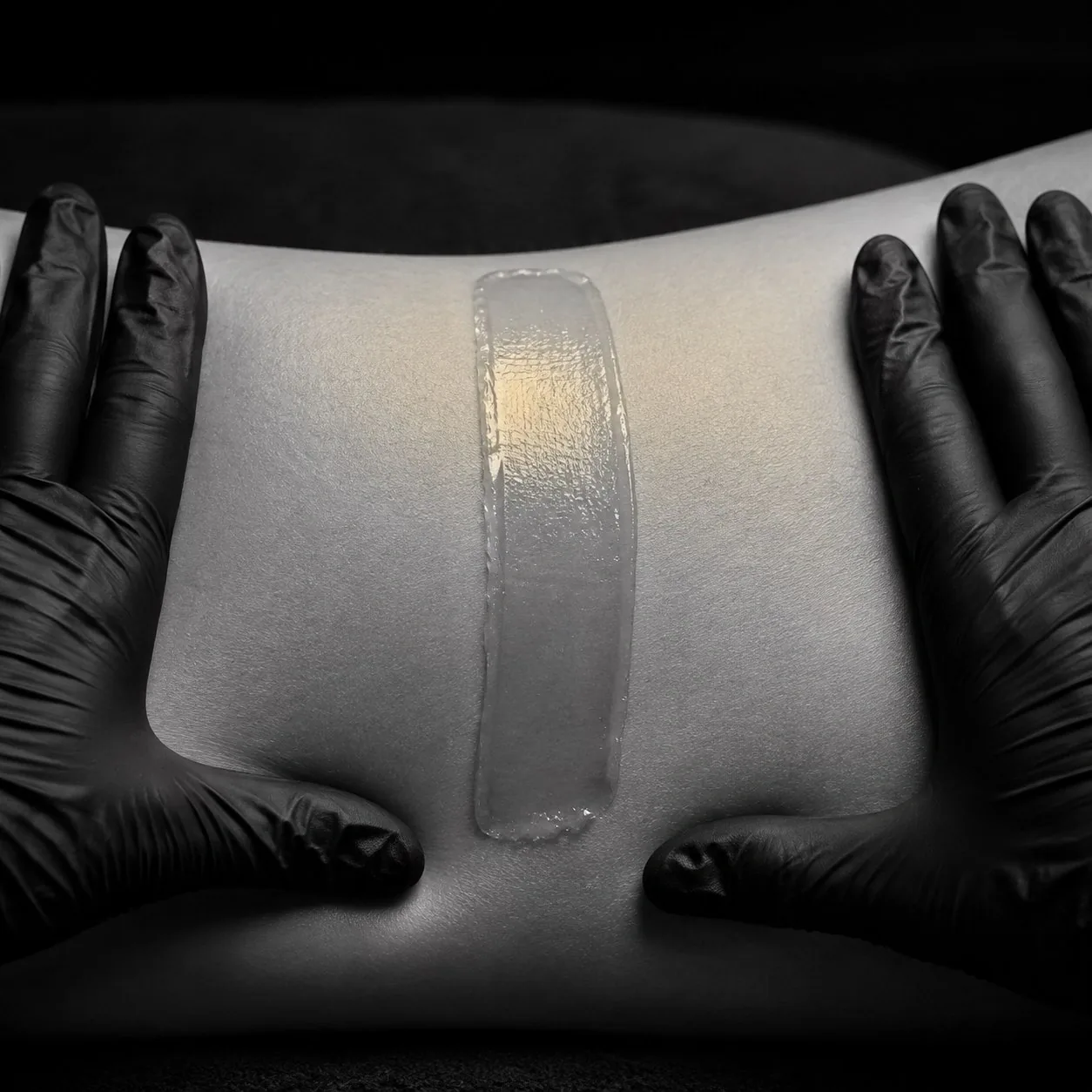
15. Shaft
Thin, highly mobile skin with no fat underneath and nothing to brace against. The problem here is almost entirely tension. Skin that cannot be held flat does not release cleanly, and hard wax plus a second point of tension is the whole technique. Covered further in the Brozilian piece.
16. Behind the Knee and the Inside of the Elbow
Thin, folded, mobile, and the hair grows in swirls rather than one direction. Every one of those is a problem at once. These two small areas routinely surprise people who found the rest of the limb easy.
17. Areolas
Thin transitional skin, high nerve density, and hair that is usually coarse and deeply anchored despite there being very little of it. Small area, disproportionate sensation.
18. Underarms
The most underestimated area on this list, and the one most people rank wrongly before their first appointment.
Everything stacks here. Some of the densest coarse terminal hair on the body. Thin skin. Skin that is loose and folds, so tension is difficult. High nerve density. Hair that grows in three or four directions at once, which means multiple passes at different angles. It is also warm and enclosed, which is a separate aftercare problem rather than a pain one.
This is the single best argument for laser over waxing if the hair qualifies, and it is one of the areas where people notice the improvement between sessions most clearly.
19. Scrotum and Labia
Thin, mobile, richly innervated tissue with no underlying support. As with the shaft, the technical problem is tension, and it cannot be solved one-handed. Hard wax only, small sections, and the client holding the skin is not optional, it is part of the method.
20. Inner Thigh
Soft, mobile, prone to folding, and the hair changes direction as it approaches the groin. Sweat and friction also mean this skin is often already slightly irritated before anyone touches it.
21. Perineum
Everything from the two entries above, in a smaller space, over the pudendal nerve. Brief, and honestly reported by most people as one of the sharper moments of a Brazilian.
22. Pelvis and Groin
The densest coarse terminal hair anywhere on the body, sitting over the pubic bone, with essentially no cushioning at the symphysis. Density and bone in the same place is the worst combination on this list, and this is where it appears.
23. Chest
Coarse hair, and the sternum is bone directly under thin skin. The outer chest is considerably easier than the centre line, which is why this ranks where it does rather than lower.
24. Upper Lip
The classic, and it earns its reputation. Dense terminal hair, thin skin stretched over the maxilla with teeth behind it, and one of the highest concentrations of nerve endings on the face. It is also very hard to keep still, since the area moves every time you speak or breathe.
For electrolysis specifically this is the area where duration bites. The hair count is high and every hair is an insertion.
25. Chin and Jawline
The deepest, coarsest, most stubbornly anchored terminal follicles on the face. Beard hair is built to stay put. Add the bone of the mandible directly underneath and skin that has to be held against a moving jaw.
This is the most requested electrolysis area I do, and it is also the longest course, which is exactly why the pain conversation and the session-order conversation both matter here more than anywhere else.
26. Neck
Thin, mobile skin, hair growing in whorls that change direction within a centimetre, and the throat, which every human being instinctively guards. The anxiety component is genuinely part of the pain here rather than separate from it.
The front of the neck under the jaw is the sharpest part. The nape at the back is much easier.
27. Head and Scalp
The deepest and densest follicles on the body, in skin with dense innervation and no give at all, stretched over bone in every direction. There is nowhere for the force to go.
Why I Work in This Order
I start at the easy end and move toward the hard end, deliberately, and the reasons are not sentimental.
Anticipation is doing half the damage. Expecting pain increases the pain that arrives. If the first thing you feel is the worst thing in the session, everything after it happens to a person who is braced, guarded and flinching. If the first thing you feel is a shin, you get real data instead of imagination, and the data is almost always better than the imagination.
Your body helps out as the session goes on. Twenty minutes in, there is an adrenaline and endorphin response running that was not there at minute one. Working toward the difficult areas means arriving at them with that already in place. Working away from them wastes it.
Flinching costs more than it saves. A tense client is a harder treatment. Skin will not hold taut against a braced muscle, the pull drags, and the drag is what causes both the pain and the lifting. Calm skin is genuinely easier skin.
If we run out of time or you have had enough, the easy areas are already banked. Stopping is always allowed. Stopping after the difficult section, with the simple areas still to do, is a badly built appointment.
Numbing cream needs the clock. If we are using it, it goes on the difficult area first and then needs thirty to sixty minutes. Working the easy areas during that window is not a preference, it is the only sensible way to schedule it.
The honest counterargument, because there is one. Some practitioners do the worst area first, on the reasoning that tolerance is highest when you are fresh and fatigue lowers it later. That is a real position and it is not stupid. I do not use it because in my experience the anticipation cost outweighs the fatigue cost, and because a client who has had the worst part done in the first five minutes has no reason to trust anything I say for the rest of the hour.
One exception. If you have a hard stop, or one area is the only reason you booked, we do that first and I will tell you what it costs you.
What Actually Helps
In the days before
Hydrate, properly and continuously. Dry skin is the single most underrated cause of a bad appointment. Dehydrated skin is brittle, it grips wax rather than releasing it, it lifts more easily and it takes longer to settle afterward. Drink water and moisturise heavily every day in the run-up.
Moisturise up to the day before, then stop. This is the part people get wrong. Lotion or oil on the skin on the day stops wax gripping the hair, which means more passes over the same area. Hydrated skin, clean and dry surface.
Exfoliate gently 24 to 48 hours before, not on the day. It lifts trapped hairs and clears dead surface cells. Doing it the same morning leaves the skin sensitised.
Get the hair length right. About a quarter of an inch for waxing. For laser, shave the day before or the morning of. For electrolysis, leave enough that I can see and grasp it.
Sleep. This is not a throwaway. In a controlled study, one night without sleep dropped the temperature at which people reported pain from about 111 to 107 degrees Fahrenheit, and activity in the pain-processing region of the brain rose by 126 percent while the brain's own analgesic circuitry was suppressed. Sleep loss both turns the volume up and disables the dimmer. A late night before a Brazilian is a genuinely bad plan.
If you menstruate, avoid the few days before and during your period. Pain sensitivity is measurably higher then. Mid-cycle is the easier window.
On the day
Eat. Low blood sugar amplifies everything and it is the most common cause of feeling faint on the table. This matters more if you have diabetes, and that is covered in the diabetes guide.
Acetaminophen, not ibuprofen. Take plain acetaminophen, Tylenol, thirty to sixty minutes before. It works and it does nothing to your platelets.
Ibuprofen and other NSAIDs are the wrong choice here even though they are painkillers, because they have an antiplatelet effect. That means more pinpoint bleeding and more bruising, and it matters most for electrolysis, where every insertion is a small wound. You trade a slightly easier hour for a worse-looking two days. Aspirin is worse again.
Skip the drink. Alcohol dehydrates you, thins your blood and does not actually reduce the pain. It also makes people harder to read on the table.
A note on cannabis. People assume it helps. The evidence does not clearly support that, and at least one study of daily users found reduced pain tolerance rather than improved. Beyond the pharmacology, THC raises heart rate and produces anxiety in a meaningful minority of people, and anxiety is one of the reliable ways to make a painful thing hurt more. I would not build a plan around it.
Caffeine, honestly. You will read everywhere that caffeine makes waxing worse. Pharmacologically that is not true. Caffeine is a recognised analgesic adjuvant, and a Cochrane review found that adding at least 100 mg of it to a standard painkiller produces a small but real increase in the number of people who get good relief. What caffeine does do is make some people jittery, alert and anxious, and that raises perceived pain. So the sensible advice is not "no coffee." It is "not four coffees on an empty stomach."
Come in a decent mood, and give yourself time. Arriving late, stressed and rushed is a measurable disadvantage, not a vibe. Catastrophising is one of the strongest known predictors of how badly a painful procedure lands.
Wear loose clothing. Not for the pain, for the two hours afterward.
During the appointment
Breathe out on the pull. Not held breath, not bracing. A slow exhale timed to the strip. Diaphragmatic breathing genuinely reduces pain perception and it stops the reflexive tensing that makes the pull drag.
Firm pressure straight after the strip, and this one is real science rather than folklore. Pressing a flat hand hard on the area immediately after the pull floods the same nerve pathway with pressure signals. Large touch fibres travel faster than pain fibres and they close the gate on the pain signal before it fully arrives. It works, it costs nothing, and you should do it yourself if my hands are busy.
Let me hold the skin, and hold it yourself where I ask. On the intimate areas this is not modesty theatre, it is technique. Two points of tension instead of one is the difference between a snap and a drag.
Say stop. Stopping is always available and it is never a problem. What is a problem is somebody enduring in silence, going rigid, and making the next twenty minutes worse for both of us.
Numbing cream, used properly. It is genuinely useful for laser and for large or difficult areas. Lidocaine and prilocaine, thirty to sixty minutes ahead, a thin layer. It is far less useful for waxing, because it does not reach the depth where the hair is anchored and it leaves the surface slippery, which works against the wax.
The hard limit on numbing cream matters more than the benefit. Over a large area, applied thickly, and especially under plastic wrap, these creams are absorbed enough to be genuinely dangerous, and there are deaths on record. Never wrap it. Never slather it over a whole leg. Talk to me about the area and the amount first.
Ice, at the right end. Cold afterward, not before, for waxing. Cooling before a wax tightens the skin and closes the follicle around the hair, which is the opposite of helpful. For laser it is reversed, and the device's own contact cooling does that job better than anything you can bring.
Across the course
It gets easier, and this is the most useful thing on the page. Regular waxing on a consistent schedule thins the regrowth and reduces the density, and density is the main driver. The first appointment is the worst one you will ever have. Sporadic waxing with long gaps and shaving in between keeps resetting you to that first appointment.
Do not shave between waxes. It puts everything back on different cycles and guarantees you are always working on a full, dense area.
For laser, the drop is steeper. Fewer hairs means less absorbed energy means less sensation, and most people describe session four as a different treatment from session one.
The Things That Change the Answer
Sunburn is a full stop for both methods. Waxing lifts an epidermis that is already damaged and coming away on its own. Laser adds heat to skin that is already inflamed and already carrying extra chromophore. Not a caution, a no.
A fresh tan or self tanner is the same problem in a milder form, and self tanner is worse than people expect because the colour sits in the outermost layer, exactly where you do not want the laser to find it.
Medication changes the risk more often than it changes the pain, and some of it changes both. Isotretinoin and retinoids make skin lift. Blood thinners make you bruise. Photosensitisers change the laser conversation. Steroid creams thin the skin where you applied them. That is a whole article on its own and it is here.
Loose skin is a technique problem, not a pain problem, though it feels like one. Significant weight loss, GLP-1 medication, pregnancy, ageing and simple genetics all produce skin that will not hold tension. That means smaller sections, two points of tension, hard wax rather than soft, and a slower session. Tell me, so I plan for it rather than discover it.
Skin conditions on the area move everything. Eczema, psoriasis, active rosacea, folliculitis and dermatitis all mean more sensitivity, more risk and sometimes a rescheduled appointment. Same list as the medications piece.
Your first appointment is not your baseline. It is the highest reading you will get. Judging the service by it is like judging a run by the first kilometre.
Warnings and Hard Limits
Most of this article is about making a treatment more comfortable. This section is the other kind of information, and it is short on purpose because every item on it is firm.
Pain is not a measure of whether it is working. This is the most dangerous idea in the industry and it gets repeated constantly. A laser setting that hurts more is not treating you better, it is heating your epidermis more. A wax that takes skin is not thorough, it is wrong. Anybody who tells you it has to hurt to work is telling you something about their technique rather than about your hair. More on that in the myths piece.
Numbing cream must never be used to tolerate settings you otherwise could not. This is the version of the above that actually injures people. Your ability to feel heat is a safety system, and numbing it removes the feedback that tells me to stop. Numbing cream exists to make a correct treatment bearable, never to make an incorrect one possible. It is the same argument as reduced sensation in the diabetes guide, and it applies to everybody.
Never wax over a mole, a skin tag or any raised lesion. Wax grips a raised structure far better than it grips flat skin, and the strip can tear it. Beyond the injury and the bleeding, removing something nobody has identified destroys the evidence, which is exactly the problem described in the dermoscopy piece. I work around them, every time.
Never laser over a tattoo. Tattoo ink is a chromophore and an extremely efficient one. It absorbs enormously more energy than a follicle, and the result is blistering and a burn rather than a treatment. Ink also cannot be "worked around" by turning the power down. The full picture is in the tattoos post.
Never laser over a mole, and eye protection is not optional. Moles get covered before the handpiece comes near them. Goggles go on both of us, every session, and nothing is fired inside the orbital rim on any account.
Nothing at all over sunburn, broken skin, an active infection, a cold sore, or a current flare of eczema, psoriasis or dermatitis. These are not judgement calls made in the moment. They are reasons to move the appointment.
Cold sores deserve their own line, because lip waxing and facial laser both reactivate herpes simplex through heat and trauma. If you get them and you have a prescription for an antiviral, tell me and ask your prescriber whether they want you taking it around the appointment. Covered further in the medications guide.
Recent work on the area means waiting. Fillers or Botox, two weeks. Chemical peels and microdermabrasion, four to six. Retinoids, acids and benzoyl peroxide have their own intervals, all set out in the medications guide.
Feeling faint is common and it is not embarrassing. A long or painful appointment, an empty stomach, a warm room and some anxiety is the standard recipe for a vasovagal episode. The warning signs arrive before the faint: clammy skin, nausea, ringing ears, tunnel vision, sudden yawning, feeling too hot. Say something the moment any of that starts. Getting your legs up early prevents the whole thing, and nobody in this room finds it remarkable.
Heat is the enemy for the first 24 to 48 hours. No sauna, hot tub, hot yoga, swimming pool or long hot shower on a freshly treated area. Follicles are open and warm moist environments are opportunistic. Aftercare in full is here.
Pregnancy changes the conversation rather than ending it. Skin is more sensitive and more vascular, so waxing bleeds and bruises more readily, and laser is usually deferred. It is worth its own discussion rather than a rule, and the electrolysis and pregnancy post covers where I land.
A patch test before your first laser session is mandatory, not a formality. Anyone willing to skip it is skipping the step that exists to catch the reaction you did not know you would have.
Devices, Jewellery and Anything Else On or In the Skin
This is the group people forget to mention, partly because it has become invisible to them. If you have worn the same sensor on the back of your arm for two years, it has stopped being a thing you think about. It is very much a thing I need to know about.
Devices worn on the body
Continuous glucose monitors and insulin pump sites. Dexcom, Libre, Medtronic, Omnipod and the tubed pumps all sit on exactly the real estate people book: the back of the arm, the abdomen, the outer thigh, the upper buttock. Two separate problems. Wax lifts the adhesive and takes an expensive sensor with it, along with your glucose data for the rest of the day. Laser is worse, since these are electronics with metal components and nothing gets fired over them.
Tell me where the sensor is, where the cannula is, and where you rotate them to. I plan the session around your rotation rather than asking you to move a medical device around my calendar. More on this in the diabetes guide.
Transdermal patches, and this one is a genuine safety issue rather than an inconvenience. Hormone patches, contraceptive patches, nicotine patches and opioid patches all deliver a dose through the skin at a rate the manufacturer calculated. Heat increases that rate. Applying laser heat near a medicated patch is not a small thing, and with an opioid patch it is dangerous. Patches also come off with wax, which means a lost dose you may not notice until the effect wears off.
Estradiol and testosterone patches matter here too, and they tend to sit on the lower abdomen, hip and buttock. Tell me. I work around them or we time the appointment for a patch change.
Cardiac monitors and event recorders, the adhesive kind worn for a week or two, are the same adhesive-and-electronics problem.
Implanted devices
Any implanted electrical device is an absolute contraindication for electrolysis. Pacemakers, implanted defibrillators, cochlear implants, deep brain stimulators, spinal cord stimulators, vagus nerve stimulators and sacral nerve stimulators are all on that list, and it is not settings-dependent. Laser and waxing are unaffected.
Implanted hardware that is not a problem, since people are routinely told otherwise. Plates, screws, rods, joint replacements, surgical mesh, breast implants and dental work are all deep to the skin and unaffected by anything I do. Nobody needs to skip a leg wax because of a titanium plate in their tibia. The skin over it may be scarred, and that is the actual consideration.
Ports, PICC lines and catheters are a different matter. Nothing goes near the site, and the surrounding skin is usually fragile from repeated dressings.
Jewellery and piercings
Everything metal comes off the treatment area before laser, without exception. Metal absorbs and conducts heat efficiently, and a navel ring during an abdomen session is a burn waiting to happen. That covers navel bars, nipple jewellery, surface piercings, dermal anchors, genital jewellery, body chains, and the watch and rings for hand and forearm work.
Wax will grab jewellery and pull it, which is its own reason and considerably more unpleasant than the burn.
If a piece genuinely cannot be removed, say so at booking rather than on the table. We work around it, and I would rather rearrange the plan than discover the problem with wax already on.
A piercing that is not fully healed is a wound, and it gets treated as one. Most take six to twelve months, longer for cartilage and genital work, and considerably longer than most people assume.
Wounds, scabs and broken skin
Nothing over an open wound, a scab, a healing cut or a fresh graze. Wax takes the scab, which restarts the healing and often leaves a mark that would not otherwise have been there.
Picked ingrowns are the version of this I see most often, and people rarely mention them because they feel sheepish about it. Do not be. Show me, I work around it, and we deal with it properly. The alternative is covered in the ingrowns post.
Shaving cuts from that morning count. Very common, and they will sting and bleed.
Warts, verrucas, molluscum and impetigo are contagious, and wax is an excellent way to move them from one part of your body to another. Nothing over those, and nothing near them.
Scars depend entirely on age. A mature scar is usually fine. A scar under six to twelve months old is fragile, pigments easily, and gets left alone. Keloid history changes the plan everywhere, not only where the keloid is.
Stretch marks are fine, though fresh ones behave more like new scars than old skin.
One that is rarely mentioned anywhere
If you have had lymph nodes removed or have lymphoedema in a limb, tell me before anything is booked on that side. Trauma and infection in an affected limb carry consequences they do not carry elsewhere, and that is a conversation with your care team rather than a decision either of us makes in the room.
Bottom Line
The ranking above is a map, not a forecast. What it tells you is that pain in this room is mostly about density, tension, and what sits under the skin, and every one of those is something technique can work with.
Sleep, hydration, acetaminophen rather than ibuprofen, food in you, and skin that has been moisturised for a week rather than an hour will do more for your appointment than anything I can put on a table.
The order matters too. I start where it is easy and work toward where it is not, so that by the time we reach the difficult part you have real information instead of dread, and your own body is already helping. Nobody does their best work on a client who has been braced since minute one.
If an area frightens you, say so before we start rather than during. I will change the order, change the method, split it across two visits, or talk you out of it entirely if that is the honest answer.
One exception to everything above. If the underarms or groin flare with recurring lumps and boils rather than ordinary ingrowns, the pain ranking is not your first question. That pattern is often hidradenitis suppurativa, and it changes which method I will use on you and when I will use it. Read that one before booking either area.
One clock this ranking does not capture. The upper lip and chin sit near the top of the list, and for a trans woman clearing a beard they sit there every session for one to three years rather than once. That is a different relationship with this list than anybody else on it has, and it is covered properly in the guide for trans women.
The rest of the comfort picture. an honest guide to numbing cream, how the pain differs by method, handling erections during a treatment and sex after hair removal.